Wake Forest in Wake County, North Carolina — The American South (South Atlantic)
Wake Forest College and Wake Forest University
Photographed by Mark Parker, January 28, 2026
1. Wake Forest College and Wake Forest University Marker
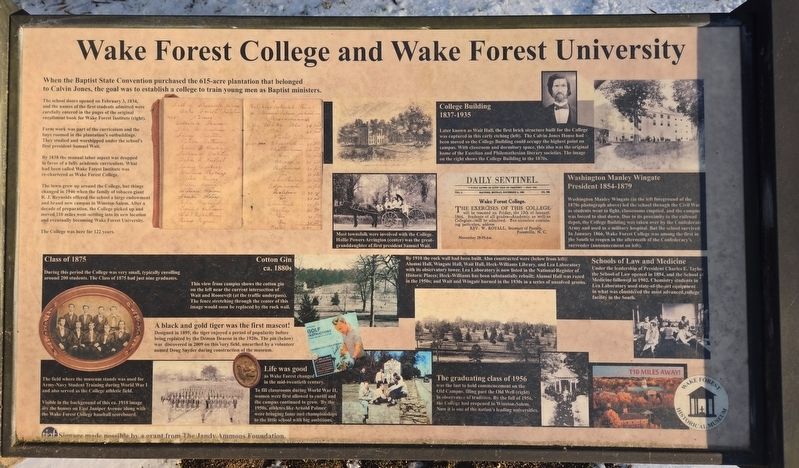
The school doors opened on February 3, 1834. and the names of the first students admitted were carefully entered in the pages of the original enrollment book for Wake Forest Institute (right).
Farm work was part of the curriculum and the boys roomed in the plantation's outbuildings. They studied and worshipped under the school's first president Samuel Wait.
By 1838 the manual labor aspect was dropped in favor of a fully academic curriculum. What had been called Wake Forest Institute was re-chartered as Wake Forest College.
The town grew up around the College, but things changed in 1946 when the family of tobacco giant R. J. Reynolds offered the school a large endowment and brand new campus in Winston-Salem. After a decade of preparation, the College picked up and moved 110 miles west-settling into its new location and eventually becoming Wake Forest University.
The College was here for 122 vears.
(captions)
College Building 1837-1935
Later known as Wait Hall, the first brick structure built for the College was captured in this early etching (left). The Calvin Jones House had been moved so the College Building could occupy the highest point on campus. With classroom and dormitory space, this also was the original home of the Euzelian and Philomathesian literary societies. The image on the right shows the College Building in the 1870s.
Most townsfolk were involved with the College. Hallie Powers Arrington (center) was the great- granddaughter of first president Samuel Wait.
Washington Manley Wingate
President 1854-1879
Washington Manley Wingate (in the left foreground of the 1870s photograph above) led the school through the Civil War as students went to fight, classrooms emptied, and the campus was forced to shut down. Due to its proximity to the railroad depot, the College Building was taken over by the Confederate Army and used as a military hospital. But the school survived In January 1866, Wake Forest College was among the first in the South to reopen in the aftermath of the Confederacy's surrender (announcement on left)
Class of 1875
During this period the College was very small, typically enrolling around 200 students. The Class of 1875 had just nine graduates.
Cotton Gin ca. 1880s
This view from campus shows the cotton gin on the left near the current intersection of Wait and Roosevelt (at the traffic underpass). The fence stretehing through the center of this image would soon be replaced by the rock wall.
A black and gold tiger was the first mascot!
Designed in 1895, the tiger enjoyed a period of popularity before being replaced by the Demon Deacon in the 1920s. The pin (below) was discovered in 2009 on this very fieid, unearthed by a volunteer named Doug Snyder during construction of the museum.
By 1910 the rock wall had been built. Also constructed were (below from left): Alumni Hall, Wingate Hall, Wait Hall, Heck-Williams Library, and Lea Laboratory with its observatory tower. Lea Laboratory is now listed in the National Register of Historic Places; Heck-Williams has been substantially rebuilt; Alumni Hall was razed in the 1950s; and Wait and Wingate burned in the 1930s in a series of unsolved arson.
School of Law and Medicine
Under the leadership of President Charles E. Taylor, the School of Law opened in 1894, and the School of Medicine followed in 1902. Chemistry students in Lea Laboratory used state-of-the-art equipment in what was considered the most advanced college facility in the South.
The field where the museum stands was used for Army-Navy Student Training during World War I and also served as the College athletic field.
Visible in the background of this ca. 1918 image are the houses on East Juniper Avenue along with the Wake Forest College baseball scoreboard.
Life was good
as Wake Forest changed in the mid-twentieth century.
To fill classrooms during World War II ◦ women were first allowed to enroll and the campus continued to grow. By the 1950s, athletes like Arnold Palmer were bringing fame and champiouships to the little school with big ambitions.
The graduating class of 1956
was the last to hold commencement on the Old Campus, filing past the Old Wellb (right) in observance of tradition. By the fall of 1956, the College had reopened in Winston-Salem. Now it is one of the nation's leading universities.
Erected by Wake
this page online
Topics. This historical marker is listed in this topic list: Education. A significant historical date for this entry is February 3, 1834.
Location. 35° 59.075′ N, 78° 30.458′ W. Marker is in Wake Forest, North Carolina, in Wake County. It can be reached from the intersection of North Main Street (Alternate U.S. 1) and East Juniper Avenue, on the right when traveling north. Location of the marker is north of the Calvin Jones House. Touch for map. Marker is at or near this postal address: 450 N Main St, Wake Forest NC 27587, United States of America. Touch for directions.

Regionally, this marker is in North Carolina’s Piedmont and in the Research Triangle. It is also in the American South and specifically in the Upper South. Globally, it is in North America, the Western Hemisphere, the Western World, and the Anglosphere. Historically, it finds itself in what was once the territory of the Mississippian Culture, one of the original Thirteen Colonies, one of the Confederate States of America, and the Antebellum South.
Other nearby markers. At least 8 other markers are within

Photographed by Mark Parker, January 28, 2026
2. Wake Forest College and Wake Forest University Marker north of the Calvin Jones House
Credits. This page was last revised on February 4, 2026. It was originally submitted on February 2, 2026, by Mark Parker of Hickory, North Carolina. This page has been viewed 56 times since then. Photos: 1, 2. submitted on February 2, 2026, by Mark Parker of Hickory, North Carolina. • Bernard Fisher was the editor who published this page.
