Wake Forest in Wake County, North Carolina — The American South (South Atlantic)
The Calvin Jones House and Plantation
Photographed by Mark Parker, January 28, 2026
1. The Calvin Jones House and Plantation Marker
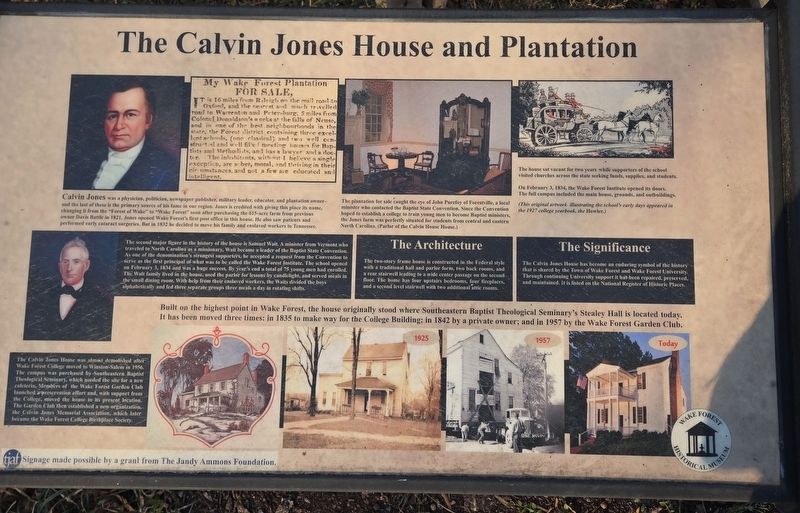
Calvin Jones was a physician, politician, newspaper publisher, military leader, educator, and plantation owner — and the last of these is the primary source of his fame in our region. Jones is credited with giving this place its name, changing it from the "Forest of Wake" to "Wake Forest" soon after purchasing the 615-acre farm from previous owner Davis Battle in 1821. Jones opened Wake Forest's first post office in this house. He also saw patients and performed early cataract surgeries. But in 1832 he decided to move his family and enslaved workers to Tennessee.
The plantation for sale caught the eye of John Purefoy of Forestville, a local minister who contacted the Baptist State Convention. Since the Convention hoped to establish a college to train young men to become Baptist ministers, the Jones farm was perfectly situated for students from central and eastern North Carolina. (Parlor of the Calvin House House.)
The house sat vacant for two years while supporters of the school visited churches across the state seeking funds, supplies, and students.
On February 3, 1834, the Wake Forest Institute opened its
this page online
The second major figure in the history of the house is Samuel Wait. A minister from Vermont who traveled to North Carolina as a missionary, Wait became a leader of the Baptist State Convention. As one of the denomination's strongest supporters, he accepted a request from the Convention to serve as the first principal of what was to be called the Wake Forest Institute. The school opened on February 3, 1834 and was a huge success, By year's end a total of 75 young men had enrolled. The Wait family lived in the house, used the parlor for lessons by candlelight, and served meals in the small dining room. With help from their enslaved workers, the Waits divided the boys alphabetically and fed three separate groups three meals a day in rotating shifts.
The Architecture
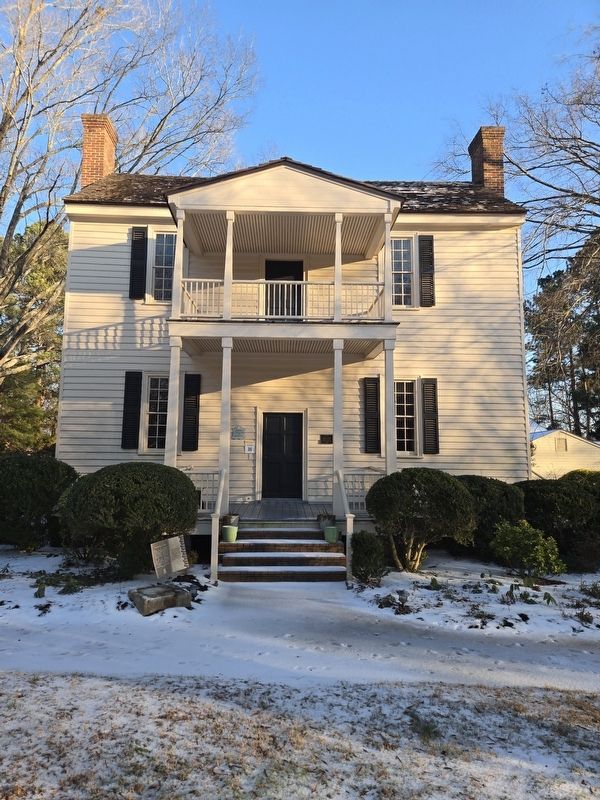
The two-story frame house is constructed in the Federal style with a traditional hall and parlor form, two back rooms, and a rear stairwell leading to a wide center passage on the second floor. The home has four upstairs bedrooms, four fireplaces and a second level stairwell with two additional
Photographed by Mark Parker, January 28, 2026
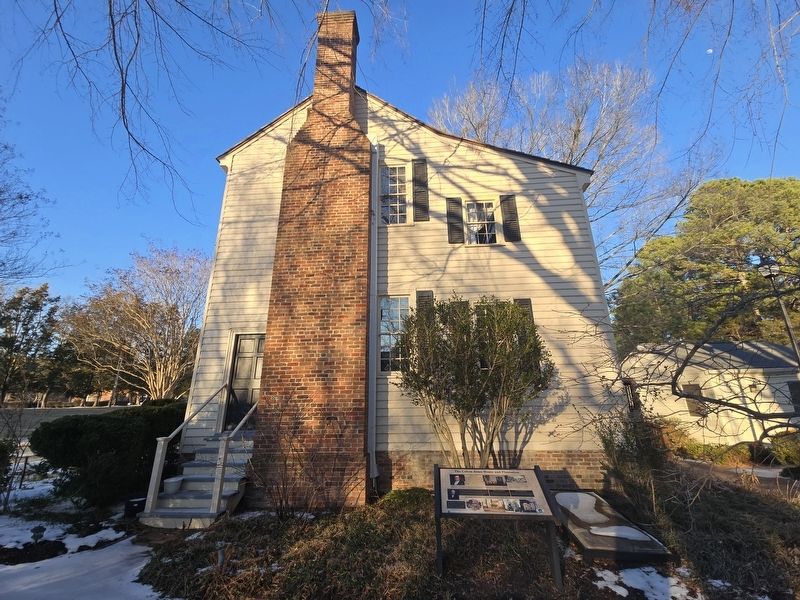
2. The Calvin Jones House and Marker
The Significance
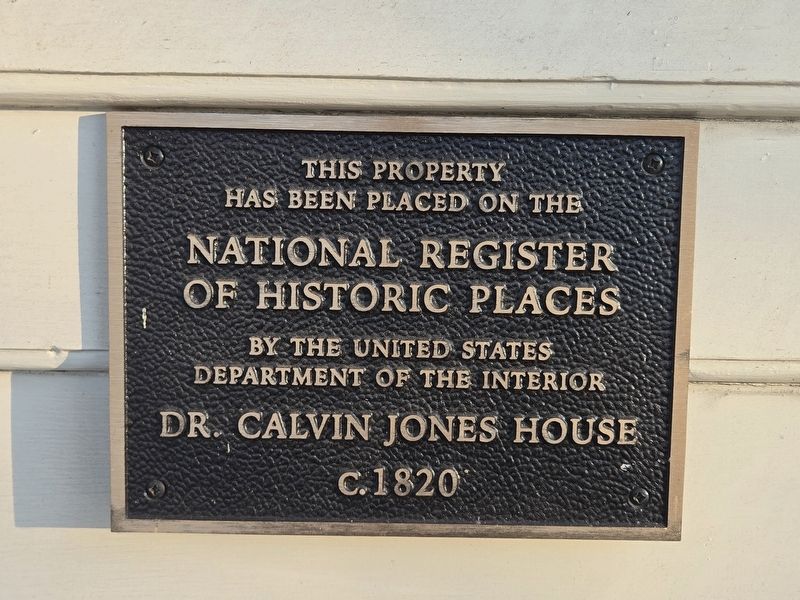
The Calvin Jones House has become an enduring symbol of the history that is shared by the Town of Wake Forest and Wake Forest University. Through continuing University support it has been repaired, preserved and maintained. It is listed on the National Register of Historic Places.
Built on the highest point in Wake Forest, the house originally stood where Southeastern Baptist Theological Seminary's Stealey Hall is located today. It has been moved three times: in 1835 to make way for the College Building; in 1842 by a private owner; and in 1957 by the Wake Forest Garden Club.
The Calvin Jones House was almost demolished after Wake Forest College moved to Winston-Salem in 1956. The campus was purchased by Southeastern Baptist Theological Seminary, which needed the site for a new cafeteria. Members of the Wake Forest Garden Club launched a preservation effort and, with support from the College, moved the house to its present location. The Garden Club then established a new organization the Calvin Jones Memorial Association, which later became the Wake Forest College Birthplace Society.
Erected by Wake
Photographed by Mark Parker, January 28, 2026
3. Front view of The Calvin Jones House
Topics. This historical marker is listed in these topic lists: Education • Notable Buildings. A significant historical year for this entry is 1821.
Location. 35° 59.059′ N, 78° 30.463′ W. Marker is in Wake Forest, North Carolina, in Wake County. It can be reached from the intersection of North Main Street (Alternate U.S. 1) and East Walnut Avenue, on the right when traveling north. The marker is on the south side of the Calvin Jones House. Touch for map. Marker is at or near this postal address: 414 N Main St, Wake Forest NC 27587, United States of America. Touch for directions.

Regionally, this marker is in North Carolina’s Piedmont and in the Research Triangle. It is also in the American South and specifically in the Upper South. Globally, it is in North America, the Western Hemisphere, the Western World, and the Anglosphere. Historically, it finds itself in what was once the territory of the Mississippian Culture, one of the original Thirteen Colonies, one of the Confederate States of America, and the Antebellum South.
Other nearby markers. At least 8
Photographed by Mark Parker, January 28, 2026
4. National Register of Historic Places plaque
Photographed by Mark Parker, January 28, 2026
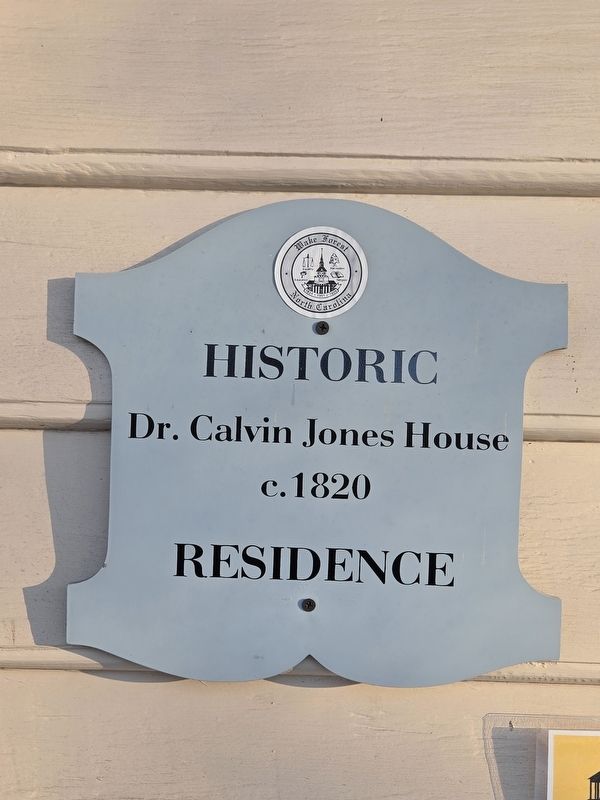
5. The Calvin Jones House plaque by the city of Wake Forest
Credits. This page was last revised on February 2, 2026. It was originally submitted on February 1, 2026, by Mark Parker of Hickory, North Carolina. This page has been viewed 67 times since then. Last updated on February 2, 2026, by Mark Parker of Hickory, North Carolina. Photos: 1, 2, 3, 4, 5. submitted on February 1, 2026, by Mark Parker of Hickory, North Carolina. • Devry Becker Jones was the editor who published this page.
Editor’s want-list for this marker. A link to the National Register of Historic Places nomination form, citing the building's historical significance. • Can you help?
