Wake Forest in Wake County, North Carolina — The American South (South Atlantic)
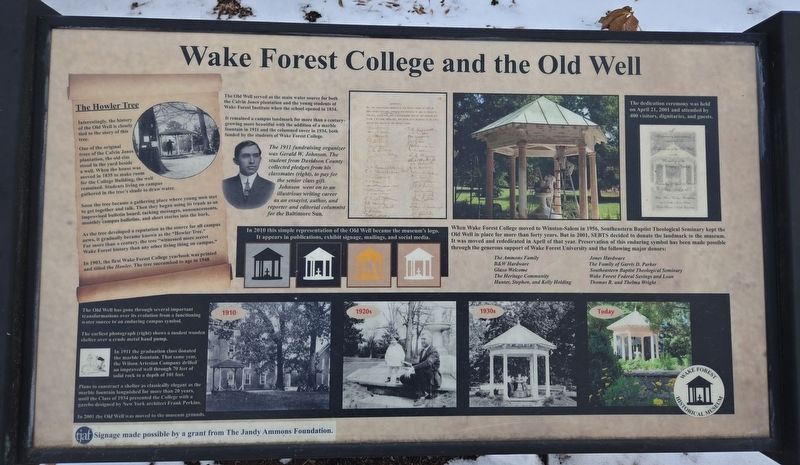
Wake Forest College and the Old Well
Photographed by Mark Parker, January 28, 2026
1. Wake Forest College and the Old Well Marker
It remained a campus landmark for more than a century—growing more beautiful with the addition of a marble fountain in 1911 and the columned cover in 1934, both funded by the students of Wake Forest College.
The 1911 fundraising organizer was Gerald W. Johnson. The student from Davidson County collected pledges from his classmates (right), to pay for the senior class gift. Johnson went on to an illustrious writing career as an essayist, author, and reporter and editorial columnist for the Baltimore Sun.
The Howler Tree
Interestingly, the history of the Old Well is closely tied to the story of this tree.
One of the original trees of the Calvin Jones plantation, the old elm stood in the yard beside a well. When the house was moved in 1835 to make room for the College Building, the well remained. Students living on campus gathered in the tree's shade to draw water. Soon the tree became a gathering place l where young men met to get together and talk.
this page online
As the tree developed a reputation as the source for all campus news, it gradually became known as the "Howler Tree." For more than a century, the tree "witnessed more secret Wake Forest history than any other living thing on campus."
In 1903, the first Wake Forest College yearbook was printed and titled the Howler. The tree succumbed to age in 1948.
When Wake Forest College moved to Winston-Salem in 1956, Southeastern Baptist Theological Seminary kept the Old Well in place for more than forty vears. But in 2001. SEBTS decided to donate the landmark to the museum. It was moved and rededicated in April of that year. Preservation of this enduring symbol has been made through the generous support of Wake Forest University and the following maior donors: The Ammons Family • B&W Hardware • Glaxo Welcome • The Heritage Community • Hunter, Stephen, and Kelly Holding • Jones Hardware • The Family of Garris D. Parker • Southeastern Baptist Theological Seminary • Wake Forest Federal Savings and Loan • Thomas R. and Thelma Wright
(photo captions)
In 2010 this simple representation of the 0ld Well became the museum's logo, It appears in publications, exhibit signage, mailings, and social media.
The dedication ceremony was held on April 21, 2001 and attended by 400 visitors, dignitaries, and guests.
The Old Well has gone through several important transformations over its evolution from a functioning water source to an enduring campus symbol.
The earliest photograph (right) shows a modest wooden shelter over a crude metal hand pump.
In 1911 the graduation class donated the marble fountain. That same year, the Wilson Artesian Company drilled an improved well through 70 feet of solid rock to a depth of 101 feet.
Plans to construct a shelter as classically elegant as the marble fountain languished for more than 20 years, until the Class of 1934 presented the College with a gazebo designed by New York architect Frank Perkins.
In 2001 the Old Well was moved to the museum grounds.
Erected by Wake

Photographed by Mark Parker, January 28, 2026
2. Wake Forest College and the Old Well Marker and well
Calvin Jones House is in the background
Topics. This historical marker is listed in this topic list: Landmarks. A significant historical year for this entry is 1911.
Location. 35° 59.078′ N, 78° 30.442′ W. Marker is in Wake Forest, North Carolina, in Wake County. It can be reached from the intersection of North Main Street (Alternate U.S. 1) and East Juniper Avenue, on the right when traveling north. Touch for map. Marker is at or near this postal address: 414 N Main St, Wake Forest NC 27587, United States of America. Touch for directions.

Regionally, this marker is in North Carolina’s Piedmont and in the Research Triangle. It is also in the American South and specifically in the Upper South. Globally, it is in North America, the Western Hemisphere, the Western World, and the Anglosphere. Historically, it finds itself in what was once the territory of the Mississippian Culture, one of the original Thirteen Colonies, one of the Confederate States of America, and the Antebellum South.
Other nearby markers. At least 8 other markers are within walking distance of this marker: The Campus Well (a few steps

Photographed by Mark Parker, January 28, 2026
3. Reconstructed Gazebo and Old Well
Photographed by Mark Parker, January 28, 2026
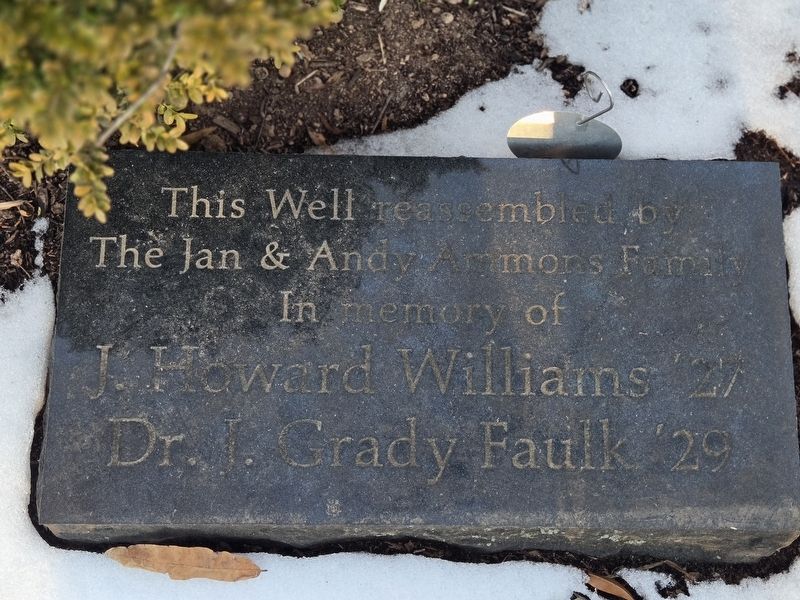
4. Dedication slab for the Old Well and Gazebo
Credits. This page was last revised on February 4, 2026. It was originally submitted on February 2, 2026, by Mark Parker of Hickory, North Carolina. This page has been viewed 63 times since then. Photos: 1, 2, 3, 4. submitted on February 2, 2026, by Mark Parker of Hickory, North Carolina. • Bernard Fisher was the editor who published this page.
