Wake Forest in Wake County, North Carolina — The American South (South Atlantic)
The Railroad and Depot in Wake Forest
Photographed by Mark Parker, January 28, 2026
1. The Railroad and Depot in Wake Forest Marker
(Header captions)
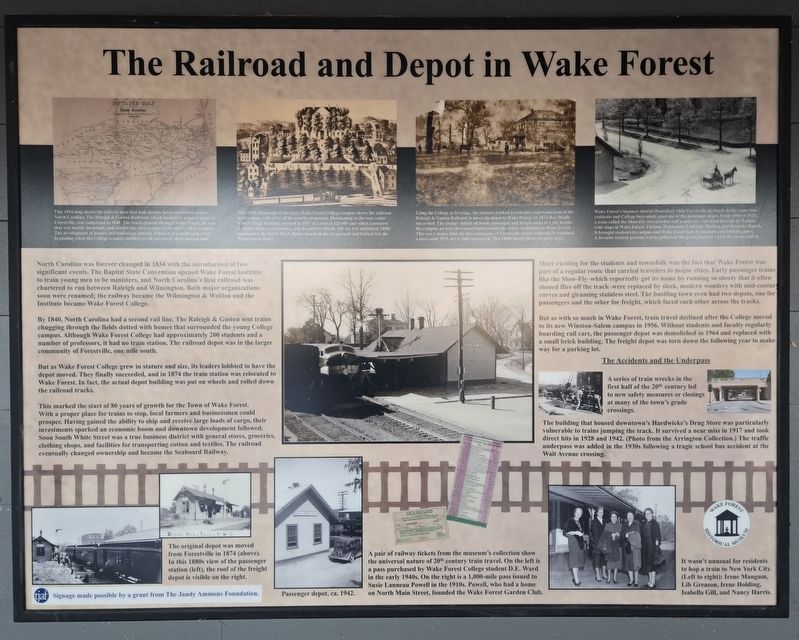
This 1854 map shows the railway lines that had already been established across North Carolina. The Raleigh & Gaston Railroad, which located its original depot in Forestville. was completed in 1840. The tracks passed through Wake Forest, an area that was mainly farmland. and skirted the eastern edge of the new College campus. The development of houses and businesses initially followed at a snail's pace, only beginning when the College trustees decided to sell parcels of their unused land.
This 1850 lithograph of the early Wake Forest College campus shows the railroad tracks along with a few of the nearby structures. Dominating in the rear center is the College Building, erected in 1837 at a cost of $20,000 and which contained a chapel, library, classrooms, and dormitory. On the left are two additional 1800s landmarks: the South Brick House stands in the foreground and behind it is the Wake Forest Hotel.
Using the College as leverage, the trustees worked to convince representatives of the Raleigh & Gaston Railroad to move the depot to Wake Forest. In 1874 they finally succeeded. The change shifted all future passenger and freight stops to a site beside the campus, an area that soon would become the center of downtown Wake Forest, This was a maior blow for the community of Forestville which, although it remained a town until 1915, never fully recovered. This 1880s image shows its early days.
Wake Forest's business district flourished while Forestville declined. At the same time, residents and College boys made good use of the passenger depot. From 1904 to 1925, a train called the Shoo-Fly — two coaches and a mail car — ran from Raleigh to Weldon with stops in Wake Forest, Thelma,Warr enton, Littleton, Norlina, and Roanoke Rapids. It brought students to campus and Wake Forest fans to baseball and football games. A favorite student pastime was to gather on the grassy bank to watch the trains pull in.
North
this page online
By 1840, North Carolina had a second rail line. The Raleigh & Gaston sent trains chugging through the fields dotted with homes that surrounded the young College campus. Although Wake Forest College had approximately 200 students and a number of professors, it had no train station. The railroad depot was in the larger community of Forestville, one mile south.
But as Wake Forest College grew in stature and size, its leaders lobbied to have the depot moved. They finally succeeded, and in 1874 the train station was relocated to Wake Forest. In fact, the actual depot building was put on wheels and rolled down the railroad tracks.
This marked the start of 80 years of growth for the Town of Wake Forest. With a proper place for trains to
Photographed by Mark Parker, January 28, 2026
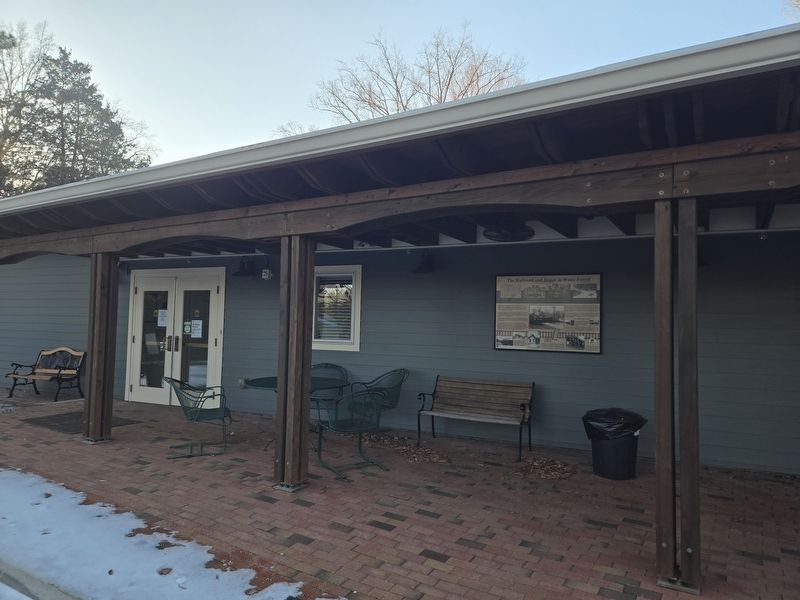
2. The Railroad and Depot in Wake Forest Marker at the Wake Forest Historical Museum entrance
More exiting for the students and townfolk was the fact that Wake Forest was part of a regular route that carried travelers to major cities. Early passenger trains like the Shoo-Fly—which reportedly get its name by running so slowly that it often shooed flies off the track—were replaced by sleek, modern wonders with mid-century curves and gleaming stainless steel. The bustling town even had two depots, one for passengers and the other for freight, which faced each other across the tracks.
But as with so mach in Wake Forest, train travel declined after the College moved to its Winston-Salem campus in 1956. Without students and faculty regularly boarding rail cars, the passenger depot was demolished in 1964 and replaced with a small brick building. The freight depot was torn down the following year to make way for a parking lot.
The Accidents and the Underpass
A series of train wrecks in the first half of the 20 century led to new safety measures or closings at many of the town's grade crossings.
The building that housed downtown's Hardwicke's Drug Store was particularly vulnerable to trains jumping the track. It survived a near miss in 1917 and took direct hits in 1928 and 1942. (Photo from the Arrington Collection.) The traffic underpass was added in the 1930s following a tragic school bus accident at the Wait Avenue crossing.
(Footer captions)
The original depot was moved from Forestville in 1874 (above). In this 1880s view of the passenger station (left), the roof of the freight depot is visible on the right.
Passenger depot, c.1942
A pair of railway tickets from the museum's collection show the universal nature of 20th century train travel. On the left is a pass purchased by Wake Forest College student D.E. Ward in the early 1940s. On the right is a 1,000-mile pass issued to Susie Lanneau Powell in the 1910s. Powell, who had a home on North Main Street, founded the Wake Forest Garden Club.
It wasn't usual for residents to hop a train to New York City (Left to right): Irene Mang, Lib Greason, Irene Holding Isabella Gill, and Nancy Harris.
Erected by Wake Forest Historical Museum, The Jandy Ammons Foundation.
Topics. This historical marker is listed in these topic lists: Education • Industry & Commerce • Railroads & Streetcars. A significant historical year for this entry is 1834.
Location. 35° 59.052′ N, 78° 30.438′ W. Marker is in Wake Forest, North Carolina, in Wake County. It can be reached from the intersection of North Main Street (Alternate U.S. 1) and East Juniper Avenue, on the right when traveling north. The marker is near the entrance to the Wake Forest Historical Museum, facing the adjacent parking lot. Touch for map. Marker is at or near this postal address: 414 N Main St, Wake Forest NC 27587, United States of America. Touch for directions.

Regionally, this marker is in North Carolina’s Piedmont and in the Research Triangle. It is also in the American South and specifically in the Upper South. Globally, it is in North America, the Western Hemisphere, the Western World, and the Anglosphere. Historically, it finds itself in what was once the territory of the Mississippian Culture, one of the original Thirteen Colonies, one of the Confederate States of America, and the Antebellum South.
Other nearby markers. At least 8 other markers are within walking distance of this marker: Unearthed and Risen (within shouting distance of this marker); The Campus Arch and the Class of 1909 (within shouting distance of this marker); The Calvin Jones House and Plantation (within shouting distance of this marker); Wake Forest College and the Old Well (within shouting distance of this marker); Wake Forest College and Wake Forest University (within shouting distance of this marker); The Campus Well (within shouting distance of this marker); Wake Forest College Birthplace (about 300 feet away, measured in a direct line); C.C. Crittenden (about 600 feet away). Touch for a list and map of all markers in Wake Forest.
Credits. This page was last revised on February 4, 2026. It was originally submitted on February 2, 2026, by Mark Parker of Hickory, North Carolina. This page has been viewed 56 times since then. Photos: 1, 2. submitted on February 2, 2026, by Mark Parker of Hickory, North Carolina. • Bernard Fisher was the editor who published this page.
