Beverly Hills in Los Angeles County, California — The American West (Pacific Coastal)
Beverly Hills Speedway
| — | Golden Shield Commemorative Plaque | — |
Photographed by Craig Baker, February 1, 2026
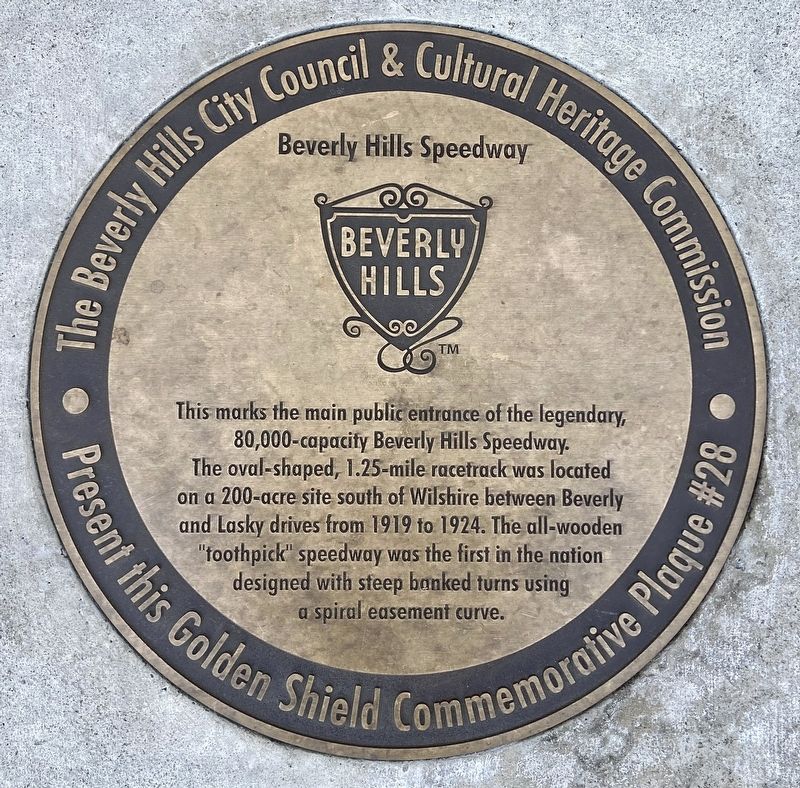
1. Beverly Hills Speedway Marker
This marks the main public entrance of the legendary, 80,000-capacity Beverly Hills Speedway. The oval-shaped, 1.25-mile racetrack was located on a 200-acre site south of Wilshire between Beverly and Lasky drives from 1919 to 1924. The all-wooden "toothpick" speedway was the first in the nation designed with steep banked turns using a spiral easement curve.
Erected by City of Beverly Hills. (Marker Number 28.)
Topics. This historical marker is listed in these topic lists: Industry & Commerce • Sports. A significant historical year for this entry is 1919.
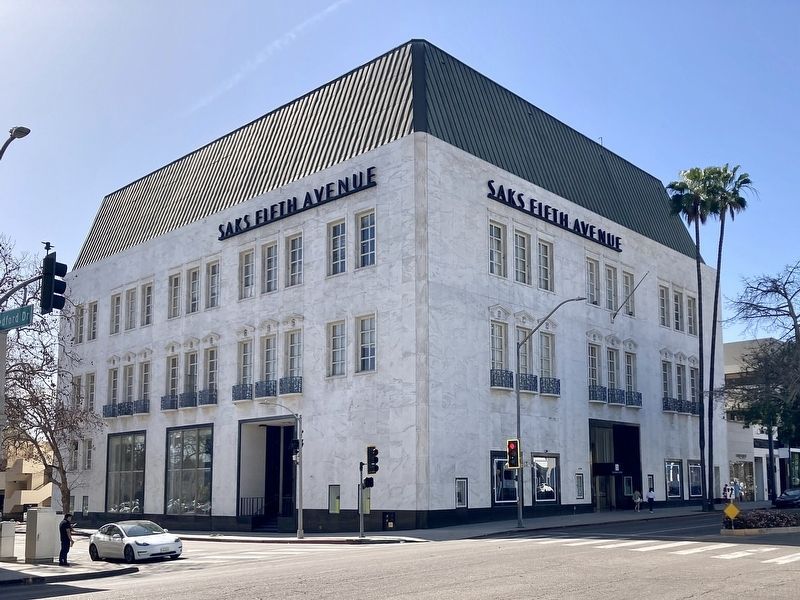
Location. 34° 4.016′ N, 118° 24.29′ W. Marker is in Beverly Hills, California, in Los Angeles County. It is at the intersection of Wilshire Boulevard and Bedford Drive, on the right when traveling east on Wilshire Boulevard. Touch for map. Marker is at or near this postal address: 9654 Wilshire Blvd, Beverly Hills CA 90212, United States of America. Touch for directions.

Regionally, this marker is in Greater Los Angeles and in the Transverse Ranges. It is also on the American Pacific Coast. Globally, it is in North America, on the Ring of Fire,
this page online
Other nearby markers. At least 8 other markers are within walking distance of this marker: Brighton Coffee Shop (about 600 feet away, measured in a direct line); Mickey Fine Pharmacy (about 600 feet away); Uncle Bernie’s Toy Menagerie (approx. 0.2 miles away); Romanoff’s/The Daisy (approx. 0.2 miles away); Anderton Court (approx. 0.2 miles away); Giorgio Beverly Hills (approx. 0.2 miles away); The Luau (approx. 0.2 miles away); Hans Ohrt Lightweight Bicycles (approx. 0.2 miles away). Touch for a list and map of all markers in Beverly Hills.
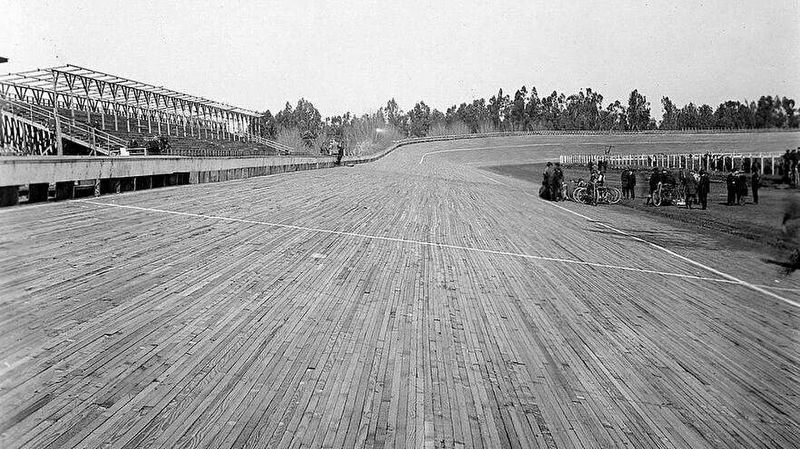
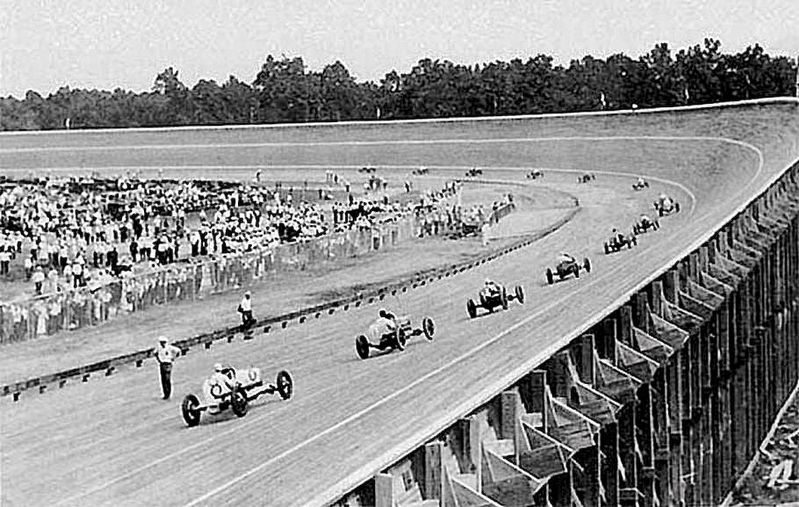
Regarding Beverly Hills Speedway. The speedway was an enormous 1.25-mile racetrack made of wood. The board track was oval shape with an incline of 35 degrees along the straightaways and greater banking angles at the turns. It was the first track in the U.S. to be designed with banked turns that incorporated an engineering solution known as a spiral easement or track transition curve.
The infield of the

Photographed by Craig Baker, February 1, 2026
2. Beverly Hills Speedway Marker
The marker lays flat in the sidewalk.
The racetrack was engineered by Arthur C. Pillsbury, who was the civil engineer for the City of Beverly Hills. Pillsbury was an avid race car enthusiast and a recognized racetrack engineer who also served as an officer of the Los Angeles Speedway Association.
At one point, California had seven wooden track speedways, also known as "board track" or "toothpick track" speedways. The Beverly Hills Speedway was also used for the Beverly Hills horse show, the flower show, polo games, and other events that brought thousands to Beverly Hills. An increased demand for residential development led to the Los Angeles Speedway Association selling the site to a developer in 1923 for $2,000,000. The last race was held in February 1924, and the entire site was razed less than a year later.
Related marker. Click here for another marker
Photographed by Craig Baker, February 1, 2026
3. Beverly Hills Speedway Marker Location

4. Beverly Hills Speedway
This photo is on display inside the Beverly Wilshire Hotel.
Public Domain
5. Beverly Hills Speedway
Public Domain
6. Beverly Hills Speedway
Credits. This page was last revised on September 24, 2026. It was originally submitted on February 2, 2026, by Craig Baker of Sylmar, California. This page has been viewed 91 times since then. Photos: 1, 2, 3. submitted on February 2, 2026, by Craig Baker of Sylmar, California. 4. submitted on July 20, 2025, by Craig Baker of Sylmar, California. 5, 6. submitted on February 4, 2026, by Craig Baker of Sylmar, California.
