Key West in Monroe County, Florida — The American South (South Atlantic)
The History of the Southernmost Point
Photographed by James Hulse, January 11, 2026
1. The History of the Southernmost Point Marker
Inscription.
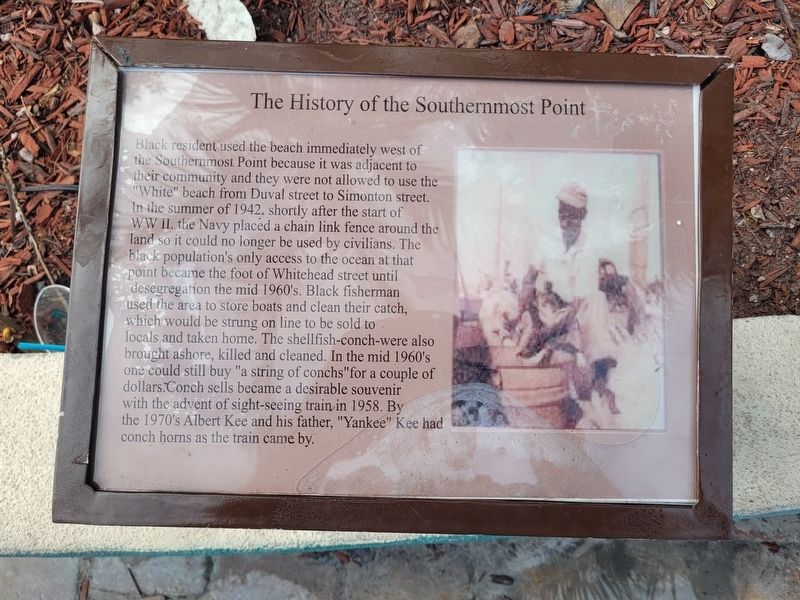
Black resident used the beach immediately west of the Southernmost Point because it was adjacent to their community and they were not allowed to use the "White" beach from Duval street to Simonton street. In the summer of 1942, shortly after the start of WW II, the Navy placed a chain link fence around the land so it could no longer be used by civilians. The black population's only access to the ocean at that point became the foot of Whitehead street until desegregation the mid 1960's. Black fisherman used the area to store boats and clean their catch, which would be strung on line to be sold to locals and taken home. The shellfish-conch-were also brought ashore, killed and cleaned. In the mid 1960's one could still buy "a string of conchs" for a couple of dollars. Conch sells became a desirable souvenir with the advent of sight-seeing train in 1958. By the 1970's Albert Kee and his father, "Yankee" Kee had conch horns as the train came by.
Topics. This historical marker is listed in these topic lists: African Americans • Animals. A significant historical year for this entry is 1942.
Location. 24° 32.806′ N, 81° 47.766′ W.
Click or scan to see this page online
Marker is in Key West, Florida, in Monroe County. It is on Duval Street south of South Street, on the right when traveling south. The marker is located near the Southernmost Point of the Continental U.S.A. Touch for map. Marker is at or near this postal address: 2315 Duval St, Key West FL 33040, United States of America. Touch for directions.
Regionally, this marker is on the Florida Keys. It is also in the American South and on the Gulf Coast. Globally, it is in the North Atlantic Region, North America, a Gulf of Mexico state, the Western Hemisphere, the Western World, and the Anglosphere. Historically, it finds itself in what was once New Spain, the territory of the Mississippian Culture, one of the Confederate States of America, and the Antebellum South.
Credits. This page was last revised on February 7, 2026. It was originally submitted on February 6, 2026, by James Hulse of Medina, Texas. This page has been viewed 54 times since then. Photos:1, 2. submitted on February 7, 2026, by James Hulse of Medina, Texas.