Telluride in San Miguel County, Colorado — The American Mountains (Southwest)
Mining
| — | Local History Series | — |
Photographed by Cosmos Mariner, July 18, 2025
1. Mining Marker
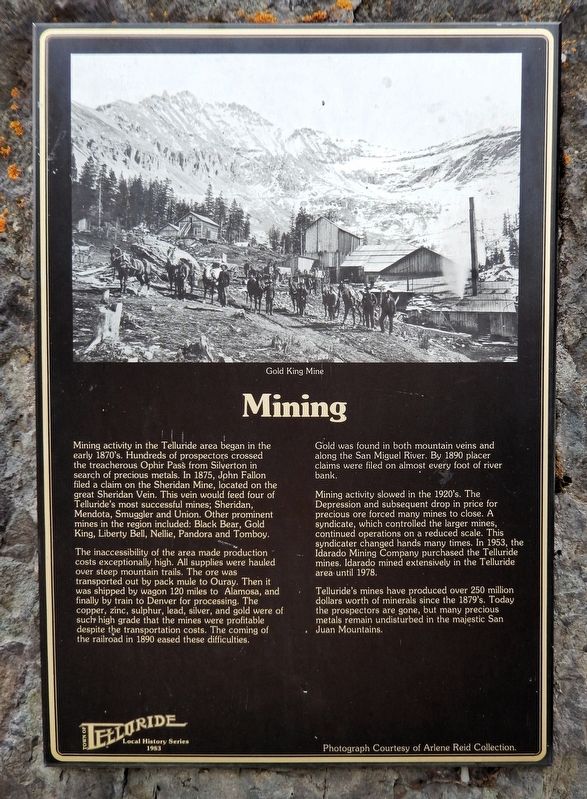
Mining activity in the Telluride area began in the early 1870's. Hundreds of prospectors crossed the treacherous Ophir Pass from Silverton in search of precious metals. In 1875, John Fallon filed a claim on the Sheridan Mine, located on the great Sheridan Vein. This vein would feed four of Telluride's most successful mines: Sheridan, Mendota, Smuggler and Union. Other prominent mines in the region included: Black Bear, Gold King, Liberty Bell, Nellie, Pandora and Tomboy.
The inaccessibility of the area made production costs exceptionally high. All supplies were hauled over steep mountain trails. The ore was transported out by pack mule to Ouray. Then it was shipped by wagon 120 miles to Alamosa, and finally by train to Denver for processing. The copper, zinc, sulphur, lead, silver, and gold were of such high grade that the mines were profitable despite the transportation costs. The coming of the railroad in 1890 eased these difficulties.
Gold was found in both mountain veins and along the San Miguel River. By 1890 placer claims were filed on almost every foot of river bank.
Mining activity slowed in the 1920's. The Depression
this page online
Telluride's mines have produced over 250 million dollars worth of minerals since the 1879's. Today the prospectors are gone, but many precious metals remain undisturbed in the majestic San Juan Mountains.
Erected 1983 by Town of Telluride.
Topics. This historical marker is listed in these topic lists: Industry & Commerce • Settlements & Settlers. A significant historical year for this entry is 1875.
Location. 37° 56.206′ N, 107° 48.594′ W. Marker is in Telluride, Colorado, in San Miguel County. It is at the intersection of East Colorado Avenue and South Spruce Street, on the right when traveling east on East Colorado Avenue. The marker is in South Spruce Park (formerly South Spruce Street). Touch for map. Marker is at or near this postal address: 200 East Colorado Avenue, Telluride CO 81435, United
Arlene Reid Collection
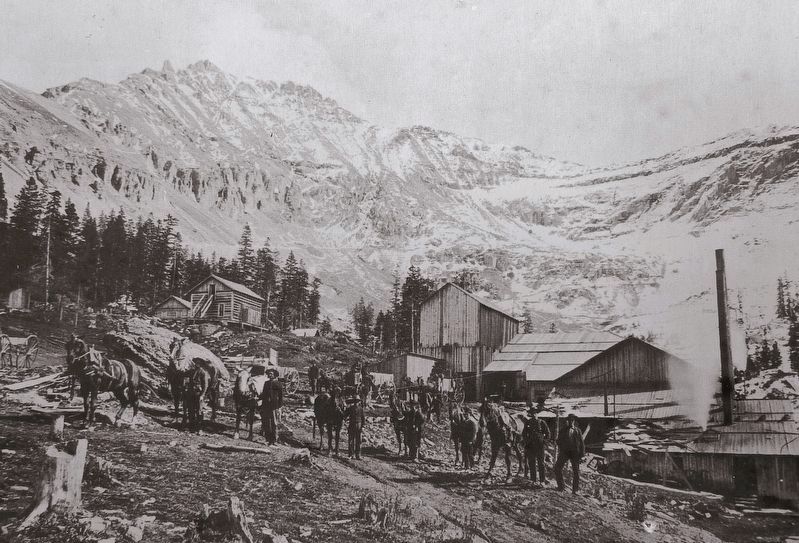
2. Marker detail: Gold King Mine

Regionally, this marker is in the Western Slope. It is also in the American Mountain West, on the Colorado Plateau, and at the Four Corners. Globally, it is in North America, the Rocky Mountains, the Western Hemisphere, the Western World, and the Anglosphere. Historically, it finds itself in what was once Mexico’s Alta California.
Other nearby markers. At least 8 other markers are within walking distance of this marker: Labor Strikes (here, next to this marker); Social Lodges (here, next to this marker); Sheridan Pool Hall (within shouting distance of this marker); The Great Waggoner Swindle (about 400 feet away, measured in a direct line); First County Courthouse Site (about 500 feet away); Mahr Building (about 500 feet away); New Sheridan Hotel (approx. 0.2 miles away); a different marker also named New Sheridan Hotel (approx. 0.2 miles away). Touch for a list and map of all markers in Telluride.
Also see . . . Telluride History (Western Mining History).
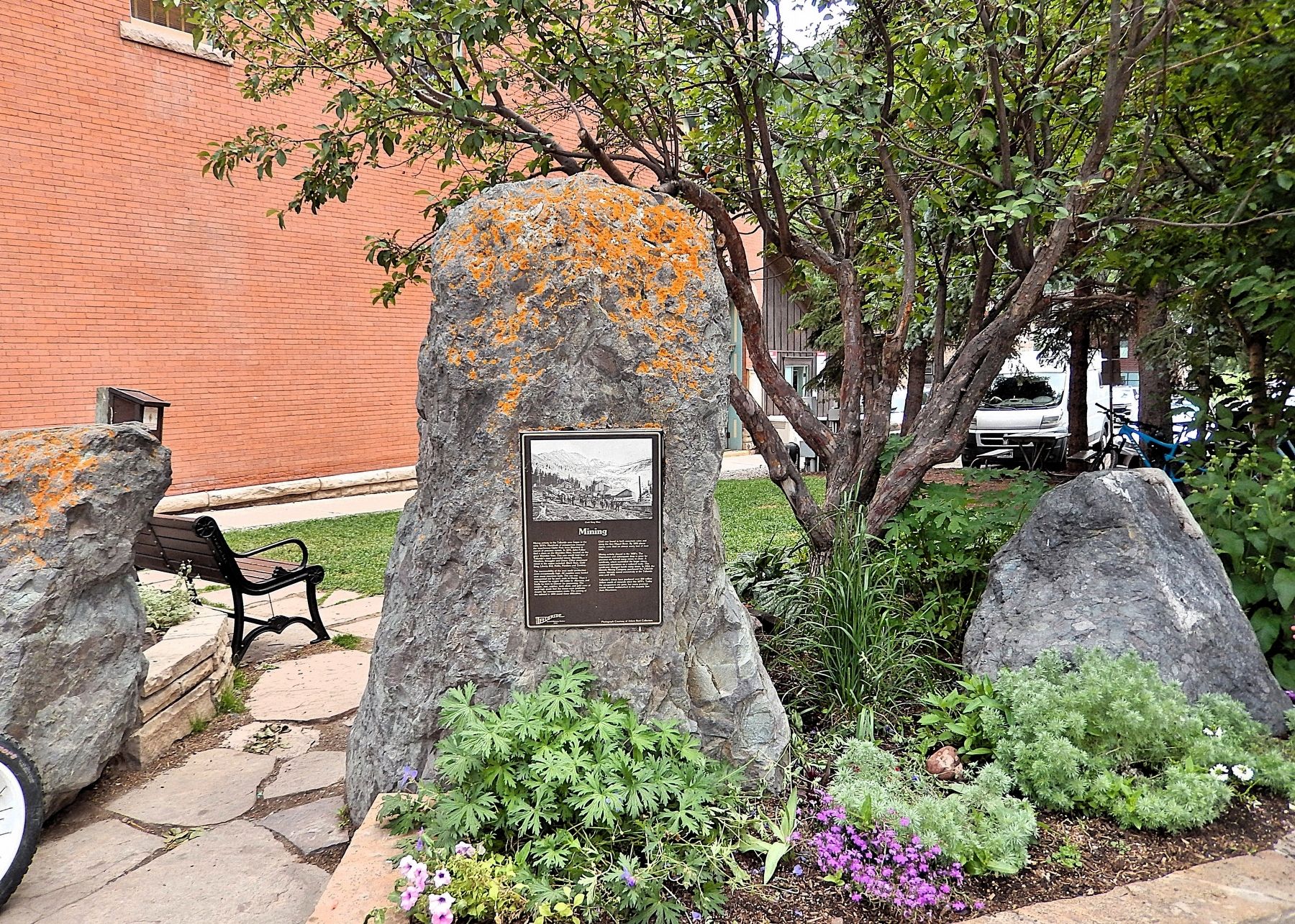
Excerpt: The town of Telluride, located in a magnificent box canyon on the headwaters of the San Miguel River,(Submitted on February 9, 2026, by Cosmos Mariner of Cape Canaveral, Florida.)owes it existence to quartz lead discoveries that were made starting in 1875.Photographed by Cosmos Mariner, July 18, 20253. Mining MarkerLooking south from East Colorado Avenue into South Spruce Park. The marker is mounted on a large boulder.
John A. Fallon is credited with the first discovery of a quartz lead — the Sheridan vein of the Smuggler Mine — located high above the valley in Marshall Basin. Soon other quartz leads were located, and interest in mining began to shift from placer to lode. A settlement west of San Miguel, closer to the lode mines, began to form in 1878.
The earliest history of the town of Telluride is difficult to discern, but some sources state the first settlement was founded in 1878 under the name Columbia. The name appears to have changed to Telluride in 1880 when the first post office was established.
The silver crash of 1893 sent Colorado's many silver mining districts into a depression. Although Telluride's brief period of staggering growth was cut short by the crash, it weathered the trouble better than other districts. Gold production increased rapidly after the silver crash, doubling between 1894 and 1895. The mines of Telluride were once again thriving, even while other districts in the state would stagnate for several more years. By the late 1890s, a wave of consolidation resulted in larger scale mining operations than were previously possible, and gold production once again dramatically increased.
Credits. This page was last revised on February 9, 2026. It was originally submitted on February 7, 2026, by Cosmos Mariner of Cape Canaveral, Florida. This page has been viewed 45 times since then. Photos: 1, 2, 3. submitted on February 9, 2026, by Cosmos Mariner of Cape Canaveral, Florida.
