Hattiesburg in Forrest County, Mississippi — The American South (East South Central)
Saenger Theatre

Photographed by Cosmos Mariner, June 20, 2025
1. Saenger Theatre Marker
Saenger Theatre
has been entered on the
National Register of Historic Places
by the U.S. Department of Interior
May, 1979
☆ ☆ ☆
Designed by New Orleans architect Emil Weil, the theatre opened on Thanksgiving Day, 1929, as part of the Saenger Brothers’ chain of movie palaces throughout the south. A local landmark since, the theatre has served as the site of cultural and entertainment events of great variety as well as being the area’s finest movie theatre.
In 1974 ABC Interstate Theaters, Inc. donated the building to the City of Hattiesburg. With the help of various civic groups the City is restoring it as an areawide cultural facility, The Saenger Center.
Topics and series. This historical marker is listed in these topic lists: Architecture • Arts, Letters, Music • Entertainment. In addition, it is included in the Art Deco, and the National Register of Historic Places (NRHP) series lists. A significant historical year for this entry is 1929.
Location. 31° 19.551′ N, 89° 17.439′ W. Marker is in Hattiesburg, Mississippi, in Forrest County. It is on Forrest Street just north of West Front
this page online

Regionally, this marker is in Mississippi’s Pine Belt. It is also in the American South, specifically in the Deep South, and in the Piney Woods. Globally, it is in North America, a Gulf of Mexico state, the Western Hemisphere, the Western World, and the Anglosphere. Historically, it finds itself in what was once New Spain, the territory of the Mississippian Culture, one of the Confederate States of America, and the Antebellum South.
Other nearby markers. At least 8 other markers are within walking distance of this marker: Old Federal Building (within shouting distance of this marker); William Harris Hardy (within shouting distance of this marker); a different marker also named William Harris Hardy (about 300 feet away, measured in a direct line); Forrest County Confederate Monument (about 600 feet away); Vernon Ferdinand Dahmer, Sr. (about 600
Photographed by Cosmos Mariner, June 20, 2025
2. Saenger Theatre Marker
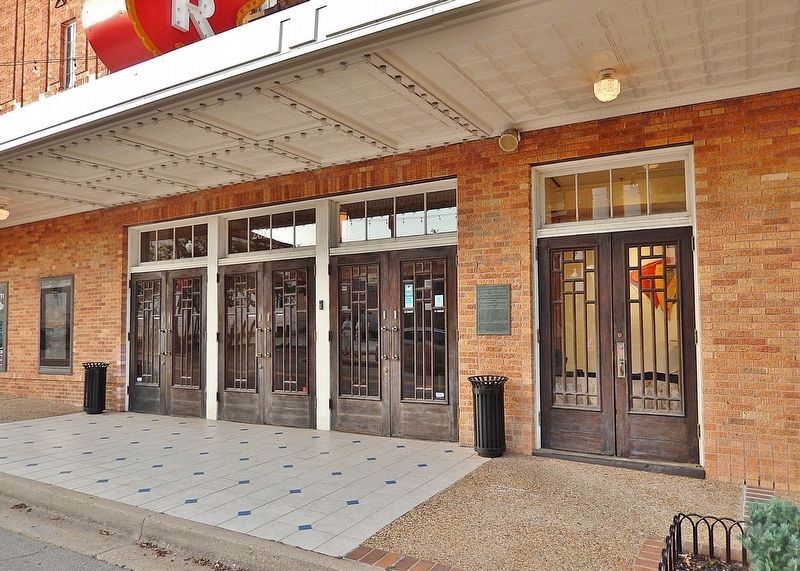
The marker is mounted at eye level on the right side of the main lobby entrance doors.
Regarding Saenger Theatre. National Register of Historic Places № 79001307.
From the National Register Nomination prepared by Michelle F. Heidelberg, 2/19/1979:
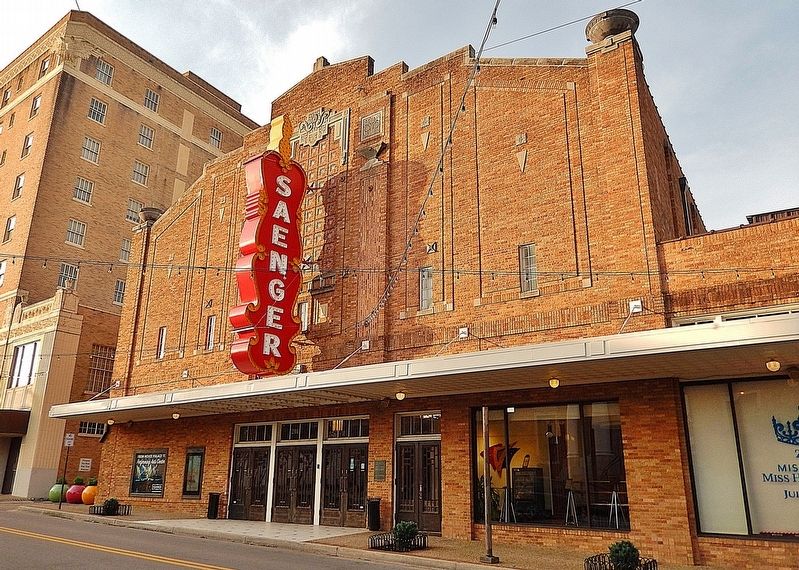
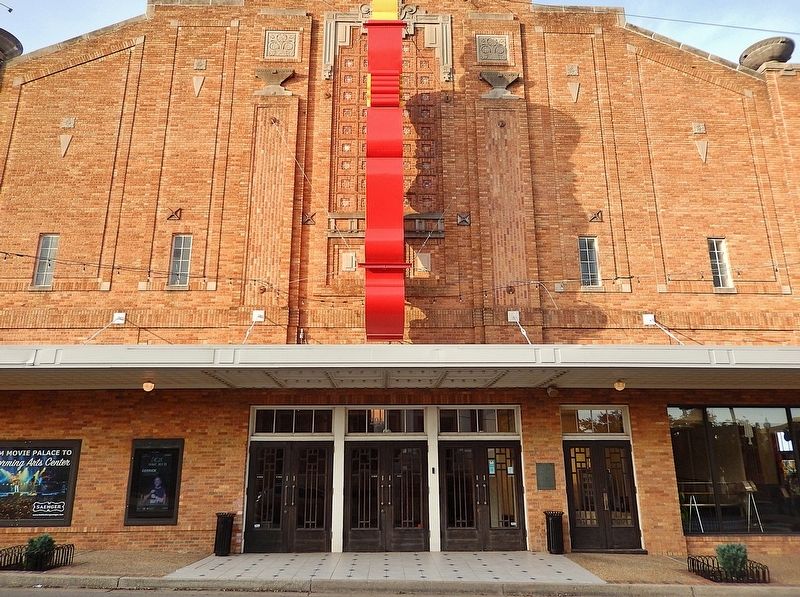
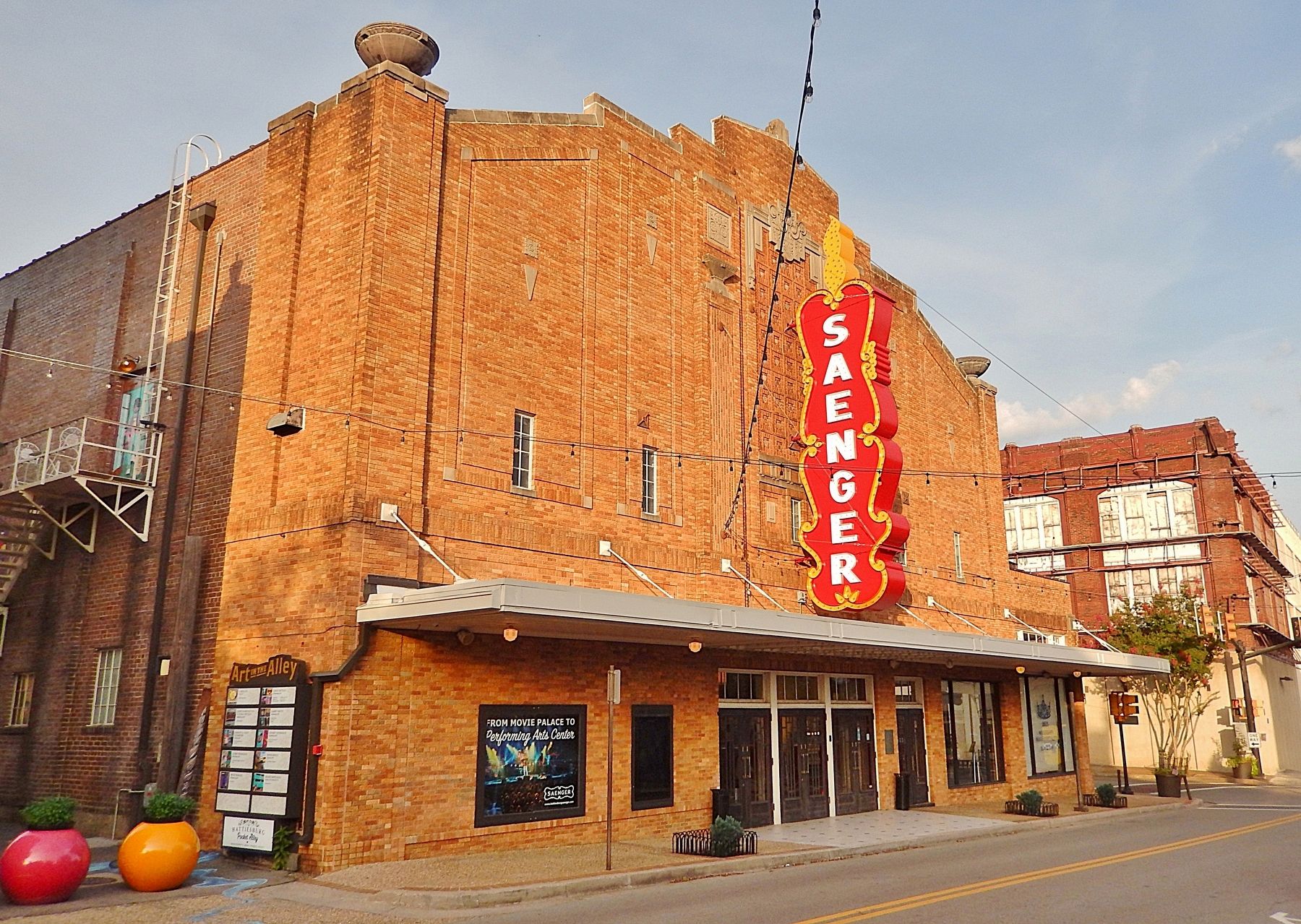
The building encompasses a major theatre auditorium seating 1100 on a ground floor and two balconies, as well as five former shop areas recently renovated and now utilize as an art gallery, an area museum, and a newsstand. The exterior of the building, constructed of locally made buff-colored brick, is virtually unaltered. The main (southwest) facade features intricate brick detailing, colored glazed terra-cotta tiles, and decorative cast-stone frieze work and trim. Two large brick pilasters are surmounted by two cast-stone urns which were originally matched by two others on the extreme ends of the facade. The southwest and southeast facades feature the original pressed-tin canopy.
Entrance to the theatre is through glass doors, which replaced the original wood-and-beveled-glass doors removedin a 1954 modernization. (Efforts are being made to locate the originals which, if unavailable, will be accurately reproduced.) The outer vestibule, also altered in 1954, was largely restored in 1976 to its former appearance, including fine plaster cornices and dentil molding and an original Art Deco chandelier.Photographed by Cosmos Mariner, June 20, 20253. Saenger Theatre (southwest elevation)
The outer vestibule opens into the main lobby, which was slightly altered in the 1950s. The large two-story room features a vaulted ceiling and plaster pilasters surmounted by a heavy plaster cornice, giving the space an imposing grandeur. Two Art Deco chandeliers and a terra-cotta wall fountain are other notable elements. Staircases at either side lead to the balconies, and directly ahead are three openings with shorter staircases which give access to the upper lobby, now used as an additional exhibit gallery.
The Saenger Theatre is the only surviving local example of the great Art Deco movie palaces of the 1920s and 1930s, and one of only four existing Art Deco buildings in the Hattiesburg area. The most notable motion picture theatre ever built in the vicinity, the building was designed by architect Emil Weil of New Orleans,whose original plans have been obtained from prior owners by the City of Hattiesburg and have provided the basis for restoration.Photographed by Cosmos Mariner, June 20, 20254. Saenger Theatre (west/front elevation)
In the early 1930s E. V. Richards and Paramount Pictures acquired the building from the Saengers, and in 1950 Paramount became the sole owner. In the 1960s American Broadcasting Corporation acquired Paramount and operated the theatre under the name of ABC Interstate Theatres until 1974, when a new theatre was built and the older structure was donated to the City of Hattiesburg.
The Saenger has been a local landmark since its construction, serving as the setting for vaudeville and opera productions, carnival balls, recitals, lectures, and other events in the cultural life of the area, as well as functioning as a movie theatre. During World War II, troops from nearby Camp Shelby spent Saturday afternoons at the Saenger. The building underwent minor non-structural renovations in 1954 and 1964, but the effects of these modernizations were largely removed during a careful and painstaking partial restoration in 1976. The master plasterer who had installed the original plasterwork in 1928-29 was retained to restorethe plasterwork.Photographed by Cosmos Mariner, June 20, 20255. Saenger Theatre (northwest elevation)
Also see . . .
1. History of the Movie Palace (Hattiesburg Saenger Theatre).
Excerpt: As a crown jewel of Hattiesburg and part of the Saenger Amusement Company, the 997-seat movie palace was one of seven Saenger Theaters built and operated throughout the South by the Saenger brothers, Abe and Julian. The Saenger Theater has characteristics typical of the Neoclassical Revival style and Art Deco Style. The Saenger was originally a venue to show silent movies. It was constructed at a time when theaters were among the first public structures to benefit from air-conditioning systems. When the Saenger Theater opened on Thanksgiving Day 1929, the admission charge was six cents for children. One of the outstanding features was the organ, which was played before the beginning of a movie and then between shows. The theater organ sound, with its ability to mimic other instruments and create sound effects, differs from that of other organs, and today it still brings instant memories to those who heard it in the earlier years. The chandelier was something to behold in the small city of Hattiesburg. Hattiesburg’s Saenger Theater was renovated in 2000 and underwent an extensive stucco and paint repair and exterior sign refurbishment in 2022.(Submitted on February 8, 2026, by Cosmos Mariner of Cape Canaveral, Florida.)
2. Saenger Theatre, Hattiesburg, MS (Cinema Treasures).
Excerpt: The Saenger Theatre opened on November 21, 1929 with Nancy Carroll in “Sweetie”. It was equipped with a Robert Morton 2 manual 6 ranks organ which had previously been installed in the Strand Theatre, Hattiesburg. The organ was removed from the Saenger Theatre in 1972 having been purchased by an individual. It operated as a movie house until closure came on May 16, 1974 with Ellen Burstyn in “The Exorcist”. The original Robert Morton organ was returned to the theatre, now enhanced with the console enlarged to 3 manuals and 8 ranks. The theatre has been restored and today operates as a venue for live performances.(Submitted on February 8, 2026, by Cosmos Mariner of Cape Canaveral, Florida.)
Credits. This page was last revised on February 8, 2026. It was originally submitted on February 7, 2026, by Cosmos Mariner of Cape Canaveral, Florida. This page has been viewed 66 times since then. Photos: 1. submitted on February 7, 2026, by Cosmos Mariner of Cape Canaveral, Florida. 2, 3, 4, 5. submitted on February 8, 2026, by Cosmos Mariner of Cape Canaveral, Florida.
