Chatfield in Fillmore County, Minnesota — The American Midwest (Upper Plains)
Chatfield's Public Education Legacy
Photographed by McGhiever, October 4, 2025
1. Chatfield's Public Education Legacy Marker
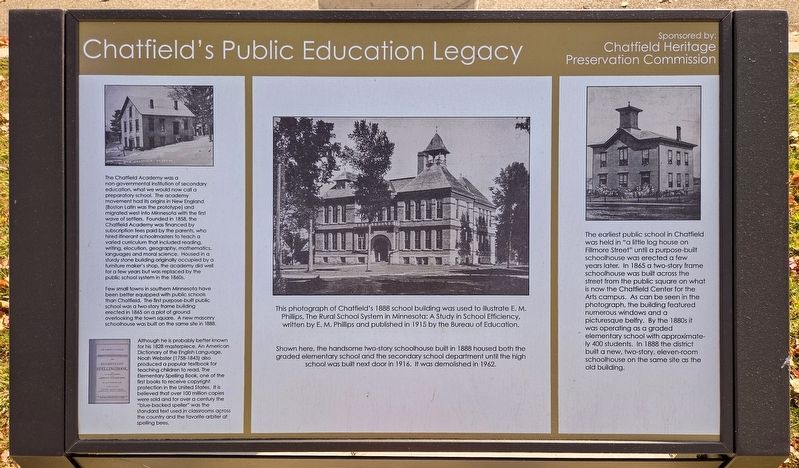
The Chatfield Academy was a non-governmental institution of secondary education, what we would now call a preparatory school. The academy movement had its origins in New England (Boston Latin was the prototype) and migrated west into Minnesota with the first wave of settlers. Founded in 1858, the Chatfield Academy was financed by subscription fees paid by the parents, who hired itinerant schoolmasters to teach a varied curriculum that included reading, writing, elocution, geography, mathematics, languages and moral science. Housed in a sturdy stone building originally occupied by a furniture maker's shop, the academy did well for a few years but was replaced by the public school system in the 1860s.
Few small towns in southern Minnesota have been better equipped with public schools than Chatfield. The first purpose-built public school was a two-story frame building erected in 1865 on a plot of ground overlooking the town square. A new masonry schoolhouse was built on the same site in 1888.
Although he is probably better known for his 1828 masterpiece, An American Dictionary of the English Language, Noah Webster
this page online
This photograph of Chatfield's 1888 school building was used to illustrate E. M. Phillips, The Rural School System in Minnesota: A Study in School Efficiency, written by E. M. Phillips and published in 1915 by the Bureau of Education.
Shown here, the handsome two-story schoolhouse built in 1888 housed both the graded elementary school and the secondary school department until the high school was built next door in 1916. It was demolished in 1962.
The earliest public school in Chatfield was held in "a little log house on Fillmore Street" until a purpose-built schoolhouse was erected a few years later. In 1865 a two-story frame schoolhouse was built across the street from the public square on what is now the Chatfield Center for the Arts campus.
Photographed by McGhiever, October 4, 2025
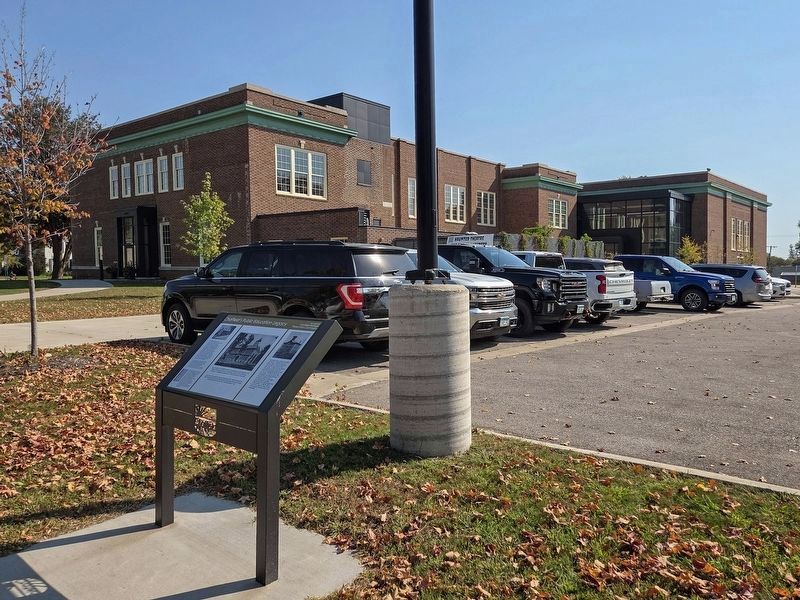
2. Marker due west of what is now the Chatfield Center for the Arts
Erected by the Chatfield Heritage Preservation Commission.
Topics. This historical marker is listed in this topic list: Education. A significant historical year for this entry is 1858.
Location. 43° 50.611′ N, 92° 11.27′ W. Marker is in Chatfield, Minnesota, in Fillmore County. It is at the intersection of 4th Street and Twiford Street SW on 4th Street. Touch for map. Marker is in this post office area: Chatfield MN 55923, United States of America. Touch for directions.

Regionally, this marker is in Southeast Minnesota and in Greater Rochester. It is also in the American Midwest, in the Corn Belt, and in the Driftless Area — Bluff Country. Globally, it is in North America, the Western Hemisphere, the Western World, and the Anglosphere. Historically, it finds itself in what was once Rupert’s Land, the territory of the Mississippian Culture, and the Louisiana Purchase.
Other nearby markers. At least 8 other markers are within walking distance of this marker: Chatfield Loses County Courthouse, Gains Its First Municipal Park (within shouting distance of this marker); Chatfield High School (1916-1959) (within shouting distance of this marker); Chatfield (about 300 feet away, measured in a direct line); Main Street—From Wilderness Trail to Modern Highway (about 300 feet away); The New Deal Comes to Chatfield (about 300 feet away); Chatfield's Legacy of Community Music (about 400 feet away); Chatfield's Historic Carnegie Library (about 400 feet away); Chatfield's Civic Geometry (about 400 feet away). Touch for a list and map of all markers in Chatfield.
Credits. This page was last revised on February 8, 2026. It was originally submitted on February 8, 2026, by McGhiever of Minneapolis, Minnesota. This page has been viewed 50 times since then. Photos: 1, 2. submitted on February 8, 2026, by McGhiever of Minneapolis, Minnesota.
