
Città Antica in Verona in Provincia di Verona, Venetia, Italy — Southern and Western Europe (Mediterranean)
Basilica di Sant'Anastasia
(Secoli XIII-XV)
⎯⎯⎯
Basilica of Saint Anastasia
(13th–15th centuries)

Photographed by James Hulse, June 11, 2025
1. Basilica di Sant'Anastasia / Basilica of Saint Anastasia Marker

Situata all'estremità orientale dell'antico decumano, lungo l'asse che conduceva dal foro al teatro romano, la basilica, capolavoro dell'architettura gotica italiana, simboleggia il periodo di maggior gloria scaligera. Fu eretta insieme al convento dai frati predicatori Domenicani alla fine del XIII secolo sul luogo di una precedente chiesa altomedievale, godendo delle donazioni di Guglielmo di Castelbarco e dei Della Scala. La basilica, terminata nella seconda metà del Quattrocento, si presenta nell'aspetto pressoché originario, a tre navate, con transetto a cinque cappelle, secondo il modello usato nella chiesa madre di San Domenico a Bologna. Un grande tramezzo in muratura, con porta e piano rialzato, demolito alla fine del Cinquecento, divideva la "chiesa dei frati", comprendente il transetto e la prima campata della navata con il coro, dalla "chiesa dei laici", composta di quattro campate e ribassata rispetto alla prima. Nel Quattrocento le due altezze furono equiparate e fu steso l'elegante "pavimento a tappeto" in marmo rosso di Verona, bianco d'Istria e basanite nera: il bel rosone centrale è copia dell'originale conservato a Castelvecchio. Nel portale bipartito, databile agli anni 1319-23, il Maestro di Santa Anastasia scolpi le figure di Santa Anastasia, Santa Caterina d'Alessandria, dei Santi domenicani (Domenico, Pietro Martire, Tommaso d'Aquino) e l'architrave con sei Storie di Cristo. Due acquasantiere tardo quattro-centesche sorrette dai celebri Gobbi accolgono all'ingresso i visitatori. All'interno, sotto le volte decorate con girali e motivi vegetali nella chiesa dei frati, e arricchite da immagini relative all'Ordine nella chiesa dei laici, il giuspatronato delle più importanti famiglie veronesi lasciò su altari o dentro le cappelle i segni del proprio potere, trasformando nei secoli la chiesa in uno straordinario scrigno di opere d'arte. L'area del transetto fu decorata per prima. Tra le pitture più antiche, nel presbiterio, a destra, il Cristo Giudice tra la Vergine e san Giovanni battista del Secondo Maestro di San Zeno, pittore post giottesco della prima metà del secolo XIV. A sinistra, il Monumento a Cortesia Serego, morto in battaglia nel 1386, dello scultore Pietro Lamberti in collaborazione con il pittore Michele Giambono. Nella cappella della famiglia Cavalli numerosi gli affreschi trecenteschi, dal Battesimo di Cristo, di artista bolognese, al capolavoro di Altichiero da Zevio raffigurante il Corteo dei nobili Cavalli presentati dai santi a Maria, alla lunetta con la Madonna e angeli di Martino da Verona. A destra del presbiterio la cappella della famiglia Pellegrini, decorata con 24 pannelli in terracotta di Michele da Firenze, reca sopra l'arco di ingresso il celeberrimo affresco di Pisanello con San Giorgio e la principessa. Altri riquadri votivi trecenteschi decorano il transetto sinistro e la cappella Salerni, mentre la cappella del Rosario conserva una Madonna dell'Umiltà di Lorenzo Veneziano. Altre pregevoli opere di scultura sono l'Arca di Gianesello da Folgaria (anonimo sec. XV), l'Altare Fregoso di Danese Cattaneo (1565). Un imponente restauro durato dal 2005 al 2011 ha restituito alla città la basilica in tutto il suo splendore.
Didascalie
(Foto #1) Marco Moro, La chiesa di santa Anastasia e il complesso absidale. Verona, Biblioteca Civica
(Foto #2) Pianta del Monastero di Santa Anastasia nel 1807. Verona, Biblioteca Civica
(Foto #3) Antonio Pisano detto il Pisanello (1395 ca, entro il 1455), San Giorgio e la principessa
Erected in the late 13th century at the eastern end of the ancient decumanus road, between the Roman forum and theatre, the Basilica of Santa Anastasia is a masterpiece of Italian Gothic architecture and a symbol of the greatest period of Scaligeri rule. The church and adjoining Dominican monastery were built over a preceding medieval church, with the benefit of donations by Guglielmo di Castelbarco and the Della Scala family. The basilica, completed in the late 1400s, is still in almost original form: a triple nave with transept and five chapels, in keeping with the model of the San Domenico mother church in Bologna. A masonry partition with door originally separated a raised area reserved for the friars, consisting of the transept, chancel and first arch of the nave, from the lower area of the four arches of the "lay church". At the end of the 1400s the division was eliminated: the heights of the two parts were equalised and the elegant "carpet-motif" flooring was installed, worked in red Verona marble, white Istrian marble and black basanite. The beautiful central rosette is a replica of the original, now preserved in Castelvecchio Museum. The double portal, from 1319-1323, shows the sculptures of the "Master of Santa Anastasia": Saint Anastasia and Saint Catherine of Alexandria, the Dominican Saints (Domenico, Peter Martyr, Thomas Aquinas) and Stories of Christ on the architrave. At the entrance, the visitor is welcomed by two late 1400s fonts supported on the well-known "Hunchbacks". Inside, the vaults are decorated with garlands and plant motifs in the friars' church and with scenes and symbols of the Dominican order in the lay church. Over the centuries the patronage of great Veronese families contributed signs of power and faith for the altars and the chapels, transforming the church into an extraordinary display of art. The transept area was decorated first. One of the oldest images, on the right side of the presbytery, is Christ as Judge between the Virgin and John Baptist, by the Second Master of Saint Zeno, a post-Giotto painter active in the first half of the 1300s. To the left is the Monument to Cortesia Serego, fallen in battle in 1386, executed by the sculptor Pietro Lamberti in collaboration with the painter Michele Giambono. The chapel of the Cavalli family shows many 1300s frescos, from the Baptism of Christ, by a Bologna artist, to Altichiero of Zevio's masterpiece, the Cortege of the Noble Cavallis Introduced to Mary by the Saints, to the lunette of the Holy Virgin and Angels by Martino of Verona. To the right of the presbytery is the Pellegrini family chapel, adorned with twenty-four terra-cotta panels by Michele of Florence, and with Pisanello's celebrated fresco of Saint George and the Princess above the entrance. Other 14th century votive pictures decorate the left transept and the Salerni chapel, while the Chapel of the Rosary preserves a Holy Virgin of Humility by Lorenzo Veneziano. Other notable sculptures include the Tomb of Gianesello of Folgaria (anonymous, 15th century), and the Fregoso Altar by Danese Cattaneo (1565). A massive restoration project between 2005 and 2011 returned the basilica the city in all its original glory.
Captions
(Photo #1) Marco Moro, The Church of Santa Anastasia and the Apse Complex. Verona, Civic Library.
(Photo #2) Plan of the Monastery of Santa Anastasia in 1807. Verona, Civic Library.
(Photo #3) Antonio Pisano, called Pisanello (c. 1395–before 1455), Saint George and the Princess.
Erected by Comune
this page online
Topics. This historical marker is listed in this topic list: Religion & Religious Structures. A significant historical year for this entry is 1386.
Location. 45° 26.711′ N, 10° 59.972′ E. Marker is in Verona, Veneto (Venetia), in Provincia di Verona. It is in Città Antica. It is at the intersection of Via Abramo Massalongo and Via Don Bassi on Via Abramo Massalongo. Touch for map. Marker is at or near this postal address: Via Abramo Massalongo 13, Verona, Veneto 37121, Italy. Touch for directions.

Regionally, it is in Europe, the European Union, the Schengen Area, a coastal Mediterranean country, and the Western World. Historically, it finds itself in what was once the Roman Empire and specifically also the Holy Roman Empire.
Other nearby markers. At least 8 other markers are within walking distance of this marker: Chiesa di San Giorgetto o San Pietro Martire / Church of San Giorgetto, or Saint Peter Martyr (a few steps from this marker); Guglielmo Guarienti (about 150 meters away, measured in a direct line); Palazzo del Governo, già Reggia Scaligera (secolo XIV)

Photographed by James Hulse, June 11, 2025
2. Basilica di Sant'Anastasia / Basilica of Saint Anastasia Marker
The marker is located to the far left at the front entrance to the church.

Photographed by James Hulse, June 11, 2025
3. Basilica di Sant'Anastasia / Basilica of Saint Anastasia Marker
The view of marker next to the Tomb of William of Castelbarco.
Photographed by James Hulse, June 11, 2025
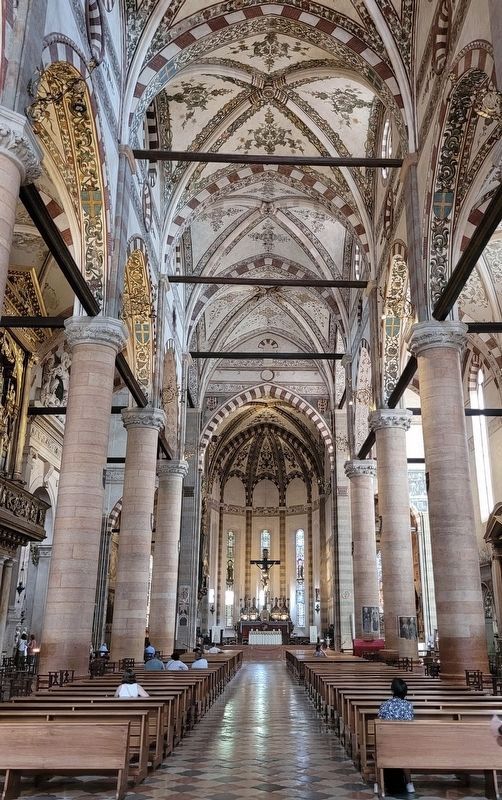
4. Basilica di Sant'Anastasia / Basilica of Saint Anastasia
The interior view of the nave of the church.

Photographed by James Hulse, June 11, 2025
5. "Il Gobbo" (The Hunchback)
This famous 15th-century holy water stoup is located at the beginning of the middle aisle in the Basilica di Santa Anastasia.

Photographed by James Hulse, June 11, 2025
6. Basilica di Sant'Anastasia / Basilica of Saint Anastasia Marker
The interior wall of the church has an organ along the upper wall.
Credits. This page was last revised on February 14, 2026. It was originally submitted on February 9, 2026, by James Hulse of Medina, Texas. This page has been viewed 26 times since then. Photos: 1, 2, 3, 4, 5, 6. submitted on February 14, 2026, by James Hulse of Medina, Texas.
