Fredericksburg, Virginia — The American South (Mid-Atlantic)
World War I Fredericksburg National Guard Monument

circa 2025
1. World War I Fredericksburg National Guard Monument Marker
This monument commemorates the World War I service of our Fredericksburg National Guard soldiers in the United States Coastal Defense Artillery.
This cannon is like one they manned. These soldiers formed in Fredericksburg, June 17, 1917, as 3rd Company, Virginia Coast Artillery Corps. They mustered into federal service on the 30th of July and quickly reported to Hampton Roads. On February 1st, 1918 the unit was redesignated as 10th Company, Coast Defenses of the Chesapeake Bay. They were demobilized at Fort Story in August of 1919. Both were organized and commanded by Captain A. L. Johnson.
This cannon is on permanent loan from the American Legion, Post 55.
This monument designed and established by the Fredericksburg Guard Association in 2011.
LTC David K. James, President
Erected 2011 by Fredericksburg Guard Association.
Topics. This monument and memorial is listed in this topic list: War, World I.
Location. 38° 17.616′ N, 77° 29.044′ W. Monument is in Fredericksburg, Virginia. It is on Emancipation Highway (U.S. 1) 0.1 miles south of William Street, on
this page online

Regionally, this memorial monument is in the Washington Metropolitan Area and in Northern Virginia. It is also in the American South and specifically in the Upper South. Globally, it is in North America, the Western Hemisphere, the Western World, and the Anglosphere. Historically, it finds itself in what was once the territory of the Mississippian Culture, one of the original Thirteen Colonies, one of the Confederate States of America, and the Antebellum South.
Other nearby markers. At least 8 other markers are within walking distance of this marker: This Monument Commemorates Our Local Militia Service (1675-1903) (a few steps from this marker); The Virginia Central Railway (approx. 0.4 miles away); Fredericksburg (approx. 0.4 miles away); Building a Railroad Through a Stream Valley (approx. 0.4 miles away); Calvin Coolidge (approx.

circa 2025
2. World War I Fredericksburg National Guard Monument
showing the gun mounted above the marker.
More about this monument. The marker is on the mounting pedestal for a memorial artillery piece - a Driggs-Seabury Mark I 6-Pounder Quick-firing gun manufactured in 1900.
Regarding World War I Fredericksburg National Guard Monument. The gun accompanying the monument is a naval weapon used to defend ships against fast torpedo boats and rake an opponent's decks in an anti-personnel capacity. As a 6-pounder, it is smaller than any caliber that the Fredericksburg Guardsmen would have used at Fort Story - the smallest weapons used in coastal fortifications around the Chesapeake Bay were 3-inch guns (firing roughly a 12-pound projectile, twice the weight of this gun's projectiles). This weapon would have been 17 years old by the time the US entered World War I, and already obsolete based on the rate of naval technology evolution both for firing too light of a projectile and for its rate of fire for its size.
Photographed by Evan Dwyer, August 5, 2023
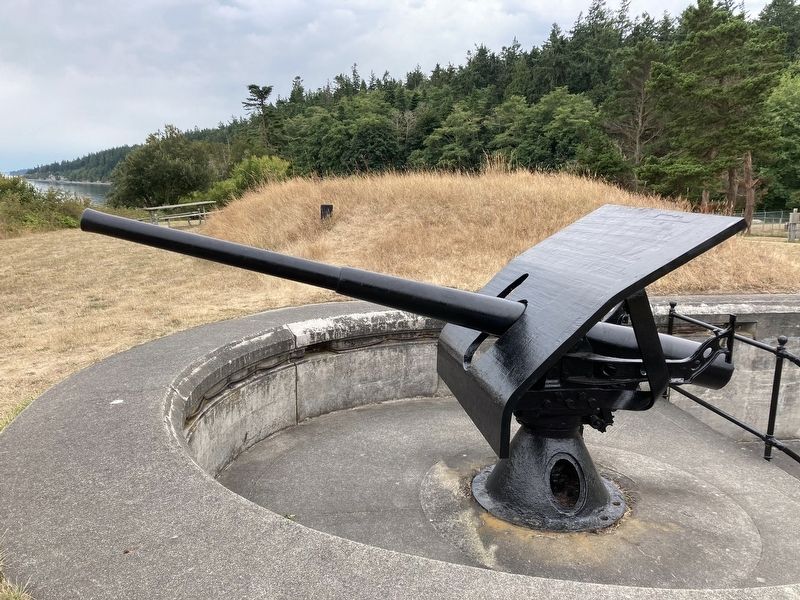
3. 3-inch Coastal Defense Gun at Fort Flagler, Washington
This is the actual size of gun that the Fredericksburg National Guardsmen would have manned in the Chesapeake Bay Defenses. This example is a 1907 Watervliet-made 3-incher moved from Fort Wint, in the Philippines, to Fort Flagler's Battery Thomas Wansboro for display in 1963.
Credits. This page was last revised on February 10, 2026. It was originally submitted on February 9, 2026, by Evan Dwyer of Richmond, Virginia. This page has been viewed 67 times since then. Photos: 1, 2, 3. submitted on February 9, 2026, by Evan Dwyer of Richmond, Virginia. • Bernard Fisher was the editor who published this page.
