Salida in Chaffee County, Colorado — The American Mountains (Southwest)
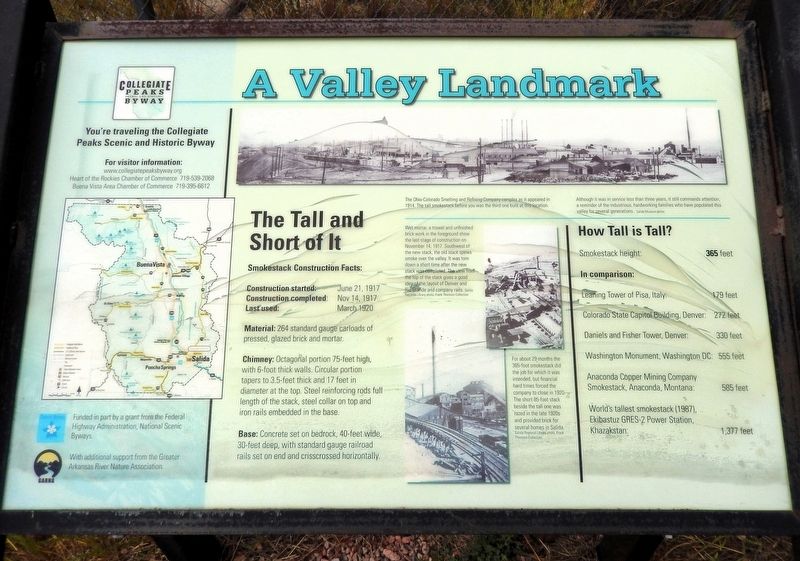
A Valley Landmark
The Tall and Short of It
| — | Collegiate Peaks Scenic and Historic Byway | — |
Photographed by Cosmos Mariner, July 23, 2025
1. A Valley Landmark Marker
Smokestack Construction Facts:
Construction started: June 21, 1917
Construction completed: Nov 14, 1917
Last used: March 1920
Material: 264 standard gauge carloads of pressed, glazed brick and mortar.
Chimney: Octagonal portion 75-feet high, with 6-foot thick walls. Circular portion tapers to 3.5-feet thick and 17 feet in diameter at the top. Steel reinforcing rods full length of the stack, steel collar on top and iron rails embedded in the base.
Base: Concrete set on bedrock, 40-feet wide, 30-feet deep, with standard gauge railroad rails set on end and crisscrossed horizontally.
How Tall is Tall?
Smokestack height: 365 feet
In comparison:
Leaning Tower of Pisa, Italy: 179 feet
Colorado State Capitol Building, Denver: 272 feet
Daniels and Fisher Tower, Denver: 330 feet
Washington Monument, Washington DC: 555 feet
Anaconda Copper Mining Company Smokestack, Anaconda, Montana: 585 feet
World's tallest smokestack (1987), Ekibastuz GRES-2 Power Station, Khazakstan: 1,377 feet
[photo captions]
• The Ohio-Colorado Smelting and Refining Company complex as it appeared in 1914. The tall smokestack before you was the third one built at this
this page online
• Although it was in service less than three years, it still commands attention, a reminder of the industrious, hardworking families who have populated this valley for several generations.
• Wet mortar, a trowel and unfinished brick work in the foreground show the last stage of construction on November 14, 1917. Southwest of the new stack, the old stack spews smoke over the valley. It was torn down a short time after the new stack was completed. The view from the top of the stack gives a good idea of the layout of Denver and Rio Grande and company rails.
• For about 29 months the 365-foot smokestack did the job for which it was intended, but financial hard times forced the company to close in 1920. The short 85-foot stack beside the tall one was razed in the late 1920s and provided brick for several homes in Salida.
You’re traveling the Collegiate Peaks Scenic and Historic Byway
For visitor information:
www.colorado.com/byways/collegiate-peaks
Heart of the Rockies Chamber of Commerce
Buena Vista Area Chamber of Commerce
Erected 2009 by Federal Highway Administration, National Scenic Byways and Greater Arkansas River Nature
Photographed by Cosmos Mariner, July 23, 2025
2. A Valley Landmark Marker
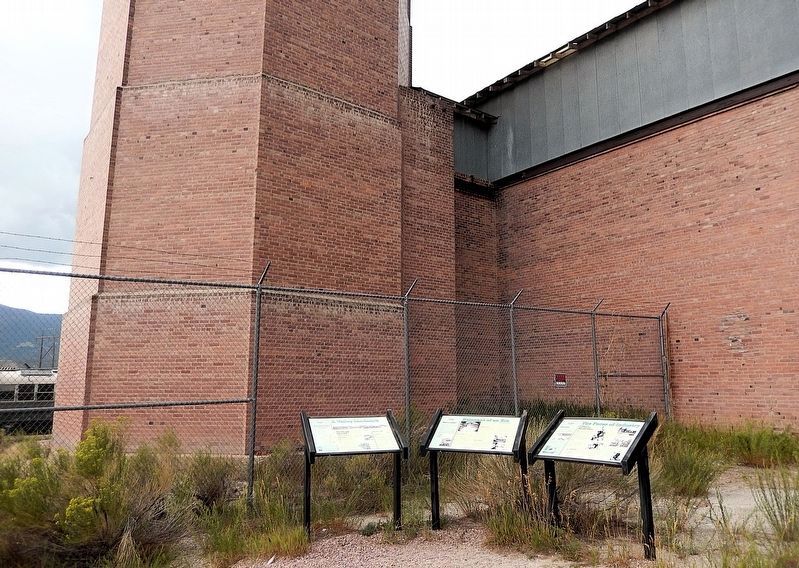
This is the leftmost of three related interpretive panels located near the base of the Ohio-Colorado Smelting & Refining Company Smokestack.
Topics and series. This historical marker is listed in these topic lists: Architecture • Industry & Commerce. In addition, it is included in the National Register of Historic Places (NRHP) series list. A significant historical date for this entry is November 14, 1917.
Location. 38° 33.143′ N, 106° 1.449′ W. Marker is in Salida, Colorado, in Chaffee County. It is on County Road 152 0.2 miles west of County Road 150. The marker is near the base of the historic Ohio-Colorado Smelting and Refining Company Smokestack, a landmark visible from anywhere in Salida. Touch for map. Marker is at or near this postal address: 8010 County Road 152, Salida CO 81201, United States of America. Touch for directions.

Regionally, this marker is in the Arkansas River Valley, in the Colorado High Rockies and on the Continental Divide. It is also in the American Mountain West. Globally, it is in North America, the Rocky Mountains, the Western Hemisphere, the Western World, and the Anglosphere.
Other nearby markers. At least 8 other markers are within 2 miles of this marker, measured as the crow flies: Remnant of an Era (here, next to this marker);
Photographed by Cosmos Mariner, July 23, 2025
3. Ohio-Colorado Smelting & Refining Company Smokestack
Regarding A Valley Landmark. National Register of Historic Places № 76000548.
From the National Register Nomination prepared by Wendell F. Hutchinson and Kenneth E. Waddell, 03/31/1975:
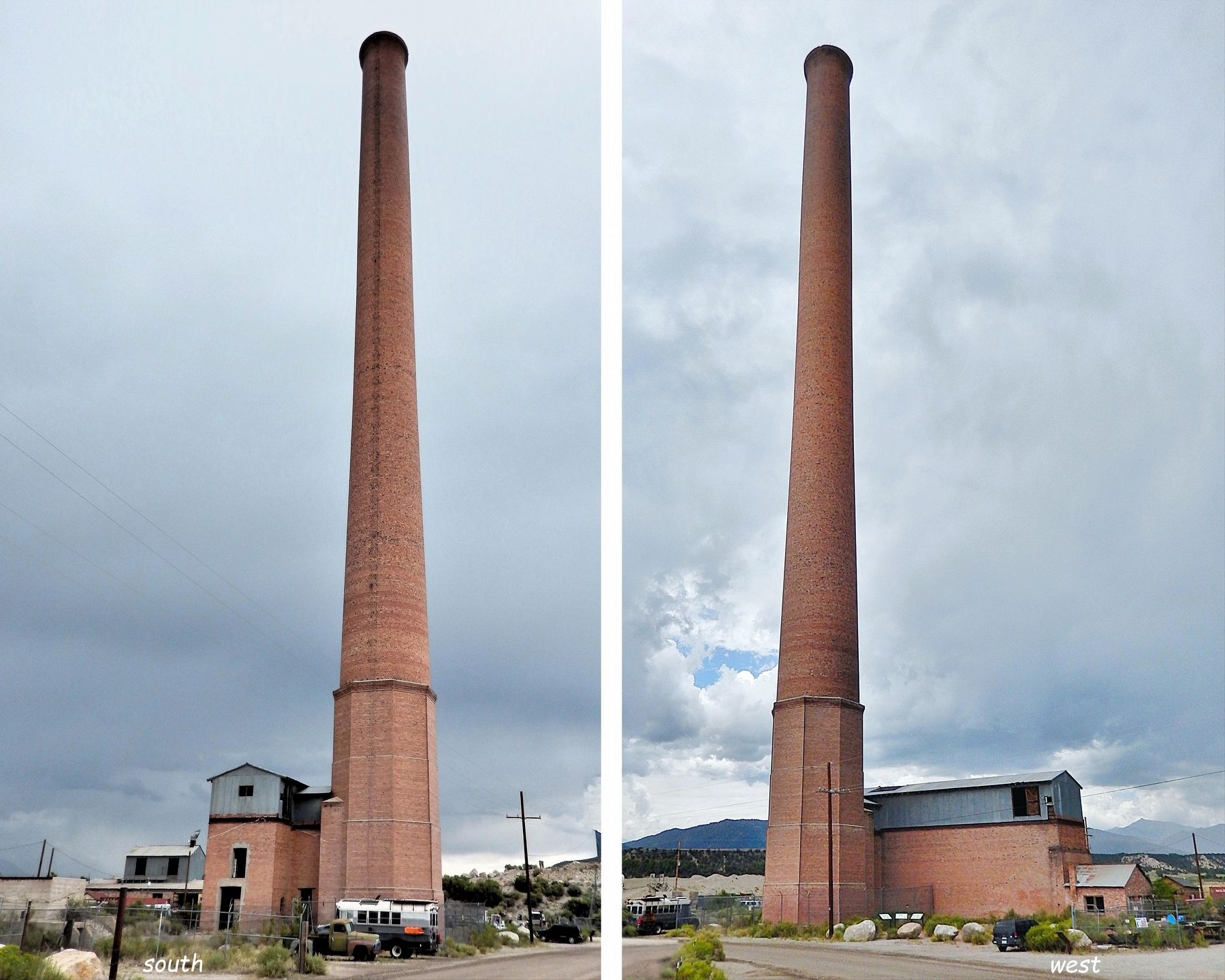
The Smeltertown Smokestack was built for the Ohio-Colorado Smelting and Refining Company. Commenced in 1916 and finished in 1917, this majestic brick and tile structure stands 365 feet into the air, twice as high as the 179 foot Leaning Tower of Pisa. Upright standard gauge railroad rails were placed in the concrete foundation to give strength; steel rods run throughout to the top of the structure, which is capped by a wide, flat, circular collar of steel, bolted onto the upright rods. Construction cost was $43,000.
The smokestack is located one mile west of Salida and one-quarter mile north of the Arkansas River. To the south and east is the community that long has been referred to as Smeltertown. The site of the smelter was an ideal one, including three mesas, affording every facility and advantage for handling ores and dumping slag.
The structure is remarkably well preserved for its many years of standing in all kinds of weather. Only a few superficial bricks are missing, due to lightning strikes during a time when the stack was not grounded. The connecting flue chamber is remarkable also in the span of its arched roof, made in radiating voussoirs without trusses. Attesting to the excellence of construction is the fact that vibration from rock crushing machinery during most of these years has not visibly impaired either the smokestack or the adjoining flue chamber.
The Smeltertown Smokestack is a highly visible monument to the industry of mining, an industry vital to the settlement of Colorado. Hundreds of people from the first great influx of miners in the years following the Colorado Gold Rush of 1859 stayed on as ranchers, merchants, and railroaders, becoming the citizens of the towns and communities along the Upper Arkansas River Valley. Early gold pans, long toms, sluices, and rockers gave way to smelters such as those at Leadville and Salida.
At the time of its completion in 1917, the 365-foot tall Smeltertown Smokestack was called the tallest structure of its kind west of the Mississippi, and among the tallest in the world. Incorporated in 1902 for three million dollars, the company spent over one million immediately for buildings, stacks, and machinery. The value of ores treated in 1903 was $1,355,455. The average tonnage treated in 1904 was 1,000 tons per day. At one time the plant had a capacity of handling 1,500 tons of ore daily with 24-hour operation. Ore and coal were shoveled by hand from the narrow-gauge cars to the smelter's wide-gauge cars. Horses were used to pull the slag pots to the slag dump 24 hours daily. At night the molten mass, at white heat, poured over the bank along the Arkansas River, a most impressive sight.
Advantages to the community were many; the smelter employed over 300 men during its construction and about that many during its operation. Workers were paid from $2.50 to $4 per day and the monthly payroll ran as high as $34,000. High ore and coal tonnage and the need for transportation developed business for railroads. The community of Smeltertown was composed of working people who bought milk, beef and vegetables from local farmers. Large amounts of hay, straw and grain were purchased from local farmers as feed and bedding for the smelter's workhorses. Money was made at home and stayed at home. Wages or farm produce were obtained at reasonable prices and many people became prosperous. The familiar landmark serves as a monument to those earlier men who worked at the smelter. Here they came — from Austria, from Greece, from Ireland, from Italy. Many of these families still reside in the Salida area and are counted among its finest citizens.
Related markers. Click here for a list of markers that are related to this marker. The Smeltertown Smokestack
Credits. This page was last revised on February 15, 2026. It was originally submitted on February 13, 2026, by Cosmos Mariner of Cape Canaveral, Florida. This page has been viewed 55 times since then. Photos: 1, 2, 3. submitted on February 14, 2026, by Cosmos Mariner of Cape Canaveral, Florida.
