Salida in Chaffee County, Colorado — The American Mountains (Southwest)
The Faces of Industry
| — | Collegiate Peaks Scenic and Historic Byway | — |
Photographed by Cosmos Mariner, July 23, 2025
1. The Faces of Industry Marker
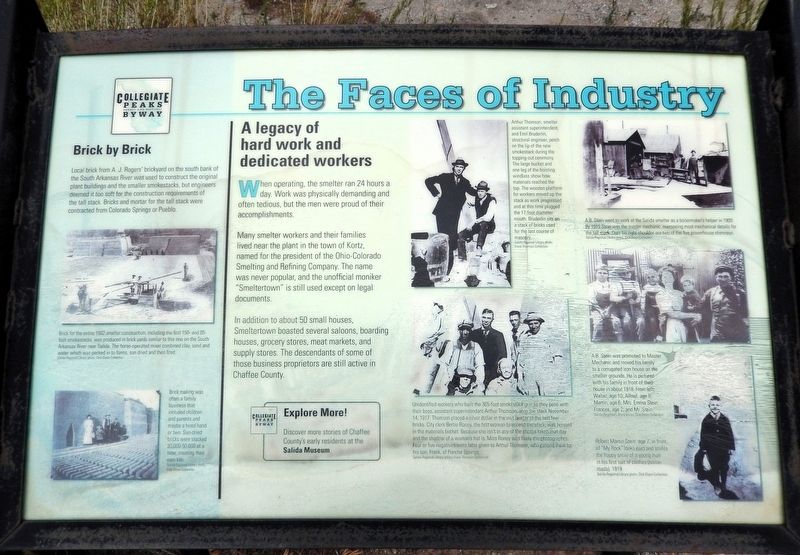
A legacy of hard work and dedicated workers
When operating, the smelter ran 24 hours a day. Work was physically demanding and often tedious, but the men were proud of their accomplishments.
Many smelter workers and their families lived near the plant in the town of Kortz, named for the president of the Ohio-Colorado Smelting and Refining Company. The name was never popular, and the unofficial moniker “Smeltertown” is still used except on legal documents.
In addition to about 50 small houses, Smeltertown boasted several saloons, boarding houses, grocery stores, meat markets, and supply stores. The descendants of some of those business proprietors are still active in Chaffee County.
Brick by Brick
Local brick from A. J. Rogers' brickyard on the south bank of the South Arkansas River was used to construct the original plant buildings and the smaller smokestacks, but engineers deemed it too soft for the construction requirements of the tall stack. Bricks and mortar for the tall stack were contracted from Colorado Springs or Pueblo.
[photo captions]
• Arthur Thomson, smelter assistant superintendent, and Emil Bruderlin, structural
this page online
• Unidentified workers who built the 365-foot smokestack grin as they pose with their boss, assistant superintendent Arthur Thomson, atop the stack November 14, 1917. Thomson placed a silver dollar in the wet mortar of the last few bricks. City clerk Bertie Roney, the first woman to ascend the stack, was hoisted in the materials bucket. Because she isn't in any of the photos taken that day and the shadow of a woman's hat is, Miss Roney was likely the photographer. Four or five negatives were later given to Arthur Thomson, who passed them to his son, Frank, of Poncha Springs.
• A.B. Stein went to work at the Salida smelter as a boilermaker's helper in 1909. By 1915, Stein was the master mechanic, overseeing most mechanical details for the tall stack. Over his right shoulder
Photographed by Cosmos Mariner, July 23, 2025
2. The Faces of Industry Marker
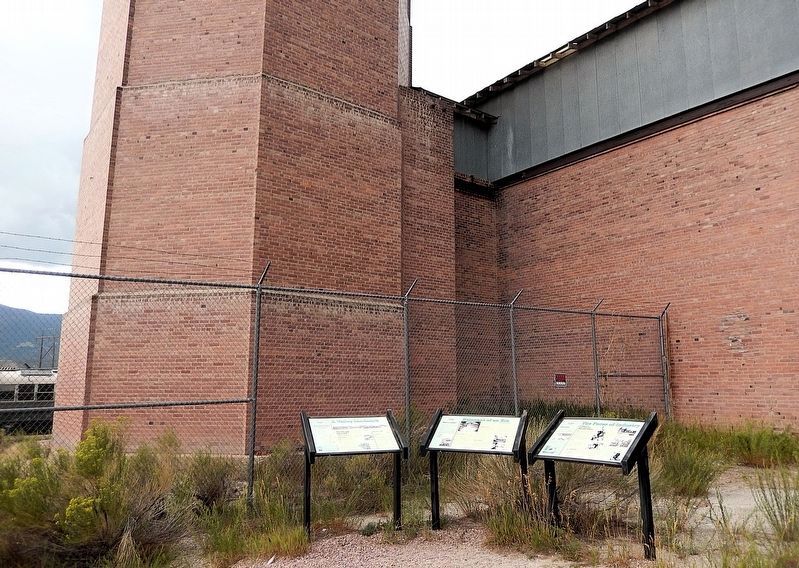
This is the rightmost of three related interpretive panels located near the base of the Ohio-Colorado Smelting & Refining Company Smokestack.
• A.B. Stein was promoted to Master Mechanic and moved his family to a corrugated iron house on the smelter grounds. He is pictured with his family in front of their house in about 1918. From left: Walter, age 10; Alfred, age 8; Martin, age 6; Mrs. Emma Stein; Frances, age 2; and Mr. Stein.
• Robert Martin Stein, age 7, in front of “My Rock” looks east and smiles the happy smile of a young man in his first suit of clothes (home-made). 1919.
• Brick for the entire 1902 smelter construction, including the first 150- and 85-foot smokestacks, was produced in brick yards similar to this one on the South Arkansas River near Salida. The horse-operated mixer combined clay, sand and water which was packed into forms, sun dried and then fired.
• Brick making was often a family business that included children and parents and maybe a hired hand or two. Sun-dried bricks were stacked 20,000-50,000 at a time, creating their own kiln.
Erected 2009 by Federal Highway Administration, National Scenic Byways and Greater Arkansas River Nature Association.
Topics. This historical marker is listed in these
Photographed by Cosmos Mariner, July 23, 2025
3. Ohio-Colorado Smelting & Refining Company Smokestack
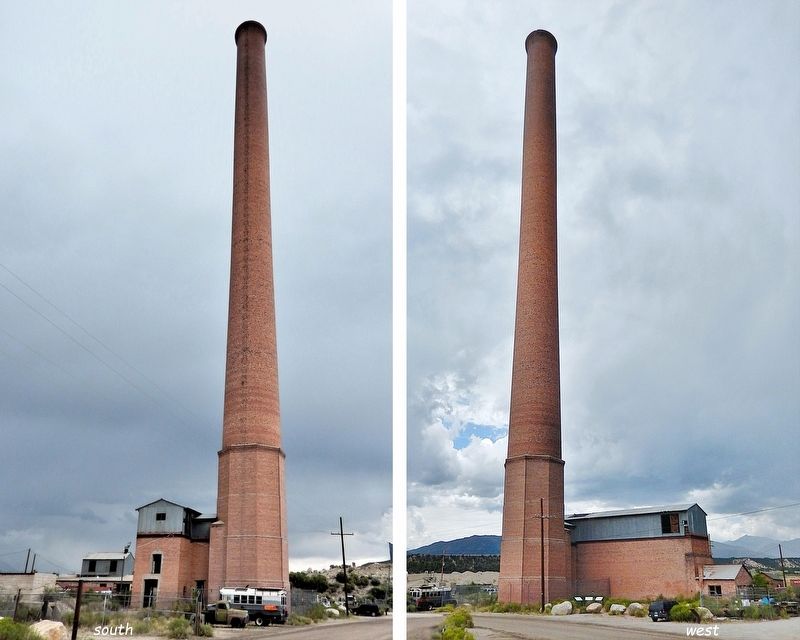
Location. 38° 33.144′ N, 106° 1.449′ W. Marker is in Salida, Colorado, in Chaffee County. It is on County Road 152 0.2 miles west of County Road 150. The marker is near the base of the historic Ohio-Colorado Smelting and Refining Company Smokestack, a landmark visible from anywhere in Salida. Touch for map. Marker is at or near this postal address: 8010 County Road 152, Salida CO 81201, United States of America. Touch for directions.

Regionally, this marker is in the Arkansas River Valley, in the Colorado High Rockies and on the Continental Divide. It is also in the American Mountain West. Globally, it is in North America, the Rocky Mountains, the Western Hemisphere, the Western World, and the Anglosphere.
Other nearby markers. At least 8 other markers are within 2 miles of this marker, measured as the crow flies: Remnant of an Era (here, next to this marker); A Valley Landmark (here, next to this marker); Chaffee County Courthouse (approx. 1.8 miles away); Old Rails New Trails (approx. 2 miles away); Heart of the Rockies (approx. 2 miles away); A Railroad Town (approx. 2 miles away); Water Use and Water Rights (approx. 2 miles away); The Salida Steam Plant (approx. 2 miles away). Touch for a list and map of all markers in Salida.
Regarding The Faces of Industry. National Register of Historic Places № 76000548.
Related markers. Click here for a list of markers that are related to this marker. The Smeltertown Smokestack
Also see . . . History of the Salida Smokestack in Smeltertown.
(By Jillian) Excerpt: Because of America’s involvement in World War I, there was an increased demand for lead and zinc which spurred demand in mines. It was during this climate that the Ohio and Colorado Smelting and Refining Company poured resources into the 365-foot Salida Smokestack that would join the rest of their plant, which had opened in 1902. And they indeed used many resources. According to Dick Dixon, the author of “Smokestack—the Story of the Salida Smelter,” the brick for the structure (not including labor) cost $43,000. Adjusted to our current times, that would add up to approximately $913,000 in bricks.(Submitted on February 15, 2026, by Cosmos Mariner of Cape Canaveral, Florida.)
The Salida area was found to have a high concentration of valuable ores like gold, silver, lead, and zinc. In order for these ores to be useful, they have to undergo the smelting process, which extracts useful metals from the crude ore found in the earth. The process of smelting is relatively complex, involving multiple stages of converting the sulfides in ore into oxides, which can then be stripped of oxygen, leaving the metal behind. Once the sulfides have been stripped from the ore, the remaining concentrate is roasted at a smelting plant, which can result in toxins like arsenic and lead being released into the air.
That’s where the huge smokestack comes in. At the time, the noxious gases released as part of the smelting process resulted in intense ecological damage in Salida. The Salida Smokestack, with its 365-foot height, was a solution to this issue. It was made to be tall enough that the toxic elements would disperse over a wide geographical area and not cause pollutants to settle in any one given spot.
The end of World War I signaled less demand for metal and therefore less demand for smelting. Additionally, the Ohio and Colorado S & R Co. was heavily indebted and went out of business. This left the 365-foot Salida Smokestack abandoned. In 1972, the County threatened to demolish the Smokestack, deeming it a potential liability. Citizens organized a coalition called Save Our Stack (SOS) to prevent the County from demolishing the historic smokestack. SOS was successful, and the Salida Museum Association took up the deed to the building in 1974. In 1976, the Salida Smokestack was placed on the National Register of Historic Places.
Credits. This page was last revised on February 15, 2026. It was originally submitted on February 13, 2026, by Cosmos Mariner of Cape Canaveral, Florida. This page has been viewed 74 times since then. Photos: 1, 2, 3. submitted on February 15, 2026, by Cosmos Mariner of Cape Canaveral, Florida.
