Salida in Chaffee County, Colorado — The American Mountains (Southwest)
Old Rails New Trails
| — | Collegiate Peaks Scenic and Historic Byway | — |
Photographed by Cosmos Mariner, July 23, 2025
1. Old Rails New Trails Marker
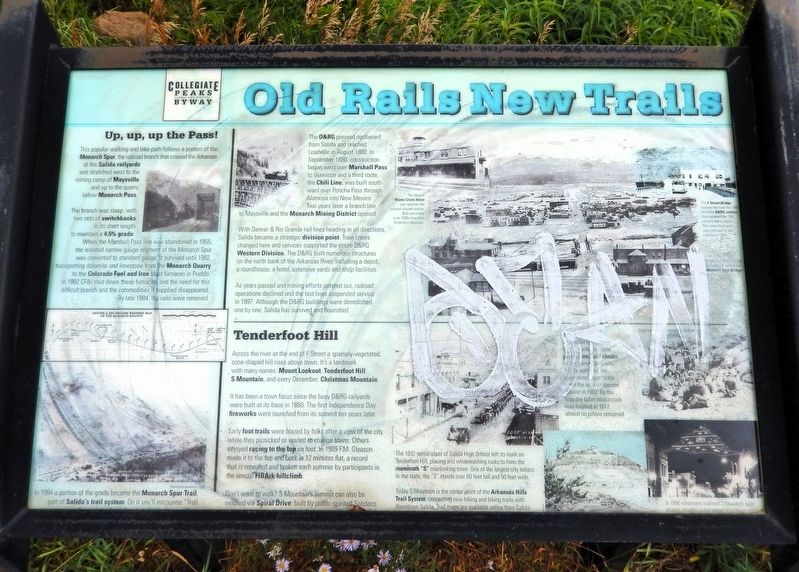
Up, up, up the Pass!
This popular walking and bike path follows a portion of the Monarch Spur, the railroad branch that crossed the Arkansas at the Salida railyards and stretched west to the mining camp of Maysville and up to the quarry below Monarch Pass.
The branch was steep, with two sets of switchbacks in its short length to maintain a 4.5% grade. When the Marshall Pass line was abandoned in 1955, the isolated narrow gauge segment of the Monarch Spur was converted to standard gauge. It survived until 1982, transporting dolomite and limestone from the Monarch Quarry to the Colorado Fuel and Iron blast furnaces in Pueblo. In 1982 CF&I shut down these furnaces and the need for this difficult branch and the commodities it supplied disappeared. By late 1984, the rails were removed. In 1994 a portion of the grade became the Monarch Spur Trail, part of Salida’s trail system.
The D&RG pressed northward from Salida and reached Leadville in August 1880. In September 1880, construction began west over Marshall Pass to Gunnison and a third route, the Chili Line, was built southward over Poncha Pass through Alamosa into New Mexico.
this page online
With Denver & Rio Grande rail lines heading in all directions, Salida became a strategic division point. Train crews changed here and services supported the entire D&RG Western Division. The D&RG built numerous structures on the north bank of the Arkansas River, including a depot, a roundhouse, a hotel, extensive yards and shop facilities.
As years passed and mining efforts petered out, railroad operations declined and the last lines suspended service in 1997. Although the D&RG buildings were demolished one by one, Salida has survived and flourished.
Tenderfoot Hill
Across the river at the end of F Street a sparsely-vegetated, cone-shaped hill rises above town. It's a landmark with many names: Mount Lookout, Tenderfoot Hill, S Mountain, and every December, Christmas Mountain.
It has been a town focus since the busy D&RG railyards were built at its base in 1880. The first Independence Day fireworks were launched from its summit ten years later.
Early foot trails were blazed by folks after a view of the city while they picnicked or waited to change trains.
Photographed by Cosmos Mariner, July 23, 2025
2. Old Rails New Trails Marker
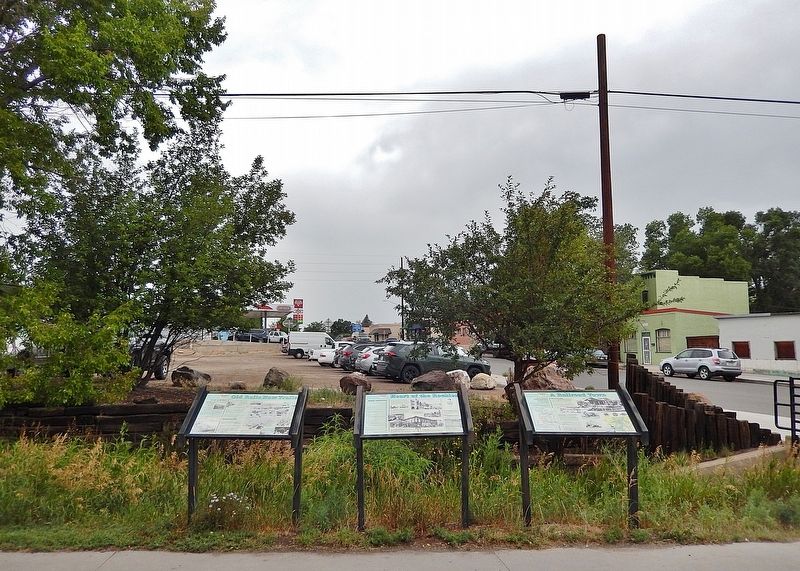
This marker is the leftmost of three related interpretive panels on the north side of the Monarch Spur Trail.
Don't want to walk? S Mountain's summit can also be reached via Spiral Drive, built by public-spirited Salidans.
The 1932 senior class of Salida High School left its mark on Tenderfoot Hill, placing and whitewashing rocks to form the mammoth "S" overlooking town. One of the largest city letters in the state, the "S" stands over 80 feet tall and 50 feet wide.
Today S Mountain is the center point of the Arkansas Hills Trail System, connecting new hiking and biking trails with downtown Salida. Trail maps are available online.
Tenderfoot Hill was once covered with the same piñon pines and shrubs as the surrounding hills. It is thought that the vegetation began to die when the smelter opened upwind in 1902. By the time the taller smokestack was finished in 1917 almost no piñons remained.
In 1990 volunteers outlined S Mountain with strands of lights in the shape of a Christmas tree.
[photo captions]
• Denver & Rio Grande Western Map of the Monarch Branch
• Monarch Townsite in 1884
• The elegant Monte Cristo Hotel was opposite the original railroad station. Both are visible in an 1890s view from Tenderfoot Mountain.
• The F Street Bridge crosses over the 1941 Art Deco D&RG station that replaced the 19th century stone station. This town focal point was removed by the railroad in 1985.
• In an 1890s view, an earlier F Street bridge is visible, as well as the Monarch Spur Bridge to the right.
• Salida high schoolers picnicking at the “Crater”.
Erected by Federal Highway Administration, National Scenic Byways and Greater Arkansas River Nature Association.
Topics. This historical marker is listed in these topic lists: Industry & Commerce • Railroads & Streetcars.
Location. 38° 32.229′ N, 105° 59.602′ W. Marker is in Salida, Colorado, in Chaffee County. It is on West 1st Street (State Highway 291) just north of G Street, on the left when traveling north. The marker is located alongside the Monarch Spur Trail, formerly the D&RGW Monarch Branch line. Touch for map. Marker is in this post office area: Salida CO 81201, United States of America. Touch for directions.

Regionally, this marker is in the Arkansas River Valley, in the Colorado High Rockies and on the Continental Divide. It is also in the American Mountain West. Globally, it is in North America, the Rocky Mountains, the Western Hemisphere, the Western World, and the Anglosphere.
Other nearby markers. At least 8 other markers are within walking distance of this marker: Heart of the Rockies (here, next to this marker); A Railroad Town (here, next to this marker); The Salida Steam Plant (about 500 feet away, measured in a direct line); FIBArk: First in Boating on the Arkansas (about 600 feet away); Water Use and Water Rights (about 600 feet away); Chaffee County Honor Roll Board (about 700 feet away); Chaffee County Courthouse (approx. ¼ mile away); Votes for Women (approx. 0.3 miles away). Touch for a list and map of all markers in Salida.
Related markers. Click here for a list of markers that are related to this marker.
Also see . . . Monarch Branch (Wikipedia).
Excerpt: The Monarch Branch was a branch line of the Denver & Rio Grande Western built in the 1880s to serve the Colorado Fuel & Iron limestone quarry at Monarch, Colorado. Originally part of the D&RGW's narrow-gauge system, the 15-mile line connected with the rest of the narrow-gauge network at Poncha Junction, on the Marshall Pass line. The upper part of the Branch was on a 4.5% grade and included both an "S" curve and a double switchback to reach an elevation of over 10,000 ft. The line was converted to standard-gauge in 1956 after the narrow-gauge mainline from Salida to Gunnison was closed in the early 1950s. The line operated as a standard-gauge branch of the D&RGW until the early 1980s when Colorado Fuel & Iron closed its blast furnaces at Pueblo, Colorado.(Submitted on February 15, 2026, by Cosmos Mariner of Cape Canaveral, Florida.)
Credits. This page was last revised on February 16, 2026. It was originally submitted on February 13, 2026, by Cosmos Mariner of Cape Canaveral, Florida. This page has been viewed 81 times since then. Photos: 1, 2. submitted on February 15, 2026, by Cosmos Mariner of Cape Canaveral, Florida.
