Salida in Chaffee County, Colorado — The American Mountains (Southwest)
A Railroad Town
| — | Collegiate Peaks Scenic and Historic Byway | — |
Photographed by Cosmos Mariner, July 23, 2025
1. A Railroad Town Marker
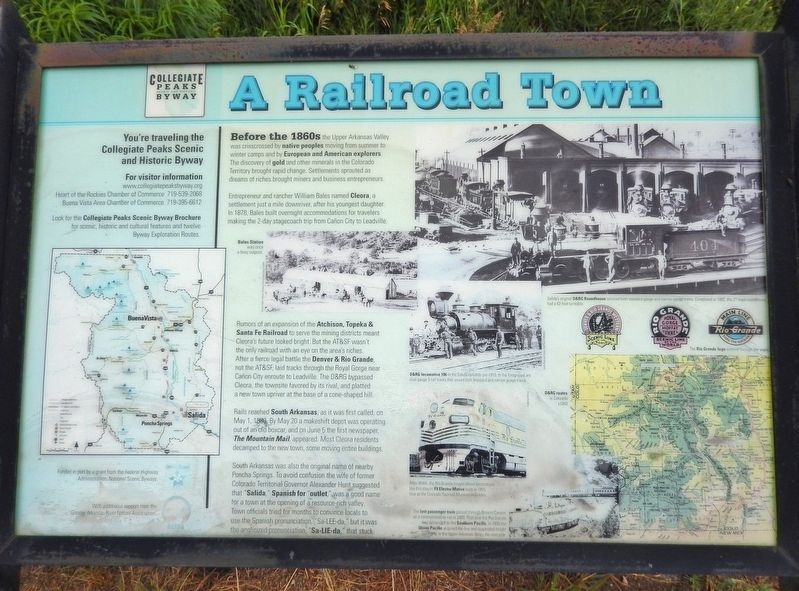
Before the 1860s the Upper Arkansas Valley was crisscrossed by native peoples moving from summer to winter camps and by European and American explorers. The discovery of gold and other minerals in the Colorado Territory brought rapid change. Settlements sprouted as dreams of riches brought miners and business entrepreneurs.
Entrepreneur and rancher William Bales named Cleora, a settlement just a mile downriver, after his youngest daughter. In 1878, Bales built overnight accommodations for travelers making the 2-day stagecoach trip from Cañon City to Leadville.
Rumors of an expansion of the Atchison, Topeka & Santa Fe Railroad to serve the mining districts meant Cleora's future looked bright. But the AT&SF wasn't the only railroad with an eye on the area's riches. After a fierce legal battle the Denver & Rio Grande, not the AT&SF, laid tracks through the Royal Gorge near Cañon City enroute to Leadville. The D&RG bypassed Cleora, the townsite favored by its rival, and platted a new town upriver at the base of a cone-shaped hill.
Rails reached South Arkansas, as it was first called, on May 1, 1880. By May 20 a makeshift depot
this page online
South Arkansas was also the original name of nearby Poncha Springs. To avoid confusion the wife of former Colorado Territorial Governor Alexander Hunt suggested that “Salida,” Spanish for “outlet,” was a good name for a town at the opening of a resource-rich valley. Town officials tried for months to convince locals to use the Spanish pronunciation, “Sa-LEE-da,” but it was the anglicized pronunciation, “Sa-LIE-da,” that stuck.
[photo captions]
• Bales Station was once a busy outpost.
• Salida’s original D&RG Roundhouse serviced both standard-gauge and narrow-gauge trains. Completed in 1882, the 27-track roundhouse had a 62-foot turntable.
• The Rio Grande logo evolved through the years.
• D&RG locomotive 106 in the Salida railyards pre-1915. In the foreground are dual-gauge 3-rail tracks that served both standard and narrow gauge trains.
• D&RG routes in Colorado, c1942
• After WWII, the Rio Grande bought diesel locomotives like this classic F9 Electro Motive built
Photographed by Cosmos Mariner, July 23, 2025
2. A Railroad Town Marker
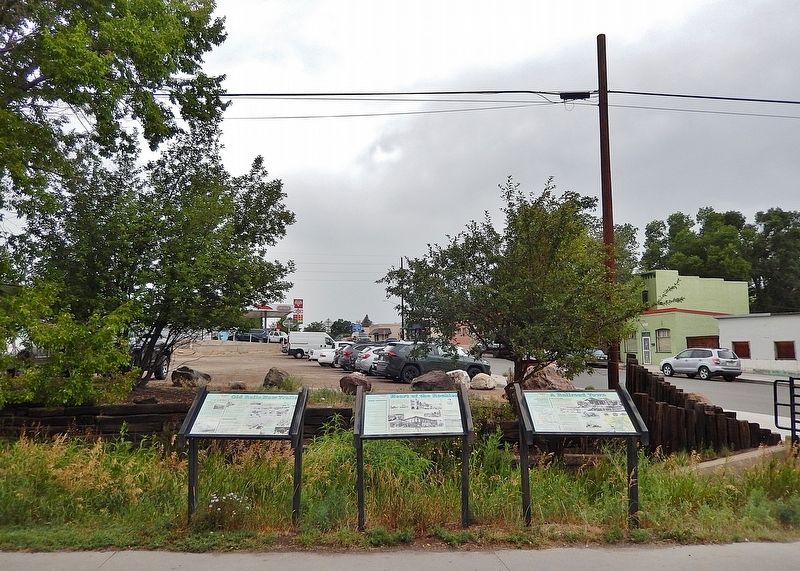
This marker is the rightmost of three related interpretive panels on the north side of the Monarch Spur Trail.
• The last passenger train passed through Browns Canyon on a commemorative run in 1988. That year the Rio Grande was rebranded as the Southern Pacific. In 1996 the Union Pacific acquired the line and suspended freight traffic in the Upper Arkansas Valley the next year.
You’re traveling the Collegiate Peaks Scenic and Historic Byway
For visitor information:
www.colorado.com/byways/collegiate-peaks
Heart of the Rockies Chamber of Commerce
Buena Vista Area Chamber of Commerce
Erected by Federal Highway Administration, National Scenic Byways and Greater Arkansas River Nature Association.
Topics. This historical marker is listed in these topic lists: Industry & Commerce • Railroads & Streetcars • Settlements & Settlers. A significant historical date for this entry is May 1, 1880.
Location. 38° 32.23′ N, 105° 59.6′ W. Marker is in Salida, Colorado, in Chaffee County. It is on West 1st Street (State Highway 291) just north of G Street, on the left when traveling north. The marker is located alongside the Monarch Spur Trail, formerly the D&RGW Monarch Branch line. Touch for map. Marker is in this post office area: Salida CO 81201, United States of America. Touch for directions.

Regionally, this marker is in the Arkansas River Valley, in the Colorado High Rockies and on the Continental Divide. It is also in the American Mountain West. Globally, it is in North America, the Rocky Mountains, the Western Hemisphere, the Western World, and the Anglosphere.
Other nearby markers. At least 8 other markers are within walking distance of this marker: Heart of the Rockies (here, next to this marker); Old Rails New Trails (here, next to this marker); The Salida Steam Plant (about 500 feet away, measured in a direct line); FIBArk: First in Boating on the Arkansas (about 600 feet away); Water Use and Water Rights (about 600 feet away); Chaffee County Honor Roll Board (about 700 feet away); Chaffee County Courthouse (approx. ¼ mile away); Votes for Women (approx. 0.3 miles away). Touch for a list and map of all markers in Salida.
Related markers. Click here for a list of markers that are related to this marker.
Also see . . . Salida, Colorado (Western Mining History).
(includes an excellent photo of the DR&G Roundhouse at Salida, ca. 1890) Excerpt: The railroad began to set up a townsite, and the summer of 1880 brought a building frenzy to the once peaceful valley. Buildings could not be put up fast enough for the arriving townspeople and miners. Gold had been first discovered in Chaffee County back in 1859 in the creeks along the Arkansas River. Placer mining commenced and within the first 10 years, around $400,000 dollars worth of gold had been pulled out of the area. By the end of the 1860s, the placer mines were mostly played out and the miners looking for the quick buck moved on. Some lode mining began in the 1870s, but it would not be until the railroad came through in the 1880s that hard rock mining really started to produce enough to bring a permanent population to the area.(Submitted on February 16, 2026, by Cosmos Mariner of Cape Canaveral, Florida.)Salida was less of a mining camp, and more of a supply point for the agricultural and mining operations in Chaffee County. A railroad roundhouse was built to service the trains, and a 65 foot turntable was added and later replaced by an 80 foot turntable. This became the largest railroad repair facility between Denver and Salt Lake City, employing hundreds of men.
Credits. This page was last revised on February 16, 2026. It was originally submitted on February 13, 2026, by Cosmos Mariner of Cape Canaveral, Florida. This page has been viewed 74 times since then. Photos: 1, 2. submitted on February 16, 2026, by Cosmos Mariner of Cape Canaveral, Florida.
