Oak Ridge in Anderson County, Tennessee — The American South (East South Central)
Integration of Oak Ridge Schools
Moving Forward Together
Photographed by Darren Jefferson Clay, February 14, 2026
1. Integration of Oak Ridge Schools Marker
Inscription.
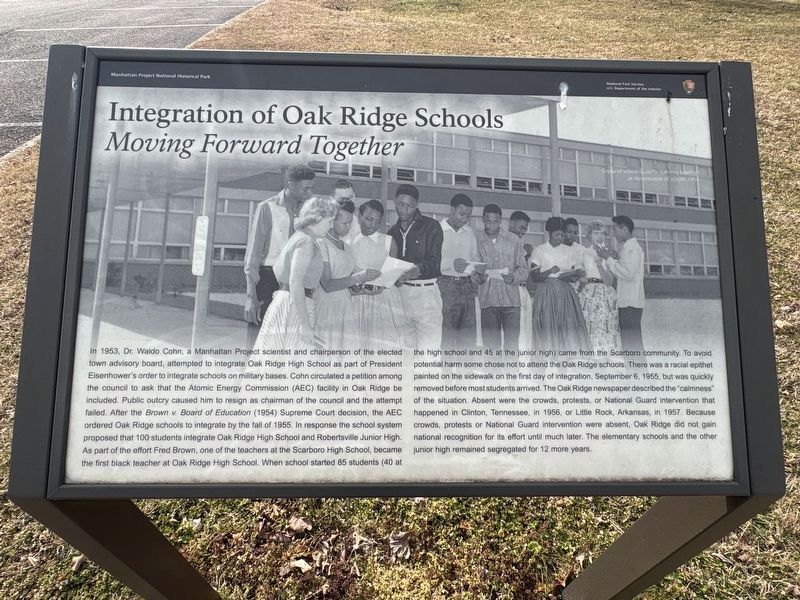
Integration of Oak Ridge Schools. Moving Forward Together. In 1953, Dr. Waldo Cohn, a Manhattan Project scientist and chairperson of the elected town advisory board, attempted to integrate Oak Ridge High School as part of President Eisenhower's order to integrate schools on military bases. Cohn circulated a petition among the council to ask that the Atomic Energy Commission (AEC) facility in Oak Ridge be included. Public outcry caused him to resign as chairman of the council and the attempt failed. After the Brown v. Board of Education (1954) Supreme Court decision, the AEC ordered Oak Ridge schools to integrate by the fall of 1955. In response the school system proposed that 100 students integrate Oak Ridge High School and Robertsville Junior High. As part of the effort Fred Brown, one of the teachers at the Scarboro High School, became the first black teacher at Oak Ridge High School. When school started 85 students (40 at the high school and 45 at the junior high) came from the Scarboro community. To avoid potential harm some chose not to attend the Oak Ridge schools. There was a racial epithet painted on the sidewalk on the first day of integration, September 6, 1955, but was quickly removed before most students arrived. The Oak Ridge newspaper described the "calmness" of the situation. Absent were the crowds, protests, or National Guard intervention that happened in Clinton, Tennessee, in 1956, or Little Rock, Arkansas, in 1957. Because crowds, protests or National Guard intervention were absent, Oak Ridge did not gain national recognition for its effort until much later. The elementary schools and the other junior high remained segregated for 12 more years., [Captions] , Group of school students standing together at the entrance to the school, 1955
In 1953, Dr. Waldo Cohn, a Manhattan Project scientist and chairperson of the elected
town advisory board, attempted to integrate Oak Ridge High School as part of President
Eisenhower's order to integrate schools on military bases. Cohn circulated a petition among
the council to ask that the Atomic Energy Commission (AEC) facility in Oak Ridge be
included. Public outcry caused him to resign as chairman of the council and the attempt
failed. After the Brown v. Board of Education (1954) Supreme Court decision, the AEC
ordered Oak Ridge schools to integrate by the fall of 1955. In response the school system
proposed that 100 students integrate Oak Ridge High School and Robertsville Junior High.
As part of the effort Fred Brown, one of the teachers at the Scarboro High School, became
the first black teacher at Oak Ridge High School. When school started 85 students (40 at
the high school and 45 at the junior high) came from the Scarboro community. To avoid
potential harm some chose not to attend the Oak Ridge schools. There was a racial epithet
painted on the sidewalk on the first day of integration, September 6, 1955, but was quickly
removed before most students arrived. The Oak Ridge newspaper described the "calmness"
of the situation. Absent were the crowds, protests, or National Guard intervention that
happened in
Click or scan to see this page online
Clinton, Tennessee, in 1956, or Little Rock, Arkansas, in 1957. Because
crowds, protests or National Guard intervention were absent, Oak Ridge did not gain
national recognition for its effort until much later. The elementary schools and the other
junior high remained segregated for 12 more years.
[Captions]
Group of school students standing together at the entrance to the school, 1955
Erected by Manhattan Project National Historical Park, National Park Service, Department of the Interior.
Topics. This historical marker is listed in these topic lists: African Americans • Education • War, World II. A significant historical date for this entry is September 6, 1955.
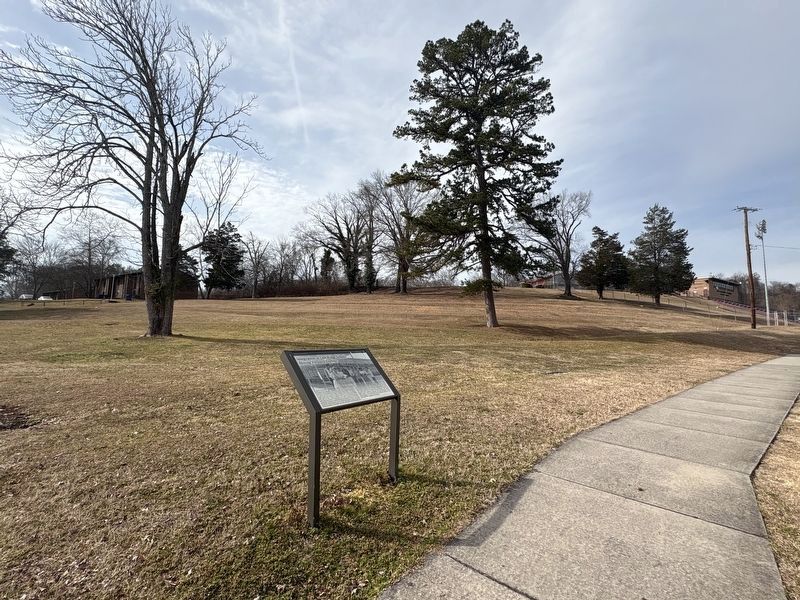
Location. 36° 1.804′ N, 84° 14.378′ W. Marker is in Oak Ridge, Tennessee, in Anderson County. It is at the intersection of Broadway Ave and Towne Road, on the left when traveling east on Broadway Ave. Touch for map. Marker is in this post office area: Oak Ridge TN 37830, United States of America. Touch for directions.
Regionally, this marker is in East Tennessee and in Greater Knoxville. It is also in the American South, specifically in the Upper South, in Appalachia, and specifically in Southern Appalachia. Globally, it is in North America, the Western Hemisphere, the Western World, and the Anglosphere. Historically, it finds itself in what was once the original Cherokee Nation, the territory of the Mississippian Culture, one of the Confederate States of America, and the Antebellum South.
Other nearby markers. At least 8 other markers are within walking distance of this marker: Historic Oak Ridge Playhouse (within shouting distance of this marker); Jackson Square (about 300 feet away, measured in a direct line); The Guest House (about 600 feet away); From Little Boy to Big Fun (about 600 feet away); a different marker
Photographed by Darren Jefferson Clay, February 14, 2026
Credits. This page was last revised on February 17, 2026. It was originally submitted on February 16, 2026, by Darren Jefferson Clay of Duluth, Georgia. This page has been viewed 54 times since then. Photos:1, 2. submitted on February 16, 2026, by Darren Jefferson Clay of Duluth, Georgia. • James Hulse was the editor who published this page.

