Downtown West in Minneapolis in Hennepin County, Minnesota — The American Midwest (Upper Plains)
Welcome to the Rail Maze
Photographed by McGhiever, September 29, 2024
1. Welcome to the Rail Maze Marker
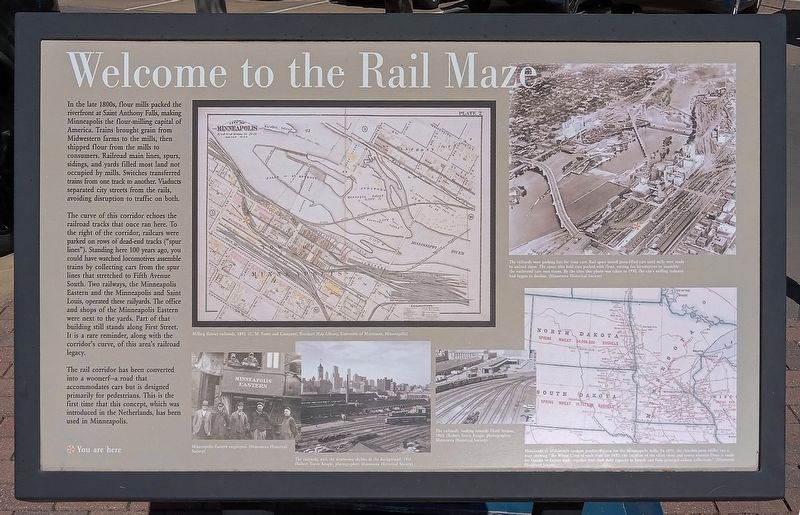
In the late 1800s, flour mills packed the riverfront at Saint Anthony Falls, making Minneapolis the flour-milling capital of America. Trains brought grain from Midwestern farms to the mills, then shipped flour from the mills to consumers. Railroad main lines, spurs, sidings, and yards filled most land not occupied by mills. Switches transferred trains from one track to another. Viaducts separated city streets from the rails, avoiding disruption to traffic on both.
The curve of this corridor echoes the railroad tracks that once ran here. To the right of the corridors, railcars were parked on rows of dead-end tracks ("spur lines"). Standing here 100 years ago, you could have watched locomotives assemble trains by collecting cars from the spur lines that stretched to Fifth Avenue South. Two railways, the Minneapolis Eastern and the Minneapolis and Saint Louis, operated these railyards. The office and shops of the Minneapolis Eastern were next to the yards. Part of that building still stands along First Street. It is a rare reminder, along with the corridor's curve, of this area's railroad legacy.
The rail corridor
this page online
Milling district railroads, 1892. (C. M. Foote and Company; Borchert Map Library, University of Minnesota, Minneapolis)
Minneapolis Eastern employees. (Minnesota Historical Society)
The railyards, with the downtown skyline in the background, 1961. (Robert Travis Keagle, photographer; Minnesota Historical Society)
The railyards, looking towards Third Avenue, 1960. (Robert Travis Keagle, photographer; Minnesota Historical Society)
The railyards were parking lots for train cars. Rail spurs stored grain-filled cars until mills were ready to unload them. The spurs also held cars packed with flour, waiting for locomotives to assemble the outbound cars into trains. By the time this photo was taken in 1930, the city's milling industry had begun to decline. (Minnesota Historical Society)
Thousands of Midwestern farmers produced grain for the Minneapolis mills. In 1893, the Northwestern Miller ran a map showing "the Wheat City of each State for 1892; the location of the chief cities and towns wherein Flour is made for Eastern or Export trade; together with their daily capacity in barrels and their principal railway connections." (Minnesota Historical Society)
Topics.
Photographed by McGhiever, September 29, 2024
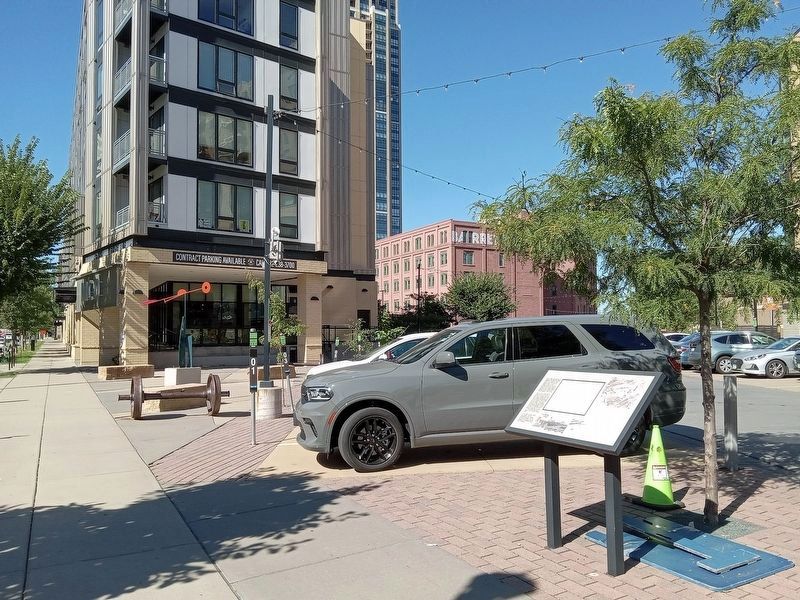
2. Welcome to the Rail Maze Marker at the entrance to the 300 S. 2nd St. Parking
Location. 44° 58.828′ N, 93° 15.695′ W. Marker is in Minneapolis, Minnesota, in Hennepin County. It is in Downtown West. It is at the intersection of S. 2nd Street and the 300 S. 2nd St. Parking, on the right when traveling west on S. 2nd Street. Touch for map. Marker is at or near this postal address: 300 S 2nd Street, Minneapolis MN 55401, United States of America. Touch for directions.

Regionally, this marker is in the Twin Cities Metropolitan Area. It is also in the American Midwest, in the Corn Belt, and in the Great River Road Region. Globally, it is in North America, the Western Hemisphere, the Western World, and the Anglosphere. Historically, it finds itself in what was once Rupert’s Land, the territory of the Mississippian Culture, and the Louisiana Purchase.
Other nearby markers. At least 8 other markers are within walking distance of this marker: Changing Times (a few steps from this marker); Trains Can't Swim (within shouting distance of this marker); A Little Railroad with a Long History (within shouting distance of this marker); Barrels / Bags / Bust / and Beyond (within shouting distance of this marker); The Washburn and Pillsbury Clans (about 500 feet away, measured in a direct line); The Resurrection of Washington Avenue (about 500 feet away); The Decline of Washington Avenue (about 500 feet away); Transportation on Washington Avenue (about 500 feet away). Touch for a list and map of all markers in Minneapolis.
Credits. This page was last revised on March 1, 2026. It was originally submitted on February 16, 2026, by McGhiever of Minneapolis, Minnesota. This page has been viewed 51 times since then. Photos: 1, 2. submitted on February 16, 2026, by McGhiever of Minneapolis, Minnesota.
