Città Antica in Verona in Provincia di Verona, Venetia, Italy — Southern and Western Europe (Mediterranean)
Duomo di Santa Maria Matricolare (secolo XII) ⎯⎯⎯ Cathedral of Santa Maria Matricolare (12th century)
Photographed by James Hulse, June 11, 2025
1. Duomo di Santa Maria Matricolare (secolo XII) / Cathedral of Santa Maria Matricolare (12th century)
Inscription. Italian:
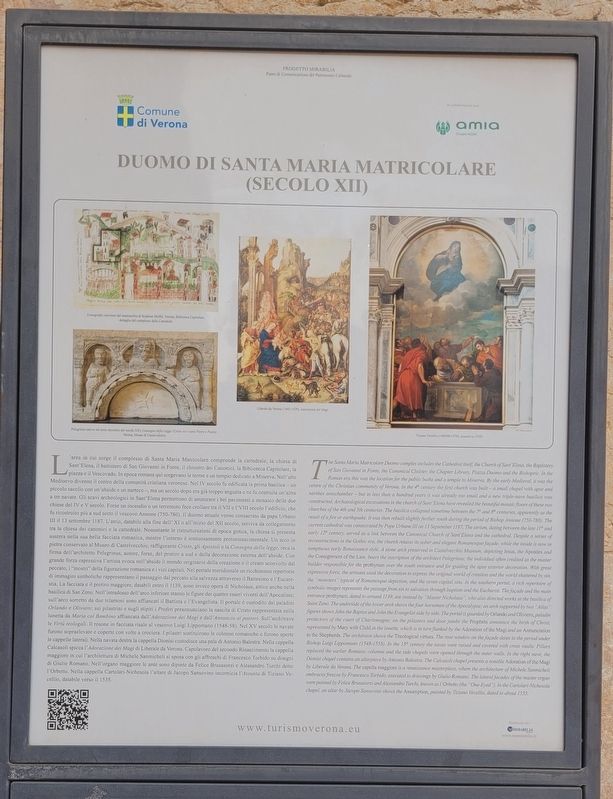
L'area in cui sorge il complesso di Santa Maria Matricolare comprende la cattedrale, la chiesa di Sant'Elena, il battistero di San Giovanni in Fonte, il chiostro dei Canonici, la Biblioteca Capitolare, la piazza e il Vescovado. In epoca romana qui sorgevano le terme e un tempio dedicato a Minerva. Nell'alto Medioevo divenne il centro della comunità cristiana veronese. Nel IV secolo fu edificata la prima basilica - un piccolo sacello con un'abside e un nartece, ma un secolo dopo era già troppo angusta e ne fu costruita un'altra a tre navate. Gli scavi archeologici in Sant'Elena permettono di ammirare i bei pavimenti a mosaico delle due chiese del IV e V secolo. Forse un incendio o un terremoto fece crollare tra il VII e l'VIII secolo l'edificio, che fu ricostruito più a sud sotto il vescovo Annone (750-780). Il duomo attuale venne consacrato da papa Urbano III il 13 settembre 1187. L'atrio, databile alla fine dell'XI o all'inizio del XII secolo, serviva da collegamento tra la chiesa dei canonici e la cattedrale. Nonostante le ristrutturazioni di epoca gotica, la chiesa si presenta austera nella sua bella
Click or scan to see this page online
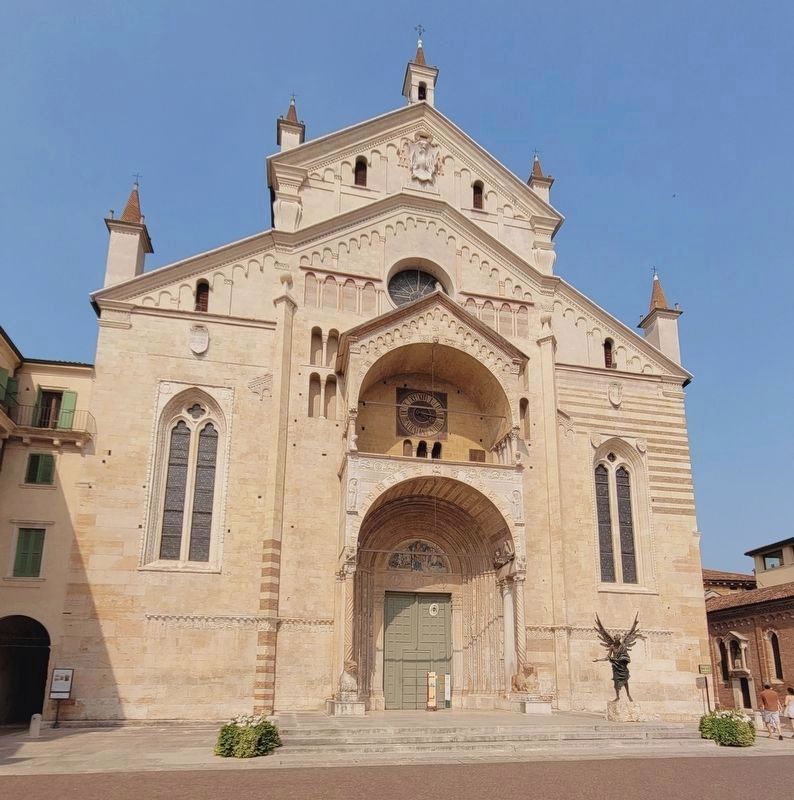
facciata romanica, mentre l'interno è sontuosamente protorinascimentale. Un arco in pietra conservato al Museo di Castelvecchio, raffigurante Cristo, gli Apostoli e la Consegna della legge, reca la firma dell'architetto Pelegrinus, autore, forse, del protiro a sud e della decorazione esterna dell'abside. Con grande forza espressiva l'artista evoca nell'abside il mondo originario della creazione e il creato sconvolto dal peccato, i "mostri" della figurazione romanica e i vizi capitali. Nel portale meridionale un ricchissimo repertorio di immagini simboliche rappresentano il passaggio dal peccato alla salvezza attraverso il Battesimo e l'Eucarestia. La facciata e il protiro maggiore, databili entro il 1139, sono invece opera di Nicholaus, attivo anche nella basilica di San Zeno. Nell'intradosso dell'arco inferiore stanno le figure dei quattro esseri viventi dell'Apocalisse; sull'arco sorretto da due telamoni sono affiancati il Battista e l'Evangelista. Il portale è custodito dai paladini Orlando e Oliviero; sui pilastrini e sugli stipiti i Profeti preannunciano la nascita di Cristo rappresentata nella lunetta da Maria col Bambino affiancata
Photographed by James Hulse, June 11, 2025
2. Cathedral of Santa Maria Matricolare (12th century) and Marker
The marker is located at the front of the church at the far left in the photo.
dall'Adorazione dei Magi e dall'Annuncio ai pastori. Sull'architrave le Virtù teologali. Il rosone in facciata risale al vescovo Luigi Lippomano (1548-58). Nel XV secolo le navate furono sopraelevate e coperte con volte a crociera. I pilastri sostituirono le colonne romaniche e furono aperte le cappelle laterali. Nella navata destra la cappella Dionisi custodisce una pala di Antonio Balestra. Nella cappella Calcasoli spicca l'Adorazione dei Magi di Liberale da Verona. Capolavoro del secondo Rinascimento la cappella maggiore in cui l'architettura di Michele Sanmicheli si sposa con gli affreschi di Francesco Torbido su disegni di Giulio Romano. Nell'organo maggiore le ante sono dipinte da Felice Brusasorzi e Alessandro Turchi detto l'Orbetto. Nella cappella Cartolari-Nichesola l'altare di Jacopo Sansovino incornicia l'Assunta di Tiziano Vecellio, databile verso il 1535.
Didascalie (Foto #1) Iconografia rateriana dal manoscritto di Scipione Maffei. Verona, Biblioteca Capitolare, dettaglio del complesso della Cattedrale (Foto #2) Pelegrinus (attivo nel terzo decennio del secolo XII), Consegna delle Legge (Cristo tra i santi Pietro e Paolo). Verona, Museo di Castelvecchio (Foto #3) Liberale da Verno (1445-1529), Adorazione dei Magi (Foto #4) Tiziano Vecellio (1480/90-1576), Assunta (c. 1535)
English:
The
Photographed by James Hulse, June 11, 2025
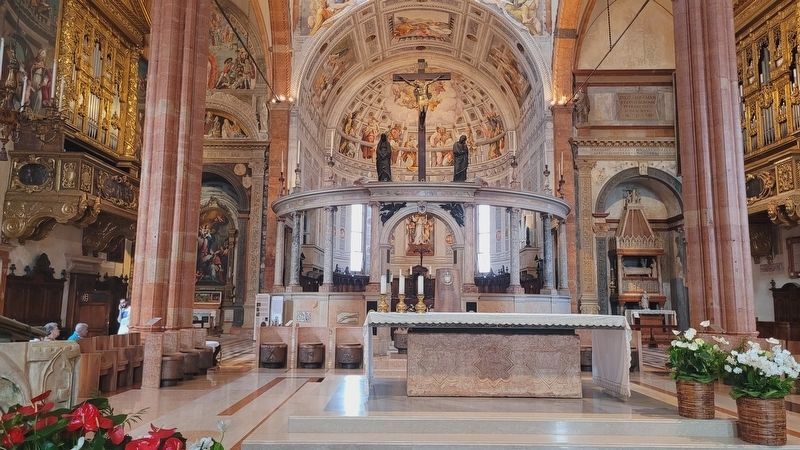
3. Cathedral of Santa Maria Matricolare (12th century)
The view of the interior alter of the church.
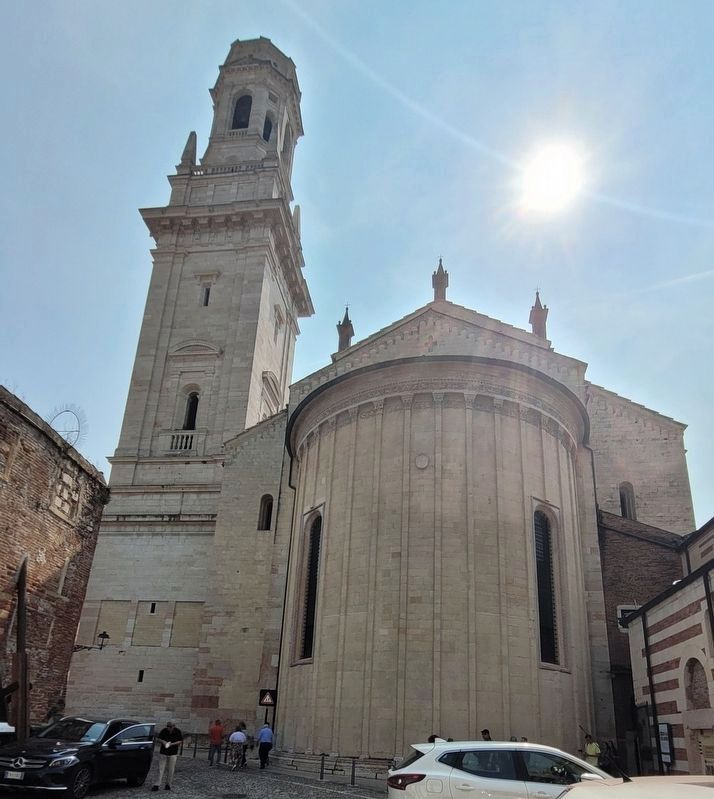
Santa Maria Matricolare Duomo complex includes the Cathedral itself, the Church of Sant'Elena, the Baptistery of San Giovanni in Fonte, the Canonical Cloister, the Chapter Library, Piazza Duomo and the Bishopric. In the Roman era this was the location for the public baths and a temple to Minerva. By the early Medieval, it was the centre of the Christian community of Verona. In the 4th century the first church was built a small chapel with apse and narthex antechamber - but in less than a hundred years it was already too small and a new triple - nave basilica was constructed. Archaeological excavations in the church of Sant'Elena have revealed the beautiful mosaic floors of these two churches of the 4th and 5th centuries. The basilica collapsed sometime between the 7th and 8th centuries, apparently as the result of a fire or earthquake. It was then rebuilt slightly further south during the period of Bishop Annone (750-780). The current cathedral was consecrated by Pope Urbane III on 13 September 1187. The atrium, dating between the late 11th and early 12th century, served as a link between the Canonical Church of Sant'Elena and the cathedral.
Photographed by James Hulse, June 11, 2025
4. Cathedral of Santa Maria Matricolare (12th century) Marker
The tower side or backside of the church.
Despite a series of reconstructions in the Gothic era, the church retains its sober and elegant Romanesque façade, while the inside is now in sumptuous early Renaissance style. A stone arch preserved in Castelvecchio Museum, depicting Jesus, the Apostles and the Consignment of the Law, bears the inscription of the architect Pelegrinus: the individual often credited as the master builder responsible for the prothyrum over the south entrance and for guiding the apse exterior decoration. With great expressive force, the artisans used the decoration to express the original world of creation and the world shattered by sin, the "monsters" typical of Romanesque depiction, and the seven capital sins. In the southern portal, a rich repertoire of symbolic images represents the passage from sin to salvation through baptism and the Eucharist. The façade and the main entrance prothyrum, dated to around 1139, are instead by "Master Nicholaus", who also directed works at the basilica of Saint Zeno. The underside of the lower arch shows the four horsemen of the Apocalypse; an arch supported by two "Atlas" figures shows John the Baptist and John the
Photographed by James Hulse, June 11, 2025
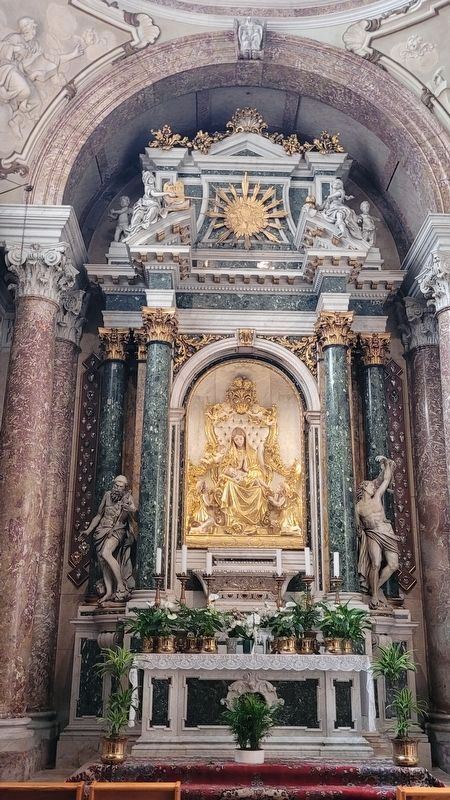
5. The statue of the "Madonna with Child"
Evangelist side by side. The portal is guarded by Orlando and Oliviero, paladin protectors of the court of Charlemagne, on the pilasters and door jambs the Prophets announce the birth of Christ, represented by Mary with Child in the lunette, which is in turn flanked by the Adoration of the Magi and an Annunciation to the Shepherds. The architrave shows the Theological virtues. The rose window on the façade dates to the period under Bishop Luigi Lippomano (1548-1558). In the 15th century the naves were raised and covered with cross vaults. Pillars replaced the earlier Romanic columns and the side chapels were opened through the outer walls. In the right nave, the Dionisi chapel contains an altarpiece by Antonio Balestra. The Calcasoli chapel presents a notable Adoration of the Magi by Liberale da Verona. The capella maggiore is a renaissance masterpiece, where the architecture of Michele Sanmicheli embraces frescos by Francesco Torbido, executed to drawings by Giulio Romano. The lateral facades of the master organ were painted by Felice Brusasorzi and Alessandro Turchi, known as l'Orbetto (the "One-Eyed"). In the Cartolari-Nichesola chapel, an altar by Jacopo Sansovino shows the Assumption, painted by Tiziano Vecellio, dated to about 1535.
Captions (Photo #1) Raterian Iconography from the manuscript of Scipione Maffei. Verona, Biblioteca Capitolare di Verona, detail of the cathedral complex. (Photo #2) Pelegrinus (active in the third decade of the 12th century), Giving of the Law (Christ between Saints Peter and Paul). Verona, Castelvecchio Museum. (Photo #3) Liberale da Verona (1445–1529), Adoration of the Magi (Photo #4) Tiziano Vecellio (1480/90–1576), Assumption (c. 1535)
Erected by Comune di Verona, Progetto Mirabilia Piana di Camimicazione del Patrimonio Culturale and amia.
Topics. This historical
Photographed by James Hulse, June 11, 2025
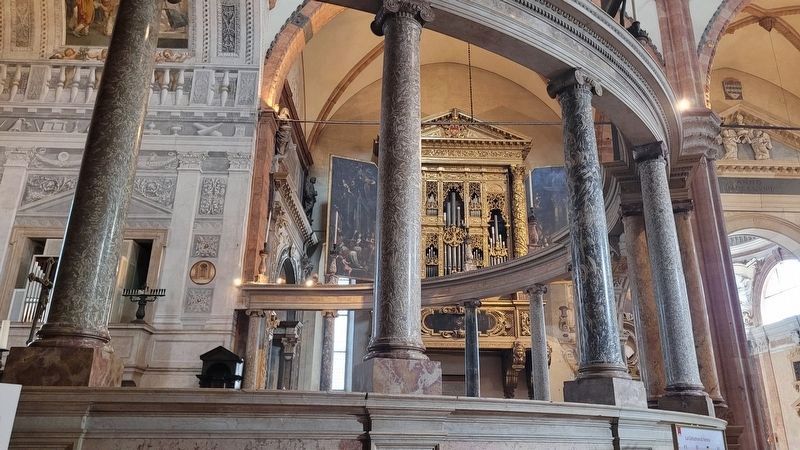
6. The large organ mounted along the interior wall of the church
marker is listed in this topic list: Religion & Religious Structures. A significant day of the year for for this entry is September 13.
Location. 45° 26.83′ N, 10° 59.795′ E. Marker is in Verona, Veneto (Venetia), in Provincia di Verona. It is in Città Antica. It is at the intersection of Piazza Duomo and Piazza Vescovado on Piazza Duomo. Touch for map. Marker is at or near this postal address: Piazza Duomo 34, Verona, Veneto 37121, Italy. Touch for directions.
Regionally, it is in Europe, the European Union, the Schengen Area, a coastal Mediterranean country, and the Western World. Historically, it finds itself in what was once the Roman Empire and specifically also the Holy Roman Empire.
Credits. This page was last revised on February 17, 2026. It was originally submitted on February 16, 2026, by James Hulse of Medina, Texas. This page has been viewed 38 times since then. Photos:1, 2, 3, 4, 5, 6. submitted on February 17, 2026, by James Hulse of Medina, Texas.