
Città Antica in Verona in Provincia di Verona, Venetia, Italy — Southern and Western Europe (Mediterranean)
La Porta Borsari
⎯⎯⎯
The Borsari Gate
Photographed by James Hulse, June 11, 2025
1. La Porta Borsari / The Borsari Gate Marker

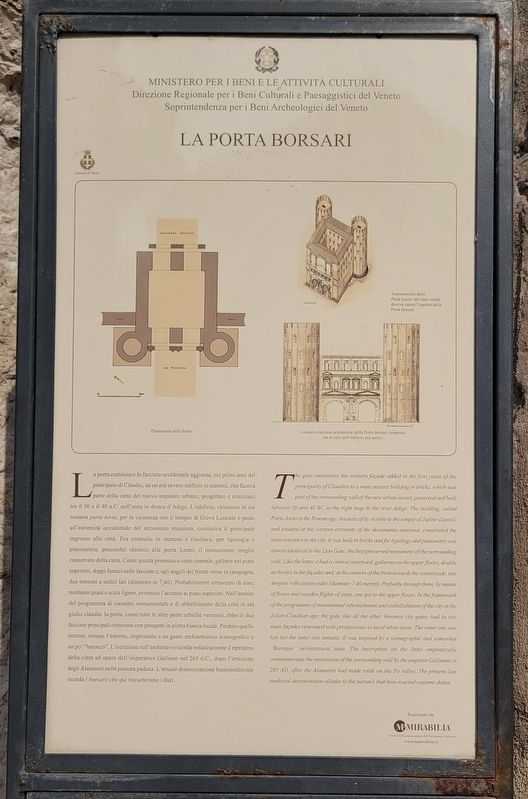
La porta costituisce la facciata occidentale aggiunta, nei primi anni del principato di Claudio, ad un più severo edificio in mattoni, che faceva parte della cinta del nuovo impianto urbano, progettato e realizzato tra il 50 e il 40 a.C. nell'ansa in destra d'Adige. L'edificio, chiamato in età romana porta lovia, per la vicinanza con il tempio di Giove Lustrale e posto all'estremità occidentale del decumano massimo, costituiva il principale ingresso alla città. Era costruito in mattoni e risultava, per tipologia e planimetria, pressoché identico alla porta Leoni, il monumento meglio conservato della cinta. Come questa presentava corte centrale, gallerie nei piani superiori, doppi fornici nelle facciate e, agli angoli del fronte verso la campagna, due torrioni a sedici lati (diametro m 7,40). Probabilmente attraverso di esse, mediante piani e scale lignee, avveniva l'accesso ai piani superiori. Nell'ambito del programma di riassetto monumentale e di abbellimento della città in età giulio claudia, la porta, come tutte le altre porte urbiche veronesi, ebbe le due facciate principali rinnovate con prospetti in pietra bianca locale. Perduto quello interno, rimane l'esterno, improntato a un gusto architettonico scenografico e un po' "barocco". L'iscrizione sull'architrave ricorda enfaticamente il ripristino della cinta ad opera dell'imperatore Gallieno nel 265 d.C., dopo l'irruzione degli Alamanni nella pianura padana. L'attuale denominazione bassomedievale ricorda i bursarii che qui riscuotevano i dazi.
Didascalie
(Foto #1) Planimetria della Porta
(Foto #2) Assonometria della Porta Leoni: del tutto simile doveva essere l'aspetto della Porta Borsari
(Foto #3) La nuova facciata occidentale della Porta Borsari compresa tra le torri dell'edificio più antico
The gate constitutes the western façade added in the first years of the principality of Claudius to a more austere building in bricks, which was part of the surrounding wall of the new urban layout, projected and built between 50 and 40 BC in the right loop in the river Adige. The building, called Porta Jovia in the Roman age, because of its vicinity to the temple of Jupiter Lustral, and situated at the western extremity of the decumanus maximus, constituted the main entrance to the city. It was built in bricks and for typology and planimetry was almost identical to the Lion Gate, the best preserved monument of the surrounding wall. Like the latter it had a central courtyard, galleries on the upper floors, double archways in the façades and, at the corners of the front towards the countryside, two donjons with sixteen sides (diameter 7.40 metres), Probably through them, by means of floors and wooden flights of steps, one got to the upper floors. In the framework of the programme of monumental refurbishment and embellishment of the city in the Julian-Claudian age, the gate, like all the other Veronese city gates, had its two main façades renovated with prospectuses in local white stone. The inner one was lost but the outer one remains. It was inspired by a scenographic and somewhat "Baroque" architectural taste. The inscription on the lintel emphatically commemorates the restoration of the surrounding wall by the emperor Gallienus in 265 AD, after the Alamanni had made raids on the Po valley. The present late medieval denomination alludes to the bursarii that here exacted customs duties.
Captions
(Photo #1) Plan of the Gate
(Photo #2) Axonometric view of Porta Leoni: the appearance of Porta Borsari must have been entirely similar.
(Photo #3) The new western façade of Porta Borsari, enclosed between the towers of the older structure.
Erected by Ministry
this page online
Topics. This historical marker is listed in this topic list: Forts and Castles.
Location. 45° 26.515′ N, 10° 59.608′ E. Marker is in Verona, Veneto (Venetia), in Provincia di Verona. It is in Città Antica. It is at the intersection of Corso Porta Borsari and Via Armando Diaz, on the right when traveling east on Corso Porta Borsari. Touch for map. Marker is at or near this postal address: Corso Porta Borsari 57A, Verona, Veneto 37121, Italy. Touch for directions.

Regionally, it is in Europe, the European Union, the Schengen Area, a coastal Mediterranean country, and the Western World. Historically, it finds itself in what was once the Roman Empire and specifically also the Holy Roman Empire.
Other nearby markers. At least 8 other markers are within walking distance of this marker: Chiesa di San Giovanni in Foro (secoli X–XII) / Church of San Giovanni in Foro (10th–12th centuries) (about 180 meters away, measured in a
Photographed by James Hulse, June 11, 2025
2. La Porta Borsari / The Borsari Gate Marker
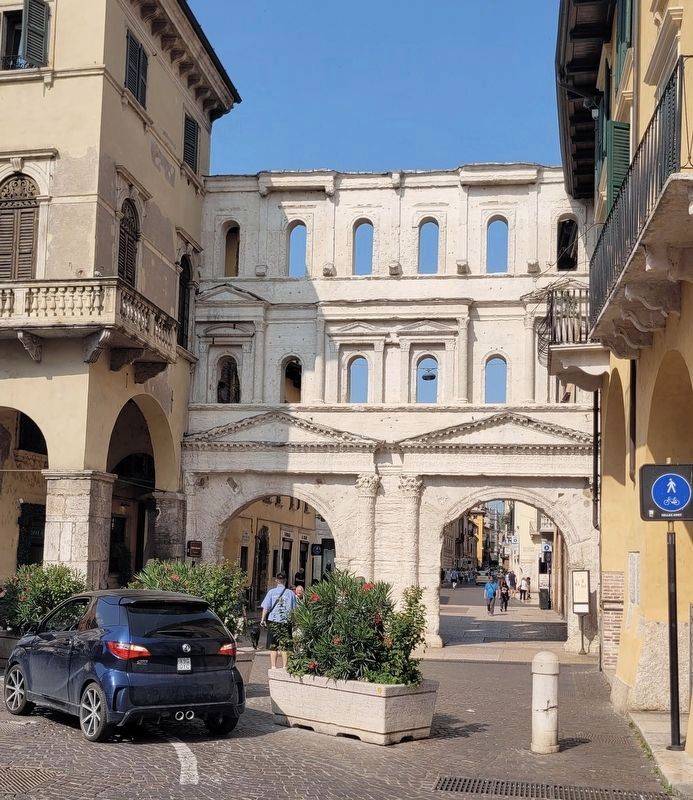
The view of the front of the Borsari Gate with the marker.
Photographed by James Hulse, June 11, 2025
3. La Porta Borsari / The Borsari Gate Marker
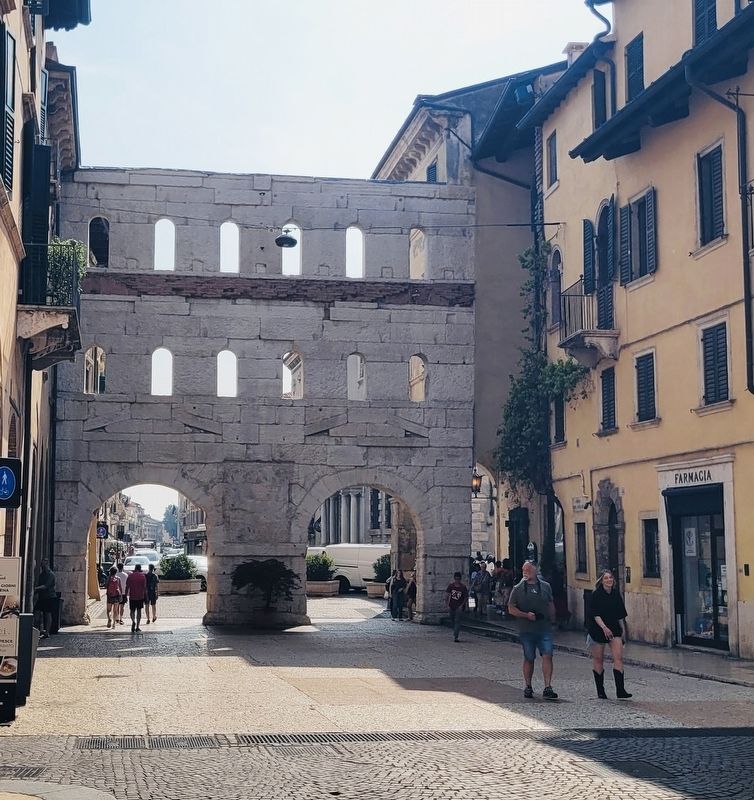
The reverse view of the Borsari Gate.
Credits. This page was last revised on February 18, 2026. It was originally submitted on February 16, 2026, by James Hulse of Medina, Texas. This page has been viewed 38 times since then. Photos: 1, 2, 3. submitted on February 18, 2026, by James Hulse of Medina, Texas.
