Grinnell in Poweshiek County, Iowa — The American Midwest (Upper Plains)
Historic Buildings
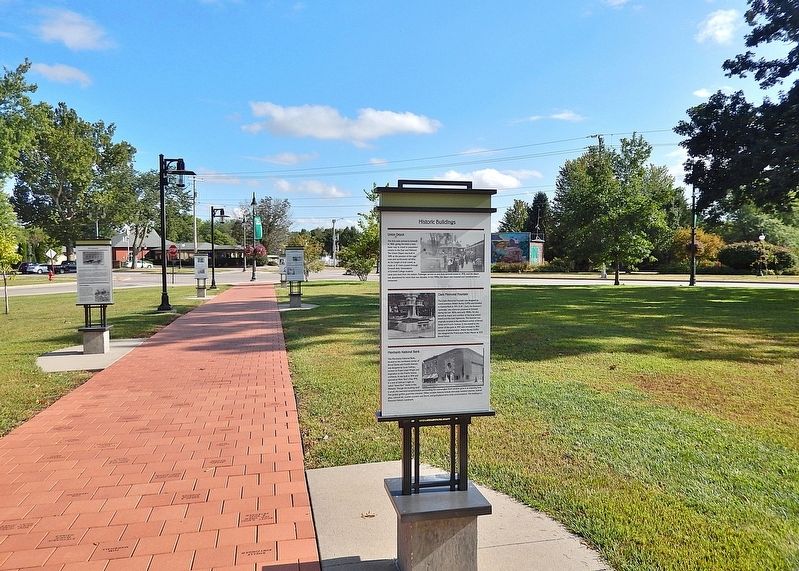
Photographed by Cosmos Mariner, September 19, 2025
1. Historic Buildings Marker
Union Depot
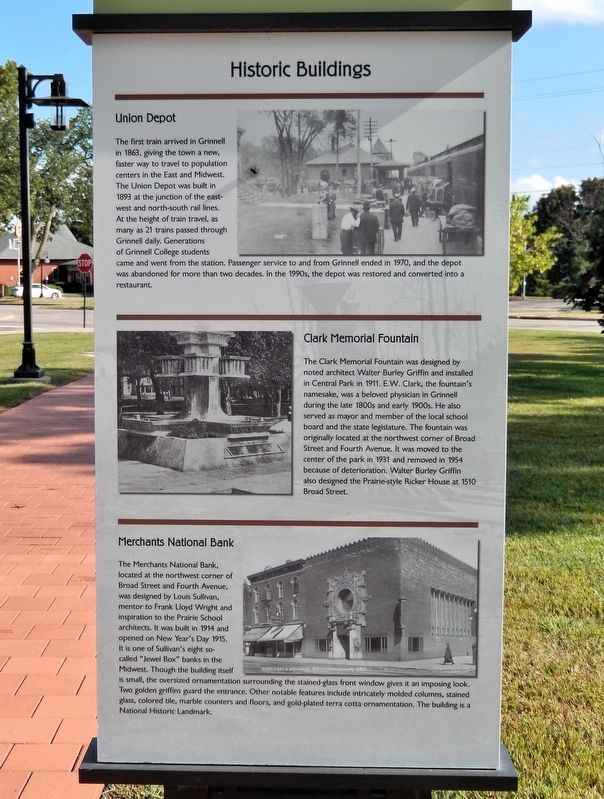
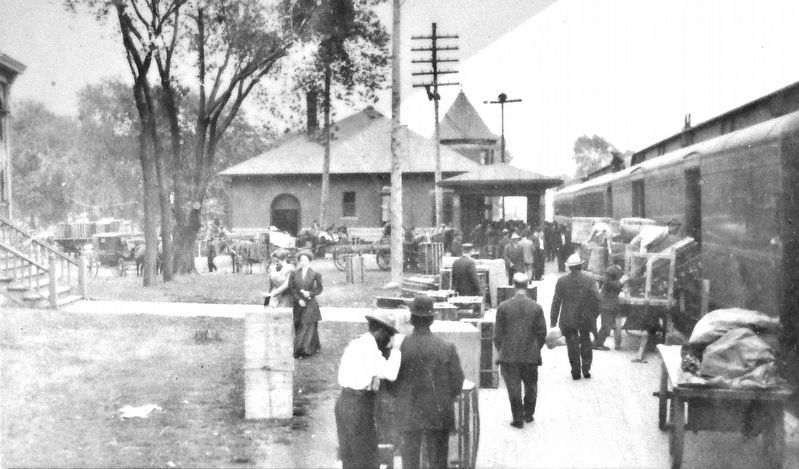
The first train arrived in Grinnell in 1863. giving the town a new, faster way to travel to population centers in the East and Midwest. The Union Depot was built in 1893 at the junction of the east-west and north-south rail lines. At the height of train travel, as many as 21 trains passed through Grinnell daily. Generations of Grinnell College students came and went from the station. Passenger service to and from Grinnell ended in 1970, and the depot was abandoned for more than two decades. In the 1990s, the depot was restored and converted into a restaurant.
Clark Memorial Fountain
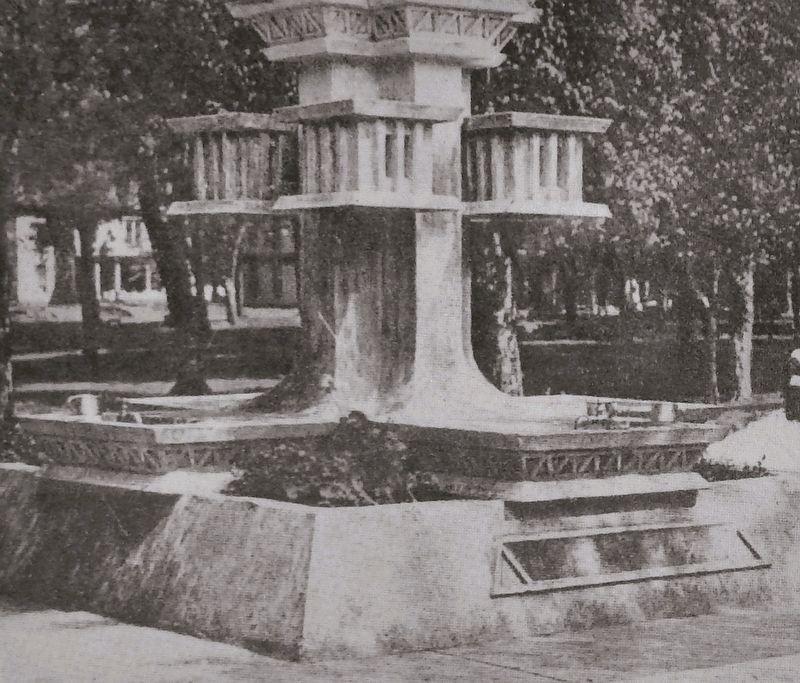
The Clark Memorial Fountain was designed by noted architect Walter Burley Griffin and installed in Central Park in 1911. E.W. Clark, the fountain's namesake, was a beloved physician in Grinnell during the late 1800s and early 1900s. He also served as mayor and member of the local school board and the state legislature. The fountain was originally located at the northwest corner of Broad Street and Fourth Avenue. It was moved to the center of the park in 1931 and removed in 1954 because of deterioration. Walter Burley Griffin also designed
this page online
Merchants National Bank
The Merchants National Bank, located at the northwest corner of Broad Street and Fourth Avenue, was designed by Louis Sullivan, mentor to Frank Lloyd Wright and inspiration to the Prairie School architects. It was built in 1914 and opened on New Year's Day 1915. It is one of Sullivan's eight so-called "Jewel Box" banks in the Midwest. Though the building Itself is small, the oversized ornamentation surrounding the stained-glass front window gives it an imposing look. Two golden griffins guard the entrance. Other notable features Include intricately molded columns, stained glass, colored tile, marble counters and floors, and gold-plated terra cotta ornamentation. The building is a National Historic Landmark.
Topics. This historical marker is listed in these topic lists: Architecture • Industry & Commerce • Railroads & Streetcars.
Location. 41° 44.531′ N, 92° 43.379′ W. Marker is in Grinnell, Iowa, in Poweshiek County. It is at the intersection of 3rd Avenue and Park Street, on the left when traveling
2. Marker detail: Union Depot

Regionally, this marker is in Eastern Iowa. It is also in the American Midwest and in the Corn Belt. Globally, it is in North America, the Western Hemisphere, the Western World, and the Anglosphere. Historically, it finds itself in what was once the territory of the Mississippian Culture and also the Louisiana Purchase.
Other nearby markers. At least 8 other markers are within walking distance of this marker: Notable Grinnellians (here, next to this marker); First Businesses (a few steps from this marker); Grinnell College (a few steps from this marker); a different marker also named Notable Grinnellians (a few steps from this marker); a different marker also named Notable Grinnellians (a few steps from this marker); J. B. Grinnell (a few steps from this marker); Founding of Grinnell (a few steps from this marker); a different marker also named Notable Grinnellians (within shouting
September 19, 2025
3. Marker detail: Clark Memorial Fountain
Related markers. Click here for a list of markers that are related to this marker.
Also see . . .
1. Union Depot (Wikipedia).
Excerpt: The Chicago, Rock Island & Pacific Railroad built the first tracks through the area in 1863, and they built a simple frame depot the same year. The Central Railroad of Iowa extended its north–south line to Grinnell nine years later, and their tracks crossed the Rock Island tracks at this location. The Minneapolis and St. Louis Railway eventually acquired the Central Railroad. The old depot became too small and this one replaced it in 1893. It was designed by the Rock Island Lines and built by a local contractor. The one-story, brick structure follows a square plan with a round corner tower at the junction of the two tracks. The tower provided the station agent with a clear view in all directions. Service included the CRI&P's Corn Belt Rocket and Rocky Mountain Rocket passenger lines. Service ended on May 31, 1970. The building now houses a restaurant. It was listed on the National Register of Historic(Submitted on February 19, 2026, by Cosmos Mariner of Cape Canaveral, Florida.)Places in 1976.Photographed by Cosmos Mariner, September 19, 20254. Historic Buildings MarkerLooking southeast through Central Park.
2. Merchants' National Bank (Wikipedia).
Excerpt: Built in 1914, it is one of a series of small banks designed by Louis Sullivan in the Midwest between 1909 and 1919. All of the banks are built of brick and for this structure he employed various shades of brick, ranging in color from blue-black to golden brown, giving it an overall reddish-brown appearance. It was declared a National Historic Landmark in 1976 for its architecture. In 1991, it was listed as a contributing property to the Grinnell Historic Commercial District.(Submitted on February 19, 2026, by Cosmos Mariner of Cape Canaveral, Florida.)
The unveiling of this Louis Sullivan building was given national coverage in the architectural press of the day. The Merchants' Bank was featured in an eleven-page spread in The Western Architect's February 1916 edition. As he did in his banks in Cedar Rapids and Sidney, Ohio, Sullivan used lions, or at least a grotesque, winged version of a lion, as figurative decoration.
3. Clark Memorial Fountain (facebook). (Submitted on February 19, 2026, by Cosmos Mariner of Cape Canaveral, Florida.)
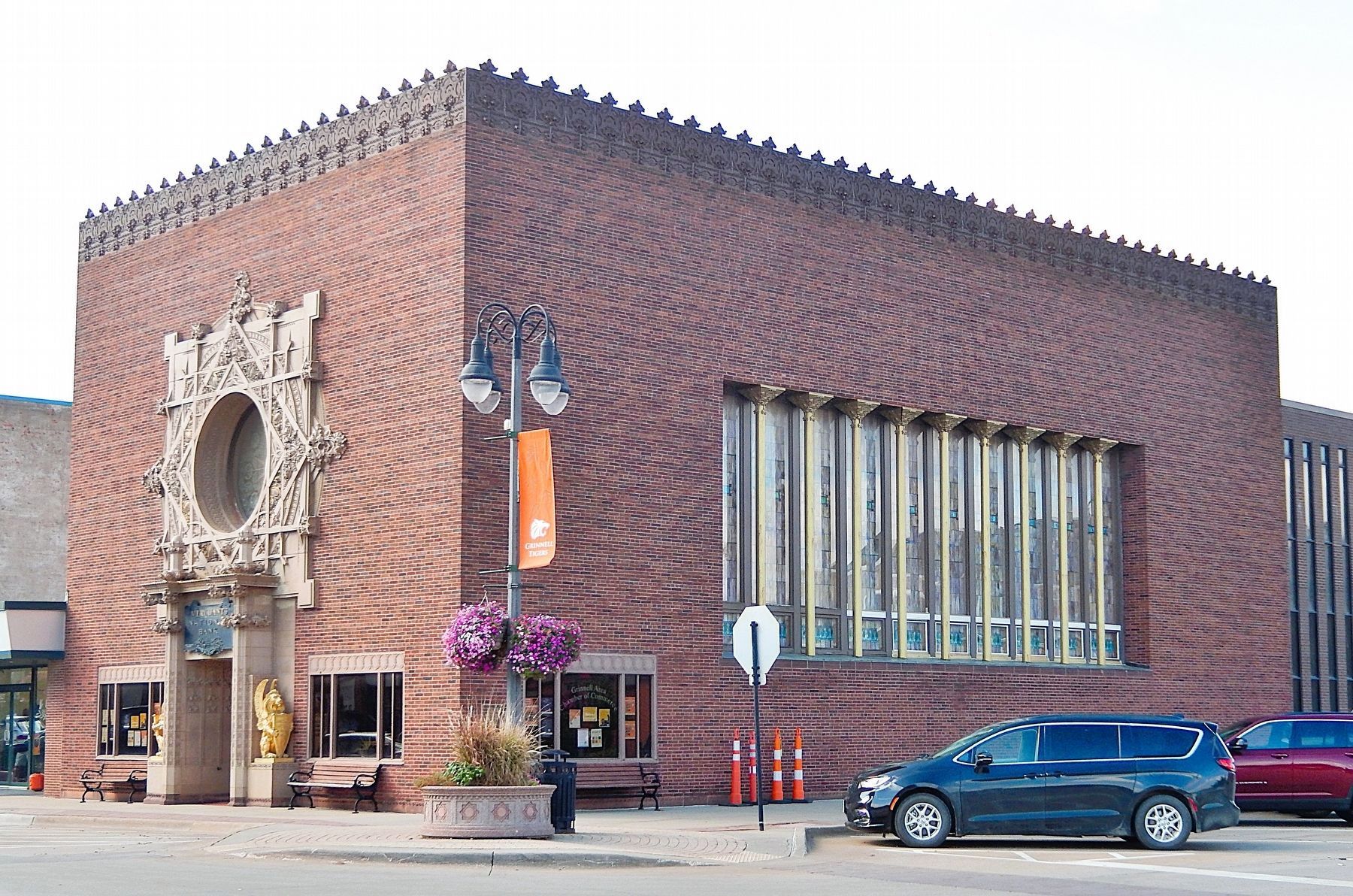
Photographed by Cosmos Mariner, September 19, 2025
5. Merchants National Bank
It is at the southeast corner of the block northwest of Central Park.
Credits. This page was last revised on February 19, 2026. It was originally submitted on February 17, 2026, by Cosmos Mariner of Cape Canaveral, Florida. This page has been viewed 40 times since then. Photos: 1, 2, 3, 4, 5. submitted on February 19, 2026, by Cosmos Mariner of Cape Canaveral, Florida.
