Grinnell in Poweshiek County, Iowa — The American Midwest (Upper Plains)
First Businesses

Photographed by Cosmos Mariner, September 19, 2025
1. First Businesses Marker
The arrival of the railroad in Grinnell in 1863 encouraged manufacturing and commerce by providing an efficient way to bring in raw material and ship out finished products.
One of the first businesses was a tanning operation started by Frederick W. Morrison. Eventually the company began to use the tanned skins to make leather gloves that were sold nationwide. The firm was first known as Morrison & McIntosh, then Morrison-Ricker.
The best-known early business was started in 1876 by blacksmith Henry W. Spaulding. The Spaulding Manufacturing Company prospered by making buggies and wagons. By 1905, the Spaulding factory was producing 10,000 buggies a year. The invention of the automobile propelled the company in 1909 into producing automobiles. Approximately 5,000 Spaulding cars were manufactured between 1909 and 1916, when competition from Henry Ford's assembly line proved to be too much for the local company, and manufacturing ceased.
Grinnell Washing Machine Company was founded in 1907 in nearby Newton. A year later it moved to Grinnell and took the town's name. The company thrived for a time, adding other products to its
this page online
Early Disasters
The young town suffered two major blows in the 1880s. In 1882, a cyclone ripped through the north part of Grinnell, destroying the two existing college buildings and damaging the residential area surrounding the campus. A total of 120 buildings were lost, 39 people were killed, and hundreds were injured. One witness described the scene: “...houses crumbled like matchsticks and people were carried long distances.” Almost immediately, J.B. Grinnell began efforts to raise money to rebuild the campus and aid the town.
A fire in 1889 destroyed a major section of the business district, including the post office and, ironically, the fire department. The town once again rebuilt quickly, with new buildings in place only six months after the blaze.
Topics. This historical marker is listed in these topic lists: Disasters • Industry & Commerce • Railroads & Streetcars.
Location. 41° 44.529′ N, 92° 43.374′ W. Marker

2. Marker detail: Spaulding Manufacturing Company cars

Regionally, this marker is in Eastern Iowa. It is also in the American Midwest and in the Corn Belt. Globally, it is in North America, the Western Hemisphere, the Western World, and the Anglosphere. Historically, it finds itself in what was once the territory of the Mississippian Culture and also the Louisiana Purchase.
Other nearby markers. At least 8 other markers are within walking distance of this marker: Grinnell College (here, next to this marker); Notable Grinnellians (here, next to this marker); Historic Buildings (a few steps from this marker); a different marker also named Notable Grinnellians (a few steps from this marker); a different marker also named Notable Grinnellians (a few steps from this marker); J. B. Grinnell (a few steps from this marker);
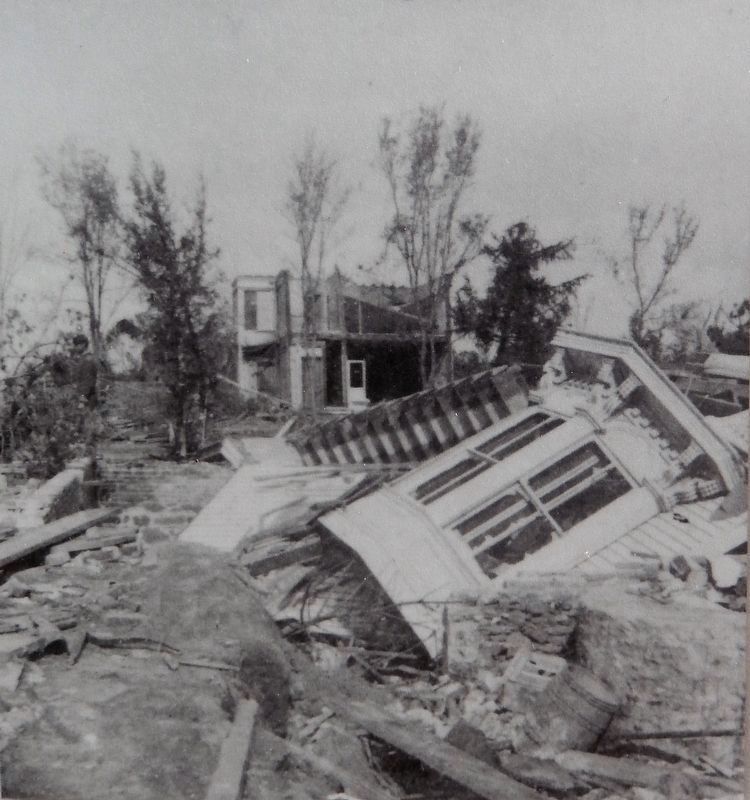
3. Marker detail: Cyclone destruction, Seventh & Broad
Also see . . .
1. Spaulding Manufacturing Company (Wikipedia).
Excerpt: Vermont native H.W. Spaulding settled in Grinnell in 1876 to open a blacksmith and wagon repair shop. Not long after, he started to manufacture wagons. Because of his modest success he entered into a series of partnerships over the years. As modes of transportation began to change, so did Spaulding. The company began manufacturing automobiles. They were one of several early automobile manufacturers that had existing operations that manufactured bicycles, wagons, and carriages. They went out of business in 1929.(Submitted on February 19, 2026, by Cosmos Mariner of Cape Canaveral, Florida.)
2. Then & Now: The Old Glove Factory.
(by Jayson Kunkel, 2024) Excerpt: This now college-owned building on Broad and 3rd, opened in 1895, housed one of Grinnell's first manufacturing companies, which began in 1865. Known by many names, including Morrison-Ricker,(Submitted on February 19, 2026, by Cosmos Mariner of Cape Canaveral, Florida.)Morrison, McIntosh & Company, and Morrison-Shults, this was the country's longest continually operating glove factory and largest manufacturer of gauntlet gloves. Despite the Morrison Company's eventual dissolution, the building survived the Great Depression, multiple tenant changes, and a major renovation as one of Grinnell's oldest and most iconic landmarks.Photographed by Cosmos Mariner, September 19, 20254. First Businesses MarkerLooking southeast through Central Park.
What follows is a short, interactive photographic and chronological history of the Old Glove Factory, followed by a brief geographical tour of the most important locations in its narrative.

3. 1882 Grinnell Tornado (Wikipedia).
Excerpt: On June 18, 1882, one of the deadliest tornadoes in Iowa history moved through several communities north of Des Moines, Iowa, notably Grinnell and Malcolm, killing 68 people and injuring an estimated 300 more. The tornado produced F5-rated damage along a track spanning over 100 miles. Later estimates suggest that more than 100 people may have been killed by the tornado.(Submitted on February 19, 2026, by Cosmos Mariner of Cape Canaveral, Florida.)
Following the event, Josiah Grinnell, founder of the town of Grinnell, helped to raise money to aid recovery efforts. Grinnell College counted total monetary losses from the tornado to be approximately $80,000 (1882 USD); the college's insurance policy over covered around $10,000 of that amount. After the tornado was mentioned in a publication of Harper's Weekly, donations from the public were sent to Grinnell from around the United States. In 1889, Grinnell College's yearbook was named The Cyclone, a reference to the tornado.
Credits. This page was last revised on February 19, 2026. It was originally submitted on February 17, 2026, by Cosmos Mariner of Cape Canaveral, Florida. This page has been viewed 52 times since then. Photos: 1, 2, 3, 4. submitted on February 19, 2026, by Cosmos Mariner of Cape Canaveral, Florida.
