Grinnell in Poweshiek County, Iowa — The American Midwest (Upper Plains)
Notable Grinnellians
Town and College
Photographed by Cosmos Mariner, September 19, 2025
1. Notable Grinnellians Marker
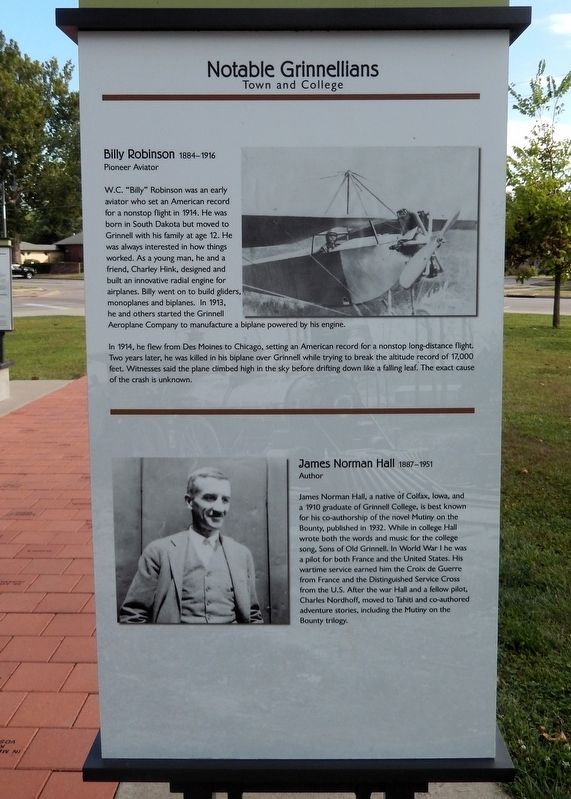
Billy Robinson 1884-1916
Pioneer Aviator
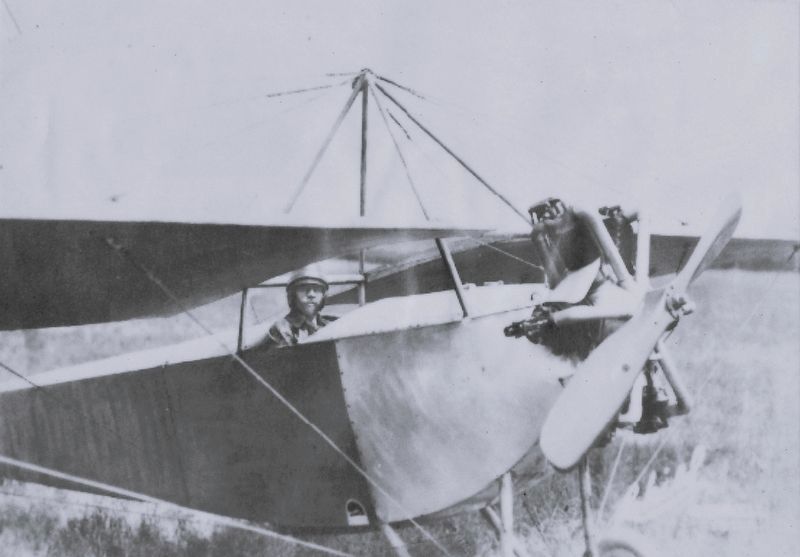
W.C. “Billy” Robinson was an early aviator who set an American record for a nonstop flight in 1914. He was born in South Dakota but moved to Grinnell with his family at age 12. He was always interested in how things worked. As a young man, he and a friend, Charley Hink, designed and built an innovative radial engine for airplanes. Billy went on to build gliders, monoplanes and biplanes. In 1913, he and others started the Grinnell Aeroplane Company to manufacture a biplane powered by his engine.
In 1914, he flew from Des Moines to Chicago, setting an American record for a nonstop long-distance flight. Two years later, he was killed in his biplane over Grinnell while trying to break the altitude record of 17,000 feet. Witnesses said the plane climbed high in the sky before drifting down like a falling leaf. The exact cause of the crash is unknown.
James Norman Hall 1887-1951
Author
James Norman Hall, a native of Colfax, Iowa, and a 1910 graduate of Grinnell College, is best known for his co-authorship of the novel Mutiny on the Bounty, published in 1932. While in college Hall wrote both
this page online
Topics and series. This historical marker is listed in these topic lists: Air & Space • Arts, Letters, Music • Industry & Commerce • War, World I. In addition, it is included in the Distinguished Service Cross/Navy Cross/Air Force Cross Recipients series list.
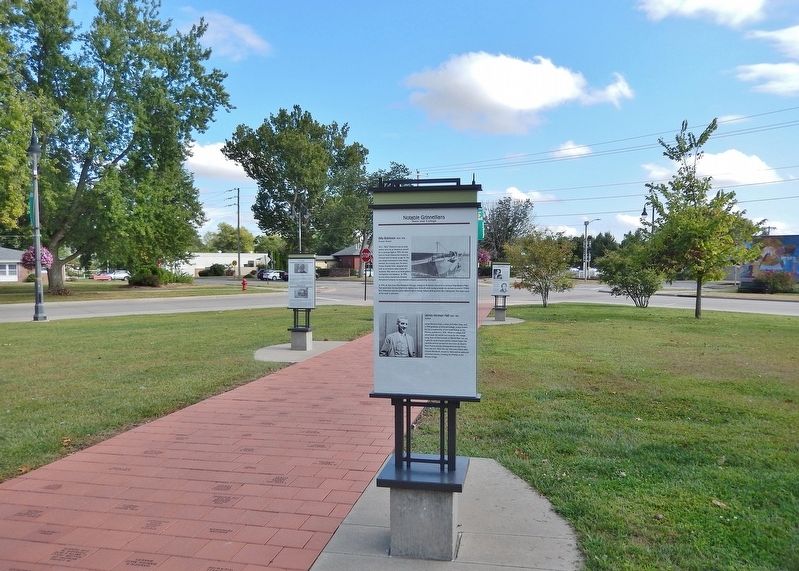
Location. 41° 44.525′ N, 92° 43.372′ W. Marker is in Grinnell, Iowa, in Poweshiek County. It is at the intersection of 3rd Avenue and Park Street, on the left when traveling east on 3rd Avenue. The marker is beside the diagonal walkway near the southeast corner of Central Park. Touch for map. Marker is at or near this postal address: 925 3rd Avenue, Grinnell IA 50112, United States of America. Touch for directions.

Regionally,
2. Marker detail: Early Radial Engine Airplane
Other nearby markers. At least 8 other markers are within walking distance of this marker: A different marker also named Notable Grinnellians (here, next to this marker); Grinnell College (here, next to this marker); First Businesses (a few steps from this marker); J. B. Grinnell (a few steps from this marker); Founding of Grinnell (a few steps from this marker); a different marker also named Notable Grinnellians (a few steps from this marker); Historic Buildings (a few steps from this marker); a different marker also named Notable Grinnellians (a few steps from this marker). Touch for a list and map of all markers in Grinnell.
Also see . . .
1. William C. Robinson (Wikipedia).
Excerpt: He was a handyman, tinkerer, and bicycle repairman who designed and built his own flying machine. In 1911, with the(Submitted on February 20, 2026, by Cosmos Mariner of Cape Canaveral, Florida.)help of Charles Hink, Robinson constructed a 60-horsepower radial motor for his monoplane. His innovations for the radial motor were revolutionary.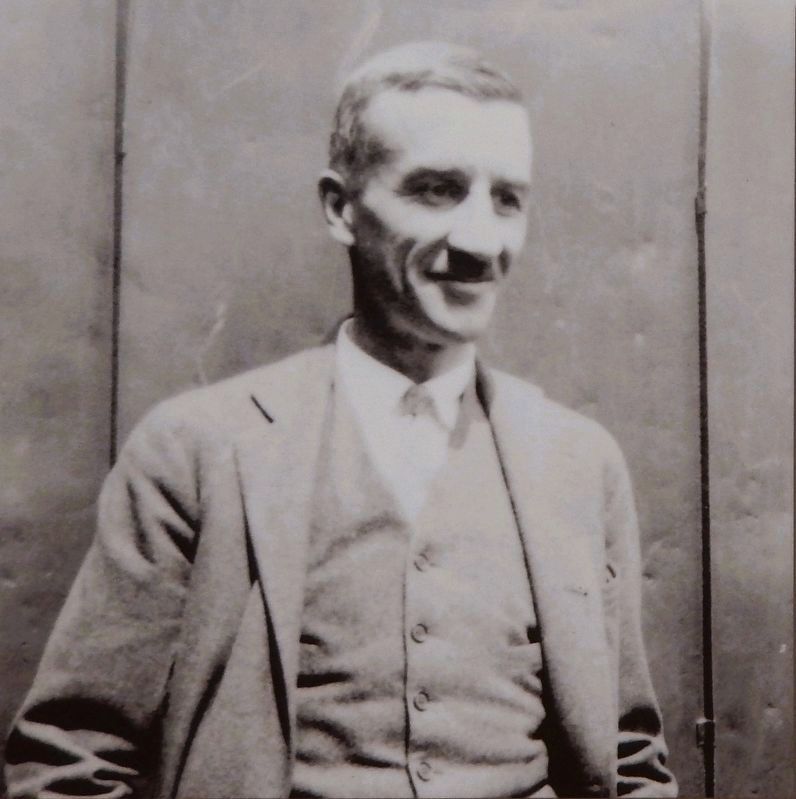 3. Marker detail: James Norman Hall
Robinson perished while flying his biplane, attempting to set an altitude record on March 11, 1916. His aircraft was witnessed climbing to altitude, before drifting down like a falling leaf, and gliding to a landing, which was controlled enough to leave skid marks, but rough enough to rupture the fuel tank and ignite the aircraft. Hypoxia was suspected among other reasons for the crash, but the fire made it impossible to verify the exact cause.
On June 18, 1988, the Grinnell Regional Airport was dedicated and named Billy Robinson Field.
2. James Norman Hall (Wikipedia).
Excerpt: During World War I, Hall uniquely served in the armed forces of three Allied nations—Great Britain as an infantryman, and later France and the United States as an aviator. His wartime honors include the Croix de Guerre, the Médaille Militaire, the Légion d'Honneur, and the Distinguished Service Cross. After the war,(Submitted on February 20, 2026, by Cosmos Mariner of Cape Canaveral, Florida.)he settled in Tahiti, where he and Nordhoff wrote a number of successful adventure novels, many of which were adapted into films.Photographed by Cosmos Mariner, September 19, 20254. Notable Grinnellians MarkerLooking southeast through Central Park.
Hall was vacationing in the United Kingdom in the summer of 1914, when World War I broke out. Posing as a Canadian, he enlisted in the British Army and served in the Royal Fusiliers as a machine gunner during the Battle of Loos. After his true nationality was discovered, he was discharged and returned to the United States. Hall returned to Europe in 1916 on assignment with The Atlantic Monthly. He was tasked with writing a series of stories about American volunteers in the Lafayette Escadrille, but after spending time with the group, Hall became inspired to enlist in the Aéronautique Militaire, the French air service at the time. By then, a growing number of American pilots — including Hall — were serving in various French squadrons as part of the Lafayette Flying Corps, a larger effort that went beyond the Escadrille. He trained at the Avord and Pau aviation schools and was assigned to Escadrille N.124 — the famed Lafayette Escadrille — in June 1917. After being wounded in combat, he recovered and rejoined the unit later that year. During his time in French aviation, Hall was awarded the Croix de Guerre with five palms and the Médaille Militaire. In early 1918, after the United States entered the war, the Lafayette Escadrille was incorporated into the American 103rd Aero Squadron, and Hall was commissioned as a captain in the Army Air Service. Hall flew several combat missions over the Western Front with the 103rd Aero Squadron and later the 94th Aero Squadron, one of the first American pursuit units. During a brief period in early 1918, he served as acting commander of the 94th, where he flew alongside future ace Eddie Rickenbacker.
On May 7, 1918, during a dogfight over German lines, Hall's Nieuport lost fabric on its upper wing and was hit by antiaircraft fire, forcing him to crash-land in enemy territory. After being shot down, Hall spent the remainder of the war as a prisoner of war in Germany. During captivity, he kept a secret diary and continued writing, an experience that later influenced both his memoir High Adventure and his fiction. Following his release, he received both the French Légion d'Honneur and the American Distinguished Service Cross.
Credits. This page was last revised on February 20, 2026. It was originally submitted on February 17, 2026, by Cosmos Mariner of Cape Canaveral, Florida. This page has been viewed 59 times since then. Photos: 1, 2, 3, 4. submitted on February 20, 2026, by Cosmos Mariner of Cape Canaveral, Florida.
