Grinnell in Poweshiek County, Iowa — The American Midwest (Upper Plains)
Founding of Grinnell
Photographed by Cosmos Mariner, September 19, 2025
1. Founding of Grinnell Marker
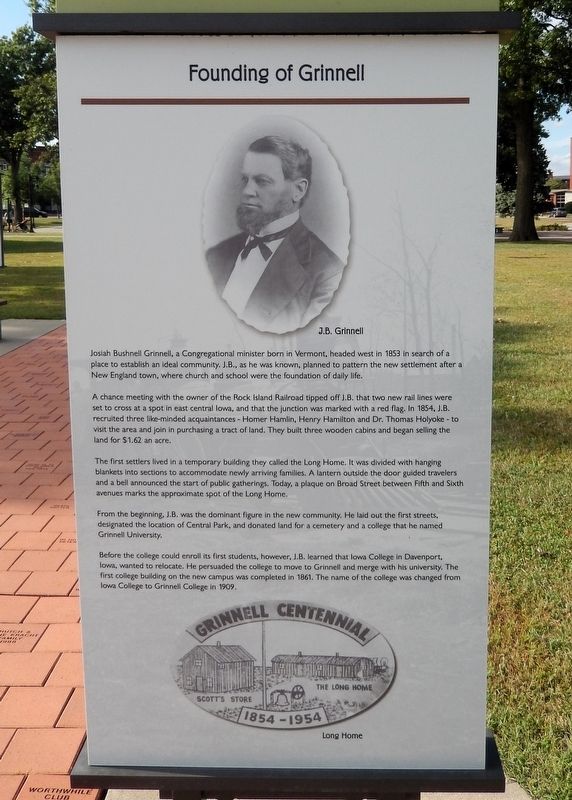
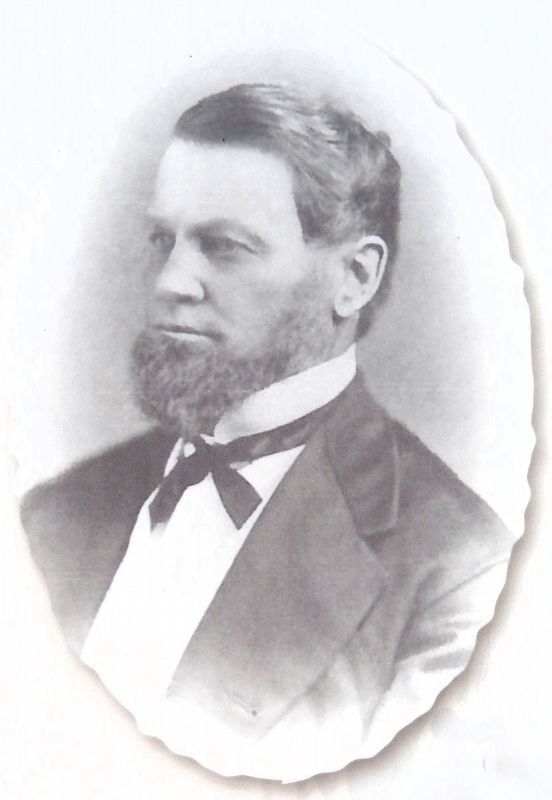
Josiah Bushnell Grinnell, a Congregational minister born in Vermont, headed west in 1853 in search of a place to establish an ideal community. J.B., as he was known, planned to pattern the new settlement after a New England town, where church and school were the foundation of daily life.
A chance meeting with the owner of the Rock Island Railroad tipped off J.B. that two new rail lines were set to cross at a spot in east central Iowa, and that the junction was marked with a red flag. In 1854, J.B. recruited three like-minded acquaintances — Homer Hamlin, Henry Hamilton and Dr. Thomas Holyoke — to visit the area and join in purchasing a tract of land. They built three wooden cabins and began selling the land for $1.62 an acre.
The first settlers lived in a temporary building they called the Long Home. It was divided with hanging blankets into sections to accommodate newly arriving families. A lantern outside the door guided travelers and a bell announced the start of public gatherings. Today, a plaque on Broad Street between Fifth and Sixth Avenues marks the approximate spot of the Long Home.
From the beginning, J.B. was
this page online
Before the college could enroll its first students, however, J.B. learned that Iowa College in Davenport, Iowa, wanted to relocate. He persuaded the college to move to Grinnell and merge with his university. The first college building on the new campus was completed in 1861. The name of the college was changed from Iowa College to Grinnell College in 1909.
Topics. This historical marker is listed in these topic lists: Education • Railroads & Streetcars • Settlements & Settlers. A significant historical year for this entry is 1854.
Location. 41° 44.523′ N, 92° 43.367′ W. Marker is in Grinnell, Iowa, in Poweshiek County. It is at the intersection of 3rd Avenue and Park Street, on the left when traveling east on 3rd Avenue. The marker is beside the diagonal walkway near the southeast corner of Central Park. Touch for map. Marker is at or near this postal address: 925 3rd Avenue, Grinnell IA 50112, United States of America. Touch for directions.

Regionally,
2. Marker detail: J.B. Grinnell
Other nearby markers. At least 8 other markers are within walking distance of this marker: J. B. Grinnell (here, next to this marker); Notable Grinnellians (here, next to this marker); a different marker also named Notable Grinnellians (a few steps from this marker); a different marker also named Notable Grinnellians (a few steps from this marker); a different marker also named Notable Grinnellians (a few steps from this marker); Grinnell College (a few steps from this marker); First Businesses (a few steps from this marker); a different marker also named Notable Grinnellians (a few steps from this marker). Touch for a list and map of all markers in Grinnell.
Also see . . . Grinnell, Iowa (Wikipedia).
Excerpt: Grinnell was founded by settlers from New England who were descended from English Puritans(Submitted on February 20, 2026, by Cosmos Mariner of Cape Canaveral, Florida.)of the 1600s. Grinnell was founded in 1854 by four men: Josiah B. Grinnell, a Congregationalist from Vermont; Homer Hamlin, a minister; Henry Hamilton, a surveyor; and Dr. Thomas Holyoke. The city was to be named "Stella," but J. B. Grinnell convinced the others to adopt his name, describing it as rare and concise. Grinnell was incorporated on April 28, 1865, and by 1880, Grinnell had a population of around 2,000. Located at the junction of two railway lines (east–west line of the Rock Island Railroad and the north–south Minneapolis and St. Louis Railway), it is the largest community in Poweshiek County.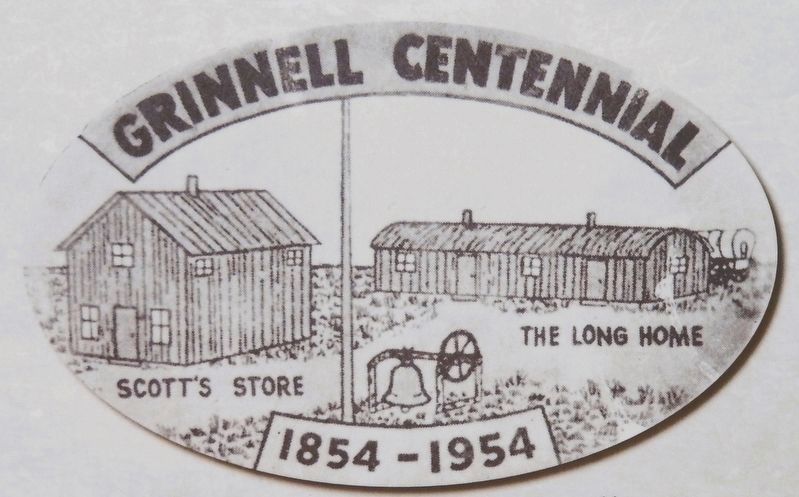 3. Marker detail: Grinnell Centennial 1854-1954
Grinnell was a stop on the Underground Railroad from its founding. One of the most famous events occurred in February 1859, when abolitionist John Brown, and 12 slaves he was helping escape to freedom, were hosted by J. B. Grinnell and several other community residents.
Photographed by Cosmos Mariner, September 19, 2025
4. Founding of Grinnell Marker
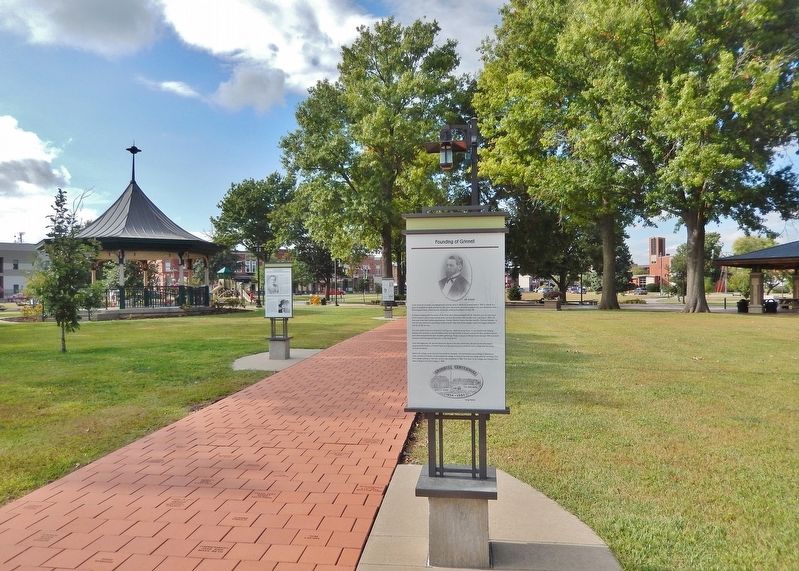
Looking northwest through Central Park.
Credits. This page was last revised on February 20, 2026. It was originally submitted on February 17, 2026, by Cosmos Mariner of Cape Canaveral, Florida. This page has been viewed 51 times since then. Photos: 1, 2, 3, 4. submitted on February 20, 2026, by Cosmos Mariner of Cape Canaveral, Florida.
