
Saint Stephens in Washington County, Alabama — The American South (East South Central)
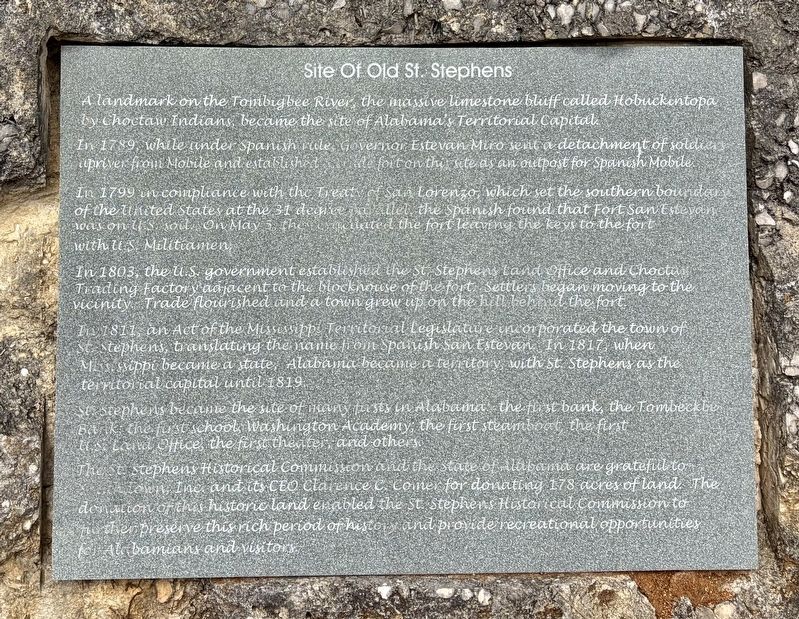
Site of Old St. Stephens
Photographed by Mark Hilton, February 17, 2026
1. Site of Old St. Stephens Marker
A landmark on the Tombigbee River, the massive limestone bluff called Hobuckintopa by Choctaw Indians, became the site of Alabama's Territorial Capital.
In 1789, while under Spanish rule, Governor Estevan Miro sent a detachment of soldiers upriver from Mobile and established a crude fort on this site as an outpost for Spanish Mobile.
In 1799 in compliance with the Treaty of San Lorenzo, which set the southern boundary of the United States at the 31 degree parallel, the Spanish found that Fort San Estevan was on its soil. On May 5, they evacuated the fort leaving the keys to the fort with US Militiamen.
In 1803, the US government established the St. Stephens Land Office and Choctaw Trading Factory adjacent to the blockhouse of the fort. Settlers began moving to the vicinity Trade flourished and a town grew up on the hill behind the fort.
In 1811, an Act of the Mississippi Territorial Legislature incorporated the town of St. Stephens, translating the name from Spanish San Estevan. In 1817, when Mississippi became a state, Alabama became a territory, with St. Stephens as the territorial capital until 1819.
this page online
St. Stephens became the site of many firsts in Alabama: the first bank, the Tombeckbe Bank; the first school, Washington Academy; the first steamboat, the first U.S. Land Office, the first theater, and others.
The St Stephens Historical Commission and the State of Alabama are grateful to Southdown, Inc. and its CEO Clarence C. Comer for donating 178 acres of land. The donation of this historic land enabled the St. Stephens Historical Commission to further preserve this rich period of history and provide recreational opportunities for Alabamians and visitors.
Topics. This historical marker is listed in these topic lists: Forts and Castles • Settlements & Settlers. A significant historical date for this entry is May 5, 1789.
Location. 31° 33.365′ N, 88° 2.259′ W. Marker is in Saint Stephens, Alabama, in Washington County. It is on Old Saint Stephens Road 1.3 miles east of Cement Plant Road, on the right when traveling north. Touch for map. Marker is in this post office area: Saint Stephens AL 36569, United States of America. Touch for directions.

Regionally, this marker is in Alabama’s Mobile Bay area. It is also in the American

Photographed by Mark Hilton, February 17, 2026
2. Site of Old St. Stephens Marker
Other nearby markers. At least 8 other markers are within 7 miles of this marker, measured as the crow flies: The St. Stephens Historical Commission (about 300 feet away, measured in a direct line); St. Stephens (about 300 feet away); The Tombigbee Settlements (approx. 0.3 miles away); St. Stephens Courthouse and Masonic Lodge (approx. 1½ miles away); Old St. Stephens Masonic Lodge No. 9 / St. Stephens Lodge (approx. 1½ miles away); Upper Salt Works (approx. 4.9 miles away); The Taylor House (approx. 5.8 miles away); Bassetts Creek (approx. 6.3 miles away). Touch for a list and map of all markers in Saint Stephens.
Also see . . . A state park designated to preserve the history of the Territorial Capital of Alabama. (Submitted on February 22, 2026, by Mark Hilton of Montgomery, Alabama.)
Additional commentary.
1.

Photographed by Mark Hilton, February 17, 2026
3. Site of Old St. Stephens Marker with Tombigbee River in far background.
Hobuckintopa was an historic Choctaw village located on a bluff along the Tombigbee River in Alabama. The village was associated with the Six Towns Choctaw and led by Chief Piamingo Hometah.
— Submitted February 18, 2026, by Mark Hilton of Montgomery, Alabama.
Credits. This page was last revised on February 22, 2026. It was originally submitted on February 18, 2026, by Mark Hilton of Montgomery, Alabama. This page has been viewed 101 times since then. Photos: 1, 2, 3. submitted on February 18, 2026, by Mark Hilton of Montgomery, Alabama.
