Marker Logo
THE HISTORICAL
MARKER DATABASE
“Bite-Size Bits of Local, National, and Global History”
Discovery District in Toronto, Ontario — Central Canada (North America)
 

Frederic W. Cumberland 1820-1881
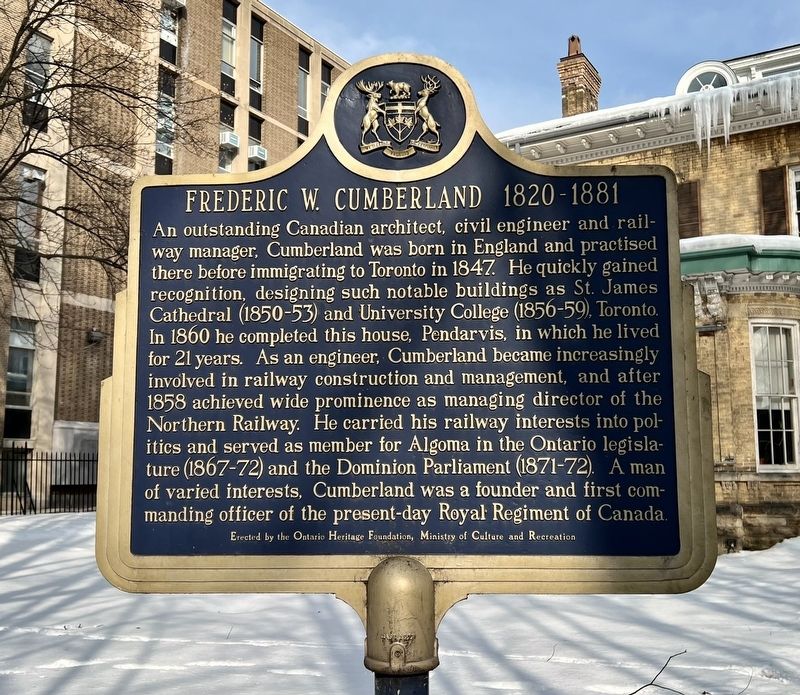
 
 
Frederic W. Cumberland 1820-1881 Marker image. Click for full size.
Photographed by Tim Boyd, February 15, 2026
1. Frederic W. Cumberland 1820-1881 Marker
Inscription. An outstanding Canadian architect, civil engineer and railway manager, Cumberland was born in England and practised there before immigrating to Toronto in 1847. He quickly gained recognition, designing such notable buildings as St. James Cathedral (1850-53) and University College (1850-59), Toronto. In 1860 he completed this house, Pendarvis, in which he lived for 21 years. As an engineer, Cumberland became increasingly involved in railway construction and management, and after 1858 achieved wide prominence as managing director of the Northern Railway. He carried his railway interests into politics and served as member for Algoma in the Ontario legislature (1867-72) and the Dominion Parliament (1871-72). A man of varied interests, Cumberland was a founder and first commanding officer of the present-day Royal Regiment of Canada.
 
Erected by Ontario Heritage Foundation.
 
Topics and series. This historical marker is listed in these topic lists: ArchitectureRailroads & Streetcars. In addition, it is included in the Canada, Ontario Heritage Trust series list. A significant historical year for this entry is 1847.
 
Location. 43° 39.563′ N, 79° 23.774′ W. Marker is in Toronto, Ontario. It is in the Discovery District. It is at the intersection of Saint
Paid Advertisement
Click or scan to see
this page online
George Street and College Street, on the right when traveling north on Saint George Street. Touch for map. Marker is at or near this postal address: 33 St George Street, Toronto ON M5S M5S, Canada. Touch for directions.

Regionally, this marker is in Greater Toronto and on the Golden Horseshoe. It is also in Central Canada. Globally, it is in North America, the Western Hemisphere, the Western World, and the Anglosphere. Historically, it finds itself in what was once a British colony, the Viceroyalty of New France, the Haudenosaunee (Iroquois) Confederacy, and Rupert’s Land.

Other nearby markers. At least 8 other markers are within walking distance of this marker: Pendarves - Cumberland House / Pendarves - Maison Cumberland (here, next to this marker); National Council of Jewish Women of Canada / Le Conseil national des femmes juives du Canada (about 120 meters away, measured in a direct line); Charles William Jefferys (about 210 meters away); Dr. Peter Bryce (approx. 0.3 kilometers away); The Macdonald-Mowat House (approx. 0.3 kilometers away); The Discovery of Insulin (approx. 0.3 kilometers away); School of Hygiene (approx. 0.3 kilometers away); Sir Daniel Wilson (approx. 0.3 kilometers away). Touch for a list and map of all markers in Toronto.
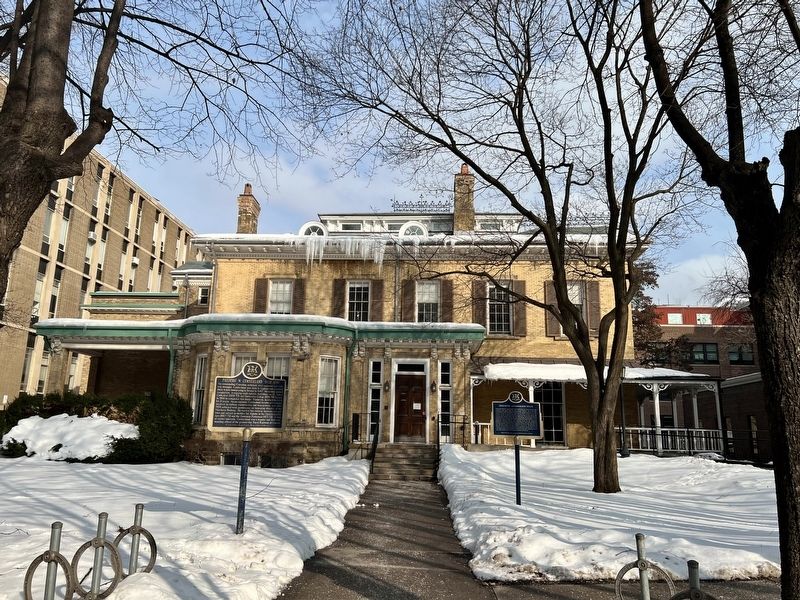
 
Frederic W. Cumberland 1820-1881 Marker (on the left) image. Click for full size.
Photographed by Tim Boyd,
2. Frederic W. Cumberland 1820-1881 Marker (on the left)
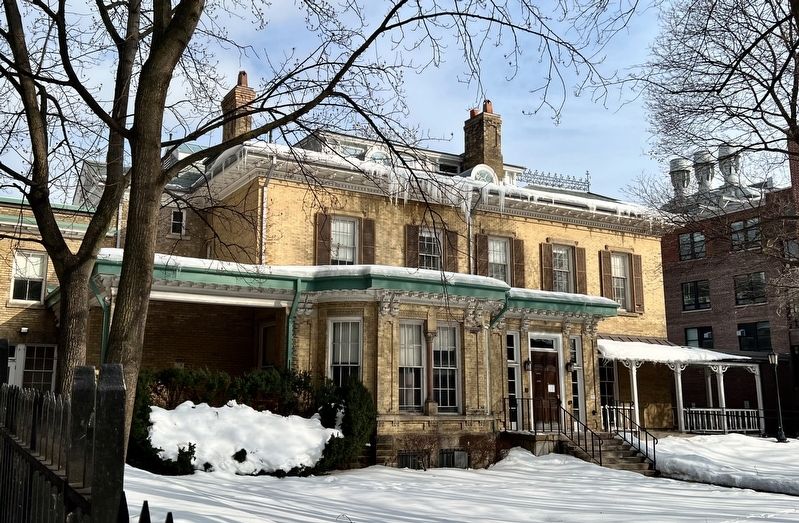
Cumberland’s house “Pendarvis”, in 2026 image. Click for full size.
Photographed by Tim Boyd, February 15, 2026
3. Cumberland’s house “Pendarvis”, in 2026
 
 
Credits. This page was last revised on February 22, 2026. It was originally submitted on February 19, 2026, by Tim Boyd of Hamilton, Ontario. This page has been viewed 47 times since then. Photos:   1, 2, 3. submitted on February 19, 2026, by Tim Boyd of Hamilton, Ontario. • Andrew Ruppenstein was the editor who published this page.

m=293863

CeraNet Cloud Computing sponsors the Historical Marker Database.
This website earns income from purchases you make after using our links to Amazon.com. We appreciate your support.
Paid Advertisement
Jun. 5, 2026
