Near Antonito in Conejos County, Colorado — The American Mountains (Southwest)
The Great Race to Build a Railroad
Los Caminos Antiguos Scenic & Historic Byway
Photographed by Cosmos Mariner, July 13, 2025
1. The Great Race to Build a Railroad Marker
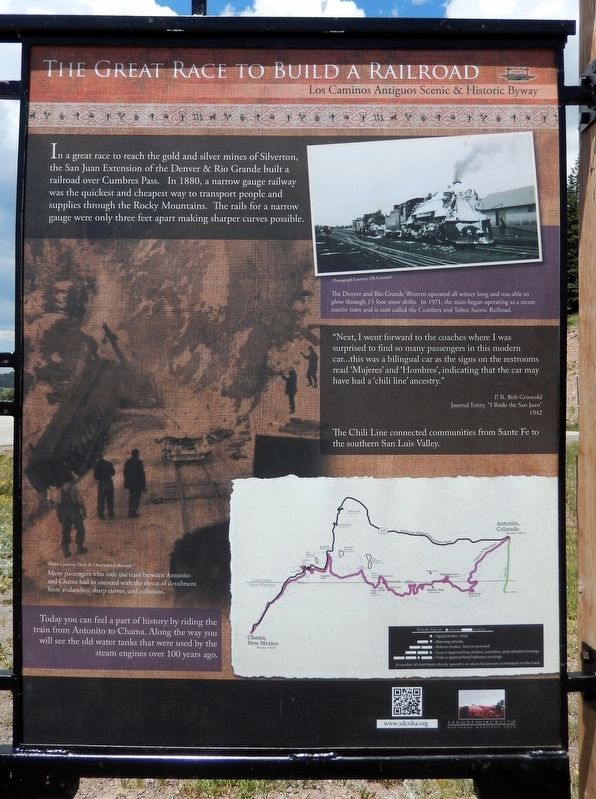
In a great race to reach the gold and silver mines of Silverton, the San Juan Extension of the Denver & Rio Grande built a railroad over Cumbres Pass. In 1880, a narrow gauge railway was the quickest and cheapest way to transport people and supplies through the Rocky Mountains. The rails for a narrow gauge were only three feet apart making sharper curves possible.
“Next, I went forward to the coaches where I was surprised to find so many passengers in this modern car...this was a bilingual car as the signs on the restrooms read ‘Mujeres’ and ‘Hombres’, indicating that the car may have had a ‘chili line’ ancestry.”
P. R. Bob Griswold
Journal Entry, “I Rode the San Juan”
1942
The Chili Line connected communities from Santa Fe to the southern San Luis Valley.
Today you can feel a part of history by riding the train from Antonito to Chama. Along the way you will see the old water tanks that were used by the steam engines over 100 years ago.
[background image caption] Many passengers who rode the train between Antonito and Chama had to contend with the threat of derailment from avalanches, sharp curves, and collisions.
Erected by Colorado
this page online
Topics. This historical marker is listed in these topic lists: Industry & Commerce • Railroads & Streetcars. A significant historical year for this entry is 1880.
Location. 37° 0.901′ N, 106° 25.191′ W. Marker is near Antonito, Colorado, in Conejos County. It is on State Highway 17 at milepost 5.8, 2.3 miles south of Cumbres Drive, on the left when traveling west. Touch for map. Marker is in this post office area: Antonito CO 81120, United States of America. Touch for directions.

Regionally, this marker is in the San Juan Mountains and in the San Luis Valley. It is also in the American Mountain West. Globally, it is in North America, the Rocky Mountains, the Western Hemisphere, the Western World, and the Anglosphere. Historically, it finds itself in what was once New Spain and also the Republic of Texas.
Other nearby markers. At least 8 other markers are within 4 miles of this marker, measured as the crow flies: Los Caminos Antiguos (here, next to this marker); The Secret Died With Him
Courtesy P.R. Griswold
2. Marker detail: D&RGW Locomotives
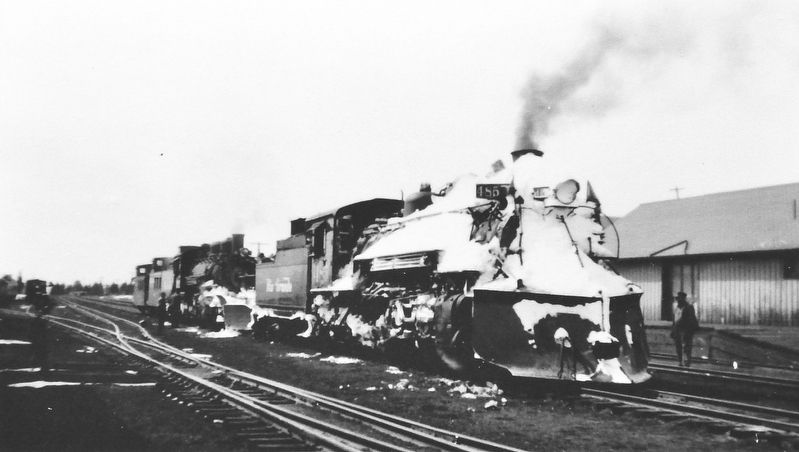
The Denver and Rio Grande Western operated all winter long and was able to plow through 15 foot snow drifts. In 1971, the train began operating as a steam tourist train and is now called the Cumbres and Toltec Scenic Railroad.
Also see . . . Alamosa–Durango line (Wikipedia).
Excerpt: The Alamosa–Durango line or San Juan extension was a railroad line built by the Denver and Rio Grande Western Railroad, following the border between the U.S. states of Colorado and New Mexico, in the Rocky Mountains. The line was originally built as a 3 ft narrow-gauge line between Alamosa, Colorado, and Durango, Colorado. Portions of the route survive: the now standard-gauged segment from Alamosa to Antonito, Colorado, and a narrow-gauge portion from Antonito to Chama, New Mexico.(Submitted on February 22, 2026, by Cosmos Mariner of Cape Canaveral, Florida.)
Following the Railroad Wars between the Denver and Rio Grande and the Atchison, Topeka and Santa Fe Railway (Santa Fe), the D&RG signed an agreement with the Santa Fe, where the Santa Fe agreed not to competewith the D&RG's plans to build an extension into the San Juan Valley. The 200-mile rail line was built in the early 1880s to access the various mineral resources in south-western Colorado. In 1881, the line reached Durango and a short time later, a branch was built up the Animas river valley to the mining town of Silverton. In addition to the ore traffic, lumber and various agricultural commodities were also hauled along the route. The Rio Grande Southern Railroad from Durango to Ridgway was completed in 1891.Photographed by Cosmos Mariner, July 13, 20253. Los Caminos Antiguos Scenic and Historic Byway KioskLooking west along Colorado Highway 17. This marker is the rightmost of two interpretive panels on the east side of this Los Caminos Antiguos Scenic & Historic Byway Kiosk.
The narrow-gauge portion between Antonito and Chama continues to operate as the Cumbres & Toltec Scenic Railroad with two trains (one in each direction) traversing the route each day during summer months.


/
4. Marker detail: D&RGW Route between Antonito CO and Chama NM
Credits. This page was last revised on February 22, 2026. It was originally submitted on February 20, 2026, by Cosmos Mariner of Cape Canaveral, Florida. This page has been viewed 56 times since then. Photos: 1, 2, 3, 4. submitted on February 22, 2026, by Cosmos Mariner of Cape Canaveral, Florida.
