Harbord Village in Toronto, Ontario — Central Canada (North America)
Croft Street
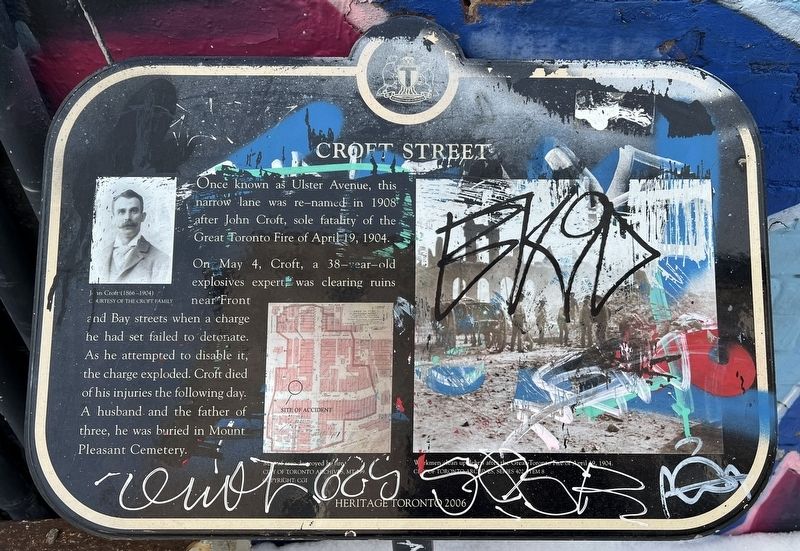
Photographed by Tim Boyd, February 15, 2026
1. Croft Street Marker
Erected 2006 by Heritage Toronto.
Topics. This historical marker is listed in this topic list: Disasters. A significant historical date for this entry is May 4, 1904.
Location. 43° 39.42′ N, 79° 24.352′ W. Marker has been damaged. Marker is in Toronto, Ontario. It is in Harbord Village. It is at the intersection of College Street and Croft Street, on the right when traveling west on College Street. Touch for map. Marker is at or near this postal address: 396 College Street, Toronto ON M5T 1S7, Canada. Touch for directions.

Regionally, this marker is in Greater Toronto and on the Golden Horseshoe. It is also in Central Canada. Globally, it is in North America, on
this page online
Other nearby markers. At least 8 other markers are within walking distance of this location: St. Stephen’s-in-the-Fields Anglican Church/Église Anglicane de St. Stephen’s-in-the-fields (about 150 meters away, measured in a direct line); Dr. Anderson Ruffin Abbott (about 150 meters away); Walter Huston (approx. 0.2 kilometers away); Kensington Market / Le Marché Kensington (approx. half a kilometer away); Alice and Dan Heap (approx. half a kilometer away); Church of Christ (1891) (approx. 0.6 kilometers away); Labor Lyceum (approx. 0.6 kilometers away); Wong Association of Ontario (approx. 0.7 kilometers away). Touch for a list and map of all markers in Toronto.
Also see . . . The Great Fire of 1904 (City of Toronto).
Exactly how the fire started has never been solved. Early reports suggested that faulty electrical wiring was to blame. Others thought that a stove left(Submitted on February 23, 2026, by Tim Boyd of Hamilton, Ontario.)burning at the end of the work day was the cause. Whatever the source, by the time a watchman saw flames and sounded the alarm at 8:04 pm on that icy night of April 19, 1904, the Wellington Street building in which it had started was already a loss, and the fire was spreading to its neighbours.Photographed by Tim Boyd, February 15, 20262. Croft Street Marker
From its origins in the E. & S. Currie Building (on the north side of Wellington Street, west of Bay), the fire quickly spread north, south, and east. Soon, both sides of Wellington and Bay were aflame. By 9 pm, every fireman in the city was at the site. The mayor, Thomas Urquhart, sent the deputy fire chief a message, asking if he needed any assistance. The deputy’s response: “We need all the assistance we can get.”


Photographed by Tim Boyd, February 15, 2026
3. Croft Street, 2026
Looking north from College Street
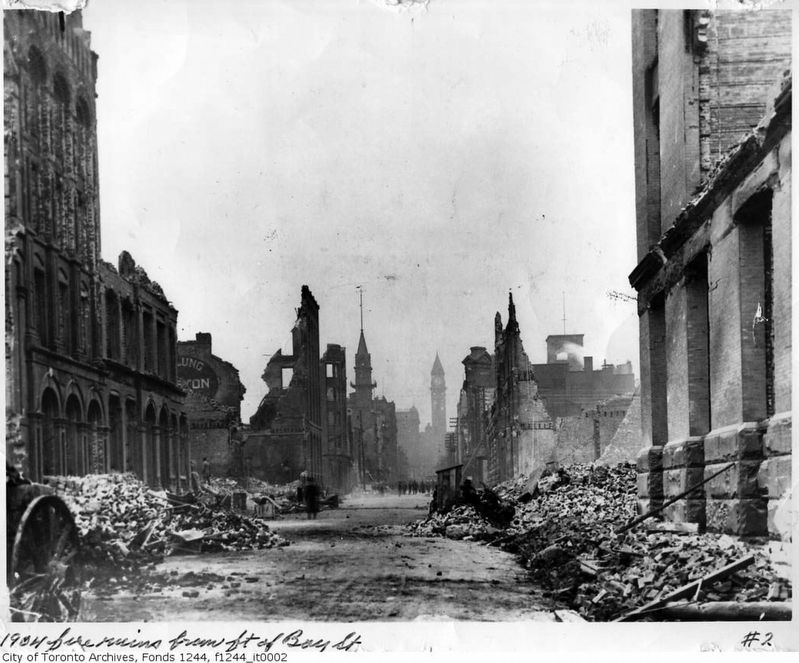
Photographed by Tim Boyd, 1904
4. After the Great Fire of 1904, looking north on Bay Street towards City Hall
City of Toronto Archives (public domain)
Credits. This page was last revised on February 24, 2026. It was originally submitted on February 23, 2026, by Tim Boyd of Hamilton, Ontario. This page has been viewed 41 times since then. Photos: 1, 2, 3, 4. submitted on February 23, 2026, by Tim Boyd of Hamilton, Ontario. • Andrew Ruppenstein was the editor who published this page.
