Altstadt in Heidelberg, Baden-Württemberg, Germany — Central Europe
Friedrich Seligmann
Photographed by James Hulse, February 19, 2026
1. Friedrich Seligmann Marker

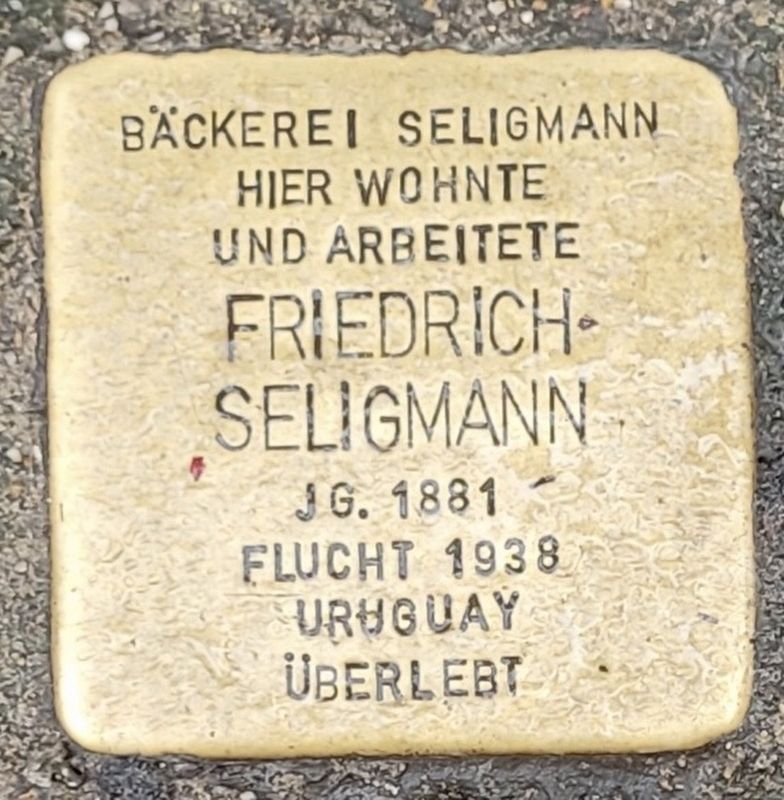
Bäckerei Seligmann
Hier wohnte
und arbeitete
Friedrich Seligmann
Jg. 1881
Flucht 1938
Uruguay
überlebt
Bakery Seligmann, here lived and worked Friedrich Seligmann, born 1881. Fled 1938, Uruguay, survived.
Topics and series. This historical marker is listed in this topic list: War, World II. In addition, it is included in the Stolpersteine series list. A significant historical year for this entry is 1881.
Location. 49° 24.558′ N, 8° 41.985′ E. Marker is in Heidelberg, Baden-Württemberg. It is in Altstadt. It is on Plöck just west of Märzgasse, on the right when traveling east. Touch for map. Marker is at or near this postal address: Plöck 34, Heidelberg BW 69117, Germany. Touch for directions.

Regionally, it is in Europe, the European Union, Atlantic Europe, Central Europe, the Schengen Area, Western Europe, and the Western World. Historically, it finds itself in what was once the Roman Empire and specifically also the Holy Roman Empire.
Other nearby markers. At least 8 other markers are within walking distance of this marker: Flora Seligmann (here, next to
this page online
Also see . . .
1. Familie Seligmann (Stolpersteine Heidelberg, in German). Excerpt (in translation):
The Seligmann Family(Submitted on February 27, 2026, by James Hulse of Medina, Texas.)
Friedrich Seligmann (1881–1951)
Flora Seligmann (1887–1948)
Ludwig Seligmann (1910–1998)
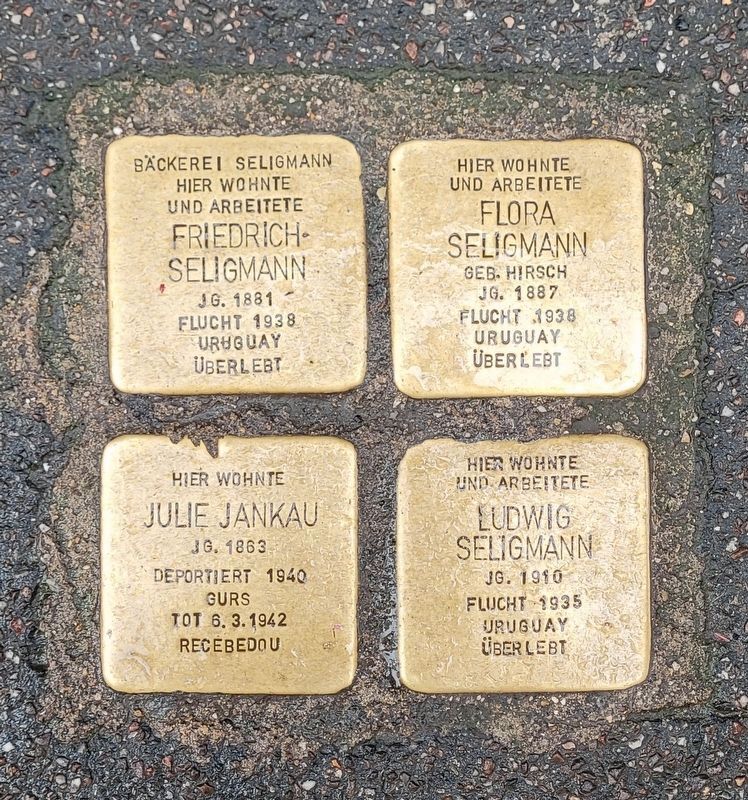
Friedrich Seligmann’s family on his father’s side came from Rohrbach. Friedrich himself was born there on February 19, 1881. His parents were Ferdinand Seligmann (1850–1927) and Hermine Falk (1856–1935). His mother came from Obergrombach near Bruchsal. Friedrich Seligmann had a sister one year younger, Mathilde, born on January 23, 1882. Since 1897 the family had lived in Heidelberg. His father Ferdinand worked in the mortgage and real estatebusiness and, since 1908, had his business and living quarters at Plöck 36. In that same house, in 1908, his son Friedrich—presumably newly qualified as a master baker—opened his own bakery in Heidelberg.Photographed by James Hulse, February 19, 20262. Friedrich Seligmann MarkerThe Stolpersteine (Stumbling Stones) for the Seligmann family consist of four individual stones placed together. Julie Jankau was not a Seligmann family member but rented a room at the Seligmann House.
During the First World War, Friedrich Seligmann served as a soldier at the fiercely contested Hartmannsweilerkopf in Alsace. In 1920 he purchased property in the Märzgarten (at the corner of Märzgasse and Plöck).
The devastation of his business during the November pogrom of 1938, which he would otherwise have had to witness, and his imprisonment the following day in Dachau—part of the mass arrests of Jewish men between the ages of 18 and 59, of whom 75 were deported from Heidelberg—were spared him.
Ludwig Seligmann had already fled to Uruguay in 1935. He had a romantic relationship with a so-called “Aryan” woman. As a result of a denunciation, he was to be interrogated by the Gestapo. However, he was warned by an SA man—a football teammate from before Jewish athletes were expelled from sports clubs: “Lutz, pack a few things and disappear; they’re planning to pick you up early tomorrow morning.”
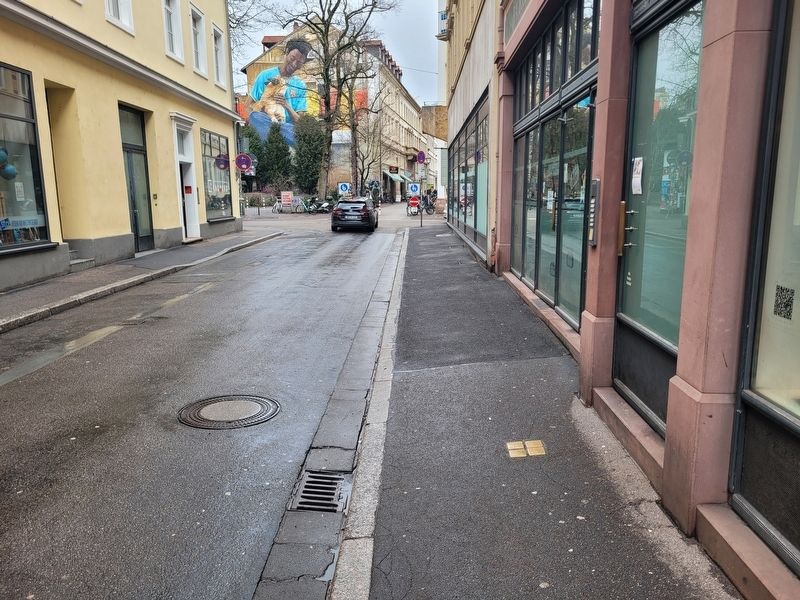
In August 1938, his parentsfollowed him to Uruguay. With the bakery machines they had brought from Germany, the couple attempted to build a new livelihood in Montevideo. They did not succeed. Flora Seligmann died in Uruguay on March 20, 1948.Photographed by James Hulse, February 19, 20263. Friedrich Seligmann MarkerThe view of the markers along the sidewalk.
On April 15, 1951, Friedrich Seligmann returned to Germany with his son Ludwig. Seven weeks later, on June 6, 1951, Friedrich Seligmann died in Heidelberg. He is buried in the Jewish cemetery at the Bergfriedhof.
In addition to losing their livelihood and homeland, and enduring fear and uncertainty about relatives and friends, the Seligmann family also suffered the loss of numerous close family members. The entire family of Flora Seligmann in Bonfeld was wiped out during the Nazi era. Friedrich Seligmann’s sister Mathilde, who had been married since 1912 to Eugen Mayer of Neustadt/Weinstraße and moved with him from Landau to Heidelberg in January 1939, was deported with her husband from Heidelberg to Gurs on October 22, 1940. Eugen Mayer died in December 1940 in the hospital of the internment camp. The fate of Mathilde Mayer, née Seligmann, is unknown; she was declared dead in 1945. Several of Friedrich Seligmann’s cousins from Heidelberg were also murdered in Auschwitz.
Ludwig Seligmann founded a family in Uruguay. He married Pauline Boksar, who was born in Uruguay in 1919. Their daughter Flora was born there in 1950. Shortly thereafter, his wife and young daughter followed Ludwig and his father-in-law to Germany. A son was born in Mannheim in 1952 but died on the day of his birth. Another daughter, Esther, was born in Heidelberg in 1953. Ludwig’s wife died in 1957 in Mannheim, where the family ran a small inn. Ludwig Seligmann died on May 24, 1998, in Heidelberg. He is buried in the Jewish cemetery at the Bergfriedhof.
2. Stolperstein. Wikipedia
A Stolperstein (in English "stumbling block") is a ten-centimetre (four-inch) concrete cube bearing a brass plate inscribed with the name and life dates of victims of Nazi extermination or persecution. The Stolpersteine project, initiated by the German artist Gunter Demnig in 1992, aims to commemorate persons at the last place that they chose freely to reside, work or study (with exceptions possible on a case-by-case basis) before they fell victim to Nazi terror, forced euthanasia, eugenics, deportation to a concentration or extermination camp, or escaped persecution by emigration or suicide. As of June 2023, 100,000 Stolpersteine have been laid, making the Stolpersteine project the world's largest decentralized memorial.(Submitted on February 27, 2026, by James Hulse of Medina, Texas.)
Additional keywords. Holocaust
Credits. This page was last revised on February 27, 2026. It was originally submitted on February 24, 2026, by James Hulse of Medina, Texas. This page has been viewed 27 times since then. Photos: 1, 2, 3. submitted on February 27, 2026, by James Hulse of Medina, Texas.
