Brooklyn Heights in Kings County, New York — The American Northeast (Mid-Atlantic)
Did You Know?
The Offerman Building
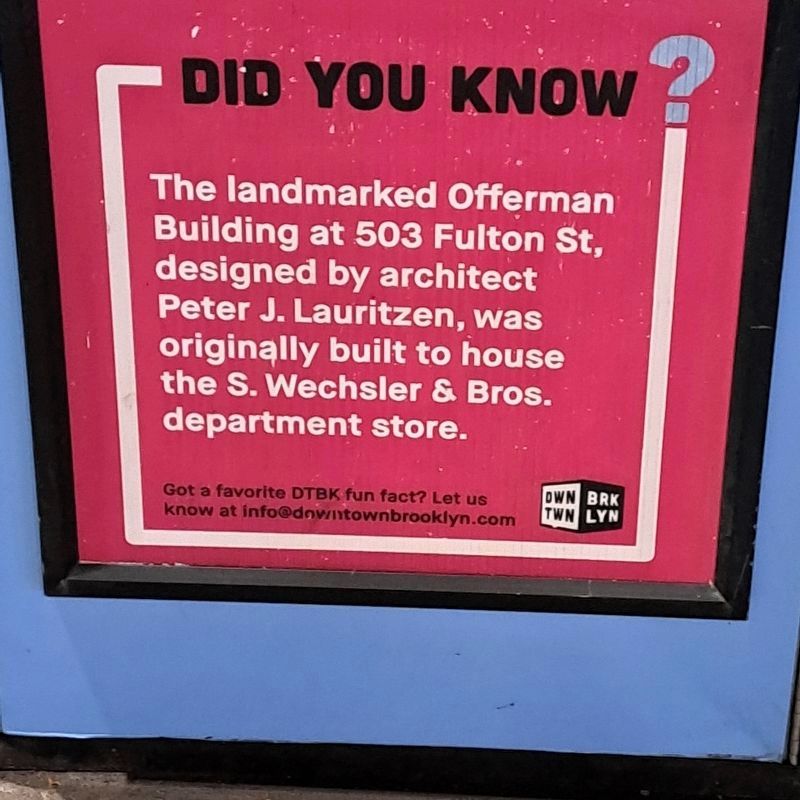
Photographed by Jack DePalma, February 21, 2026
1. Did You Know? Marker
Erected by Downtown Brooklyn Partnership.
Topics. This historical marker is listed in these topic lists: Architecture • Industry & Commerce • Landmarks. A significant historical year for this entry is 1890.
Location. 40° 41.511′ N, 73° 59.286′ W. Marker is in Brooklyn, New York, in Kings County. It is in Brooklyn Heights. It is at the intersection of Fulton Street and Pearl Street, on the right when traveling west on Fulton Street. Touch for map. Marker is at or near this postal address: 425 Pearl St, Brooklyn NY 11201, United States of America. Touch for directions.

Regionally, this marker is in New York City and on Long Island. It is also in the American Northeast, in the Mid-Atlantic, and on the Eastern Seaboard. Globally, it is in the North Atlantic Region, North America, the Western Hemisphere, the Western World, and the Anglosphere. Historically, it finds itself in what was once New Netherland and also one of the original Thirteen
this page online
Other nearby markers. At least 8 other markers are within walking distance of this marker: Residential Fulton Street (within shouting distance of this marker); Fulton Street / Downtown Brooklyn (within shouting distance of this marker); a different marker also named Did You Know? (within shouting distance of this marker); a different marker also named Did You Know? (within shouting distance of this marker); a different marker also named Did You Know? (within shouting distance of this marker); MetroTech / Downtown Brooklyn (within shouting distance of this marker); a different marker also named Did You Know? (within shouting distance of this marker); Seeing Into Tomorrow (within shouting distance of this marker). Touch for a list and map of all markers in Brooklyn.
Also see . . . Wikipedia entry. Excerpt:
When the building opened, the Brooklyn Times Union wrote that the edifice was a “palatial building”. The Brooklyn Daily Eagle wrote: “The splendid Fulton Street front and the fine facade on Duffield Street, vast and fine as they are, still do not prepare one fully for the great proportions and elegant vistas(Submitted on February 28, 2026, by Jack DePalma of Brooklyn,NY, New York.)of interior.” The Eagle wrote in 1892 that the building’s arch “is majestic in its proportions and greatly enhances the beautiful effect of the building”. Architectural writer Francis Morrone wrote in 2011 that “both the Fulton and the Duffield Street facades are Romanesque Revival extravaganzas” but that the Duffield Street facade was designed in a “much more austere manner” than that on Fulton Street. Lore Croghan of the Eagle wrote in 2016 that “the Offerman Building is a tasty piece of Romanesque Revival-style eye candy”.Photographed by Jack DePalma, February 22, 20262. Did You Know? MarkerIt is on the BetterBins litter basket pictured here.
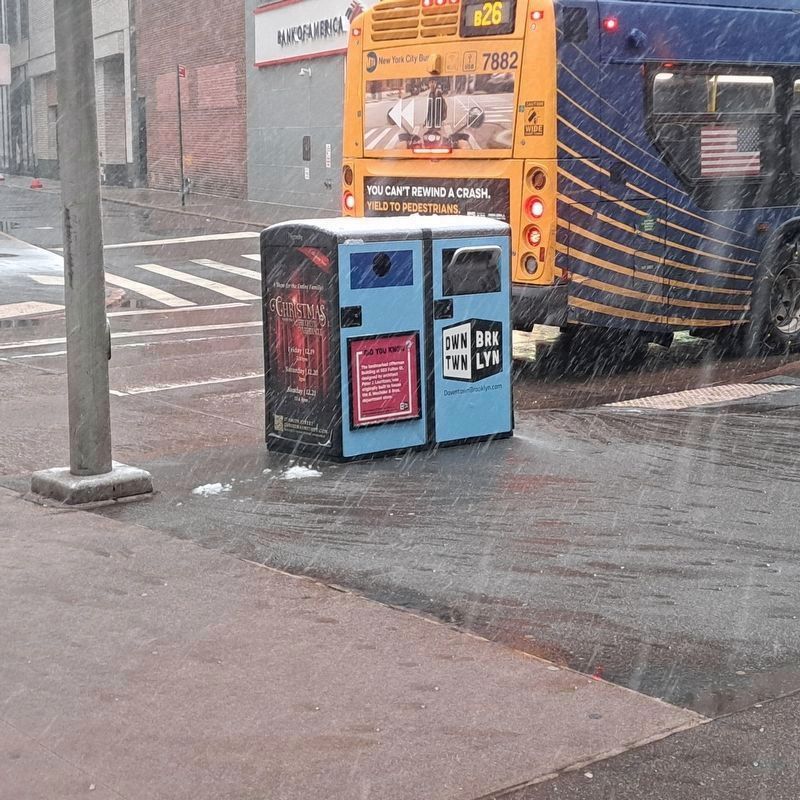
Additional commentary.
1. Offerman Building
"The Offerman Building is a historic building at 503–513 Fulton Street in the Downtown Brooklyn neighborhood of New York City, New York, U.S. Designed by Danish architect Peter J. Lauritzen in a Romanesque Revival style, the eight-story building was built between 1890 and 1892 as a commercial structure, housing the S. Wechsler & Brother department store. Although the lower stories remain in commercial use, the upper stories were converted into a 121-unit residential complex in the
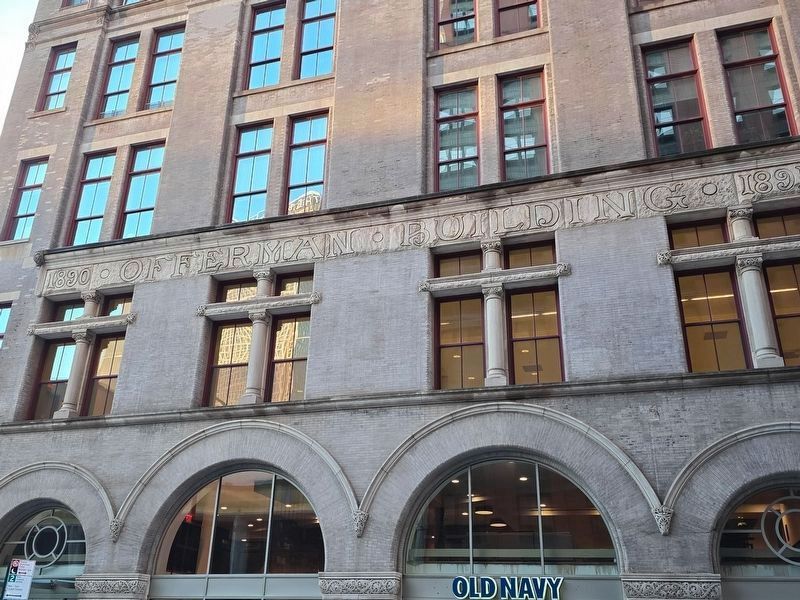
Photographed by Jack DePalma
3. The Offerman Building
— Submitted February 28, 2026, by Jack DePalma of Brooklyn,NY, New York.
Additional keywords. Offerman Building
Credits. This page was last revised on March 1, 2026. It was originally submitted on February 22, 2026, by Jack DePalma of Brooklyn,NY, New York. This page has been viewed 45 times since then. Last updated on February 26, 2026, by Jack DePalma of Brooklyn,NY, New York. Photos: 1. submitted on February 22, 2026, by Jack DePalma of Brooklyn,NY, New York. 2, 3. submitted on February 26, 2026, by Jack DePalma of Brooklyn,NY, New York. • Devry Becker Jones was the editor who published this page.
Editor’s want-list for this marker. A wide shot of the marker in context. • A photo of the Offerman Building. • A link to the National Register nomination form, citing the building's historical significance. • Can you help?
