Vauxhall in Lambeth in Greater London, England, United Kingdom — Northwestern Europe (the British Isles)
Kennington Palace
Photographed by Andrew Ruppenstein, February 26, 2026
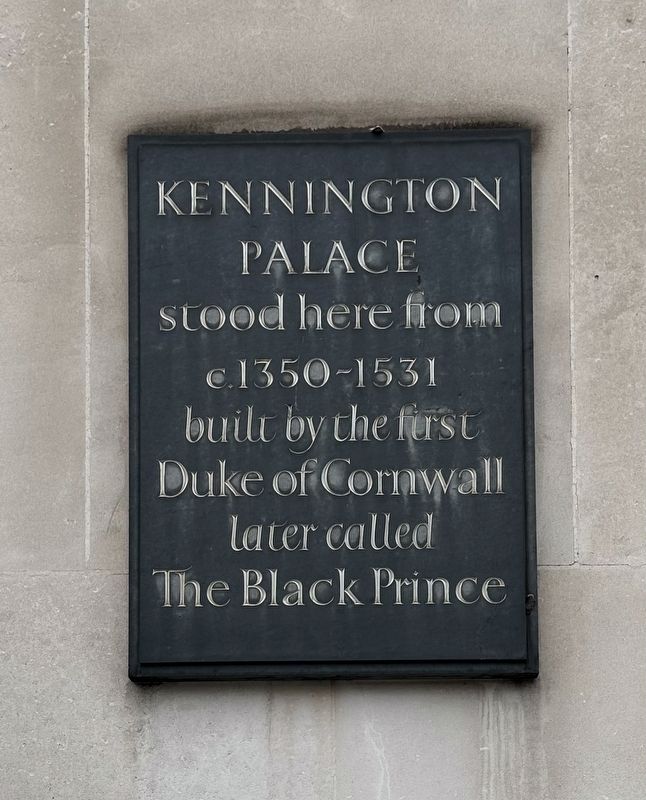
1. Kennington Palace Marker
Kennington Palace
stood here from
c.1350-1531
built by the first
Duke of Cornwall
later called
The Black Prince
Topics. This historical marker is listed in this topic list: Notable Buildings.
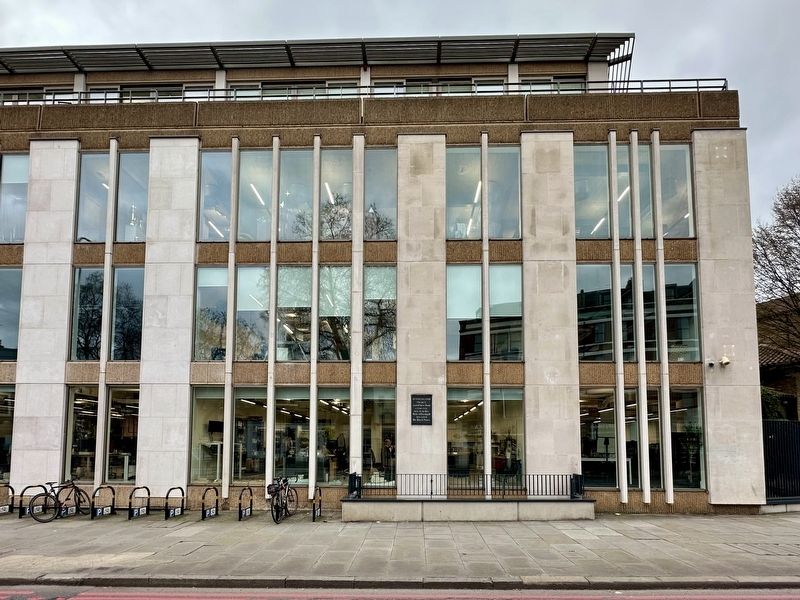
Location. 51° 29.3′ N, 0° 6.695′ W. Marker is in Lambeth, England, in Greater London. It is in Vauxhall. It is at the intersection of Kennington Lane and Kennington Road, on the left when traveling north on Kennington Lane. Touch for map. Marker is at or near this postal address: 182 Kennington Lane, Lambeth, England SE11 5DU, United Kingdom. Touch for directions.

Regionally, this marker is in London and in the Greater South East. Globally, it is on the Atlantic Ocean, in the North Atlantic Region, in Europe, in Atlantic Europe, on one of the British Isles, in the Western World, and in the Anglosphere. Historically, it finds itself in what was once the Roman Empire.
Other nearby markers. At least 8 other markers are within walking distance of this marker: Charlie Chaplin (about 120 meters away, measured in a direct line); a different marker also named Charlie Chaplin (about 120 meters away); Craigie Aitchison (approx. 0.6 kilometers away); The F.A. Cup (approx. 0.6 kilometers
this page online
Also see . . . Kennington Palace (Vauxhall History). Excerpt:
The building records of the time indicate clearly that the Black Prince was building at Kennington from the early 1340s until about 1350 and that during this period he built a Hall, a Prince’s chamber, and other chambers. Between 1353 and 1363 a new Hall was built with a chamber and wardrobe, a kitchen, bake house and pastry cook’s house, and some of the earlier buildings including the original Hall were demolished, though part of the first structure seems to have survived and to have been incorporated in the rebuilt Hall. At the end of this second phase of building the Palace consisted of a large Hall orientated east-west and measuring approximately 88 feet long by 53 feet wide: this was built entirely of stone with an undercroft sunk about 2 feet 6 inches below ground level with a chalk floor and stone-vaulted roof supporting the floor of the main Hall which was about 6 feet above ground level. At the east end of the Hall was a massive structure(Submitted on February 26, 2026.)two or three storeys high and about 87 feet long by 34 feet wide. This was the ‘Prince’s Chamber’ mentioned in the records, and in the angle between the two buildings was a small square structure interpreted as an enclosed stair and garderobe or latrine. To the west of the main Hall was a smaller building which served as a kitchen. There is considerable. evidence from contemporary writings that Kennington was used as a royal residence and as an occasional place of refuge for the King away from London politics.Photographed by Andrew Ruppenstein, February 26, 20262. Kennington Palace Marker - wide view
In 1531 the greater part of the Palace was demolished by Henry VIII to provide materials for his own Palace at Whitehall.
Credits. This page was last revised on February 26, 2026. It was originally submitted on February 26, 2026, by Andrew Ruppenstein of Lamorinda, California. This page has been viewed 24 times since then. Photos: 1, 2. submitted on February 26, 2026, by Andrew Ruppenstein of Lamorinda, California.
