Granada Hills in Los Angeles in Los Angeles County, California — The American West (Pacific Coastal)
Los Angeles Aqueduct Filtration Plant

Photographed by Craig Baker, February 26, 2026
1. Los Angeles Aqueduct Filtration Plant Marker
The California Outstanding Civil Engineering Achievement - 1988, Los Angeles Aqueduct Filtration Plant, designated by Los Angeles Section, ASCE, California State Council, ASCE.
Erected 1988 by American Society of Civil Engineers.
Topics and series. This historical marker is listed in these topic lists: Industry & Commerce • Natural Resources. In addition, it is included in the ASCE Civil Engineering Landmarks series list. A significant historical year for this entry is 1988.
Location. 34° 18.349′ N, 118° 29.208′ W. Marker is in Los Angeles, California, in Los Angeles County. It is in Granada Hills. It can be reached from Sepulveda Boulevard half a mile north of Roxford Street. Not open to the public. Touch for map. Marker is at or near this postal address: 13101 Sepulveda Blvd, Granada Hills CA 91344, United States of America. Touch for directions.

Regionally, this marker is in The Valley (the San Fernando Valley) and in the Transverse Ranges. It is also on the American Pacific Coast. Globally, it is in North America, on the Ring of Fire, on the Pacific Rim, in the Western Hemisphere, in the
this page online
Other nearby markers. At least 8 other markers are within 2 miles of this marker, measured as the crow flies: Kramer House (approx. 0.6 miles away); Edminster House (approx. 0.9 miles away); The Cascades (approx. 1.3 miles away); "The Cascades" (approx. 1.3 miles away); Rim of the Valley Trail (approx. 1½ miles away); O’Melveny Park (approx. 1½ miles away); Sayre Fire (approx. 1.8 miles away); Granada Hills Masonic Temple (approx. 1.8 miles away). Touch for a list and map of all markers in Los Angeles.
Regarding Los Angeles Aqueduct Filtration Plant. The 1987 commissioning of the Los Angeles Aqueduct Filtration Plant marked the beginning of a new era in water treatment and quality in Los Angeles. Treating up to 600 million gallons of water a day, the LAAFP is still one of the largest and most advanced facilities of its kind in the world.
Water entering the plant flows by gravity through several treatment processes. Ozone is injected into the water as it enters one of four large ozone contact

Photographed by Craig Baker, February 26, 2026
2. L.A. Aqueduct Filtration Plant
Dedicated April 1987.

Photographed by Craig Baker, February 26, 2026
3. Filtration Plant Administration Building
The marker is to the right of the doors.

Photographed by Craig Baker, February 26, 2026
4. Los Angeles Aqueduct Filtration Plant

Photographed by Craig Baker, February 26, 2026
5. Ozone Building
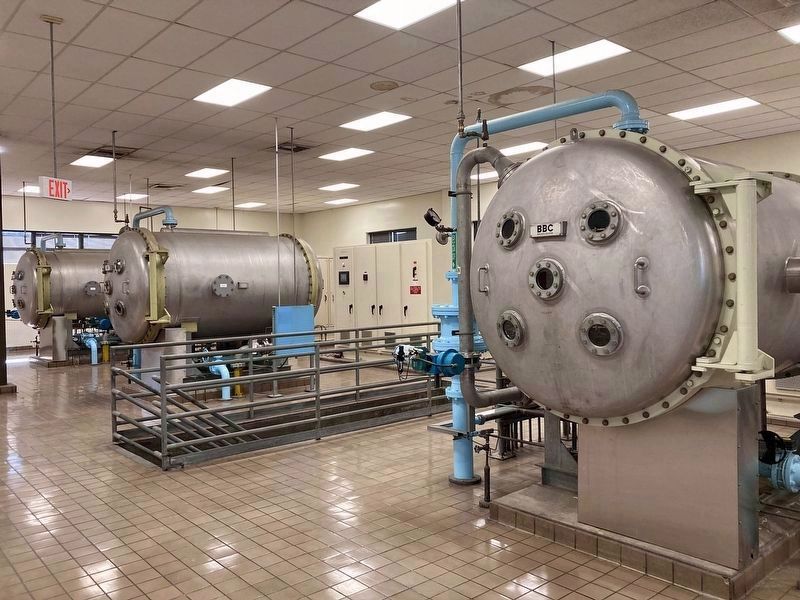
Photographed by Craig Baker, February 26, 2026
6. Ozone Building
A high voltage arc inside each oxygen tank produces ozone for water filtration.
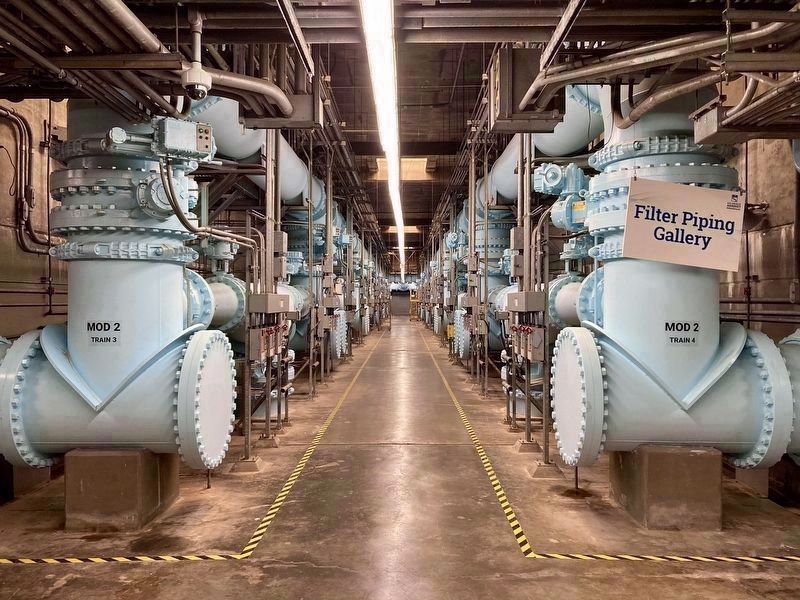
Photographed by Craig Baker, February 26, 2026
7. Filter Piping Gallery
In the basement of the Filtration Plant. Movies filmed here include Beverly Hills Cop III (1994) and Austin Powers: International Man of Mystery (1997).

Photographed by Craig Baker, February 26, 2026
8. Model of the Filtration Plant
The administration building is at top center. The aqueduct intake is at lower left.

Photographed by Craig Baker, February 26, 2026
9. Where We Get Our Water
L.A. Aqueduct. State Water Project. Colorado River Aqueduct. Local Groundwater.

Photographed by Craig Baker, February 26, 2026
10. Standby Generators
The one on the right was installed by yours truly, -C.B.

Photographed by Craig Baker, February 26, 2026
11. Los Angeles Reservoir
The 96 million shade balls ensure compliance with EPA water quality requirements. At thirty cents each, they cost almost 30 million dollars.

Photographed by Craig Baker, 2014
12. Nearby Ultraviolet Disinfection Facility
Photographed by an Electrician during construction in 2014.
Credits. This page was last revised on March 21, 2026. It was originally submitted on February 26, 2026, by Craig Baker of Sylmar, California. This page has been viewed 104 times since then. Photos: 1, 2, 3, 4, 5, 6, 7, 8, 9, 10, 11, 12. submitted on February 26, 2026, by Craig Baker of Sylmar, California.
