Schnaittach in Nürnberger Land, Bavaria, Germany — Central Europe
Das Schnaittacher Heimatmuseum und das Jüdische Museum Franken
The Schnaittach Local History Museum and the Jewish Museum of Franconia
Photographed by James Hulse, February 24, 2026
1. Das Schnaittacher Heimatmuseum und das Jüdische Museum Franken Marker

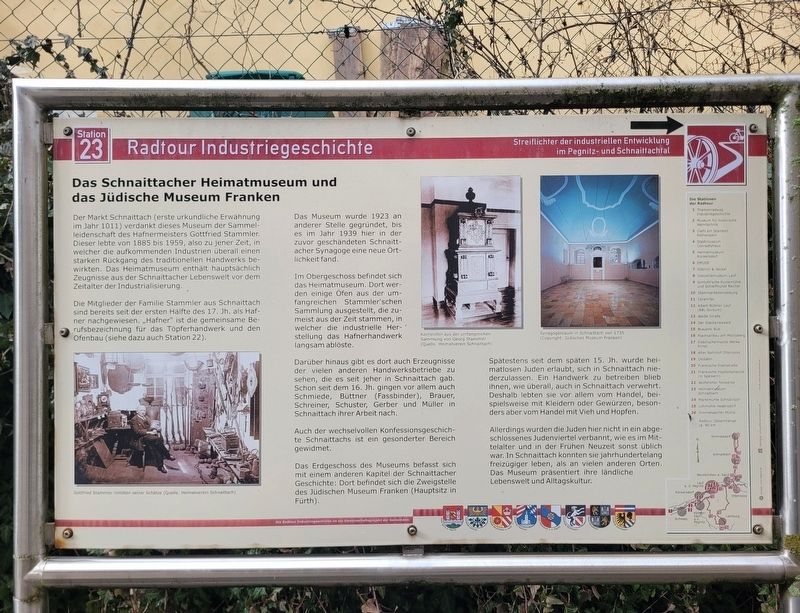
Der Markt Schnaittach (erste urkundliche Erwähnung im Jahr 1011) verdankt dieses Museum der Sammelleidenschaft des Hafnermeisters Gottfried Stammler. Dieser lebte von 1885 bis 1959, also zu jener Zeit, in welcher die aufkommenden Industrien überall einen starken Rückgang des traditionellen Handwerks bewirkten. Das Heimatmuseum enthält hauptsächlich Zeugnisse aus der Schnaittacher Lebenswelt vor dem Zeitalter der Industrialisierung.
Die Mitglieder der Familie Stammler aus Schnaittach sind bereits seit der ersten Hälfte des 17. Jh. als Hafner nachgewiesen. „Hafner" ist die gemeinsame Berufsbezeichnung für das Töpferhandwerk und den Ofenbau (siehe dazu auch Station 22).
Das Museum wurde 1923 an anderer Stelle gegründet, bis es im Jahr 1939 hier in der zuvor geschändeten Schnaittacher Synagoge eine neue Örtlichkeit fand.
Im Obergeschoss befindet sich das Heimatmuseum. Dort werden einige Öfen aus der umfangreichen Stammler'schen Sammlung ausgestellt, die zumeist aus der Zeit stammen, in welcher die industrielle Herstellung das Hafnerhandwerk langsam ablöste.
Darüber hinaus gibt es dort auch Erzeugnisse
this page online
Auch der wechselvollen Konfessionsgeschichte Schnaittachs ist ein gesonderter Bereich gewidmet.
Das Erdgeschoss des Museums befasst sich mit einem anderen Kapitel der Schnaittacher Geschichte: Dort befindet sich die Zweigstelle des Jüdischen Museum Franken (Hauptsitz in Fürth).
Spätestens seit dem späten 15. Jh. wurde heimatlosen Juden erlaubt, sich in Schnaittach niederzulassen. Ein Handwerk zu betreiben blieb ihnen, wie überall, auch in Schnaittach verwehrt. Deshalb lebten sie vor allem vom Handel, beispielsweise mit Kleidern oder Gewürzen, besonders aber vom Handel mit Vieh und Hopfen.
Allerdings wurden die Juden hier nicht in ein abgeschlossenes Judenviertel verbannt, wie es im Mittelalter und in der Frühen Neuzeit sonst üblich war. In Schnaittach konnten sie jahrhundertelang freizügiger leben, als an vielen anderen Orten. Das Museum präsentiert ihre ländliche Lebenswelt und Alltagskultur.
Gottfried Stammler inmitten seiner Schätze (Quelle: Heimatverein Schnaittach)
Kachelofen aus der umfangreichen Sammlung von Georg Stammler (Quelle: Heimatverein Schnaittach)
Synagogenraum in Schnaittach von 1735 (Copyright: Jüdisches Museum Franken)
The
Photographed by James Hulse, February 24, 2026
2. Local History Museum and the Jewish Museum of Franconia
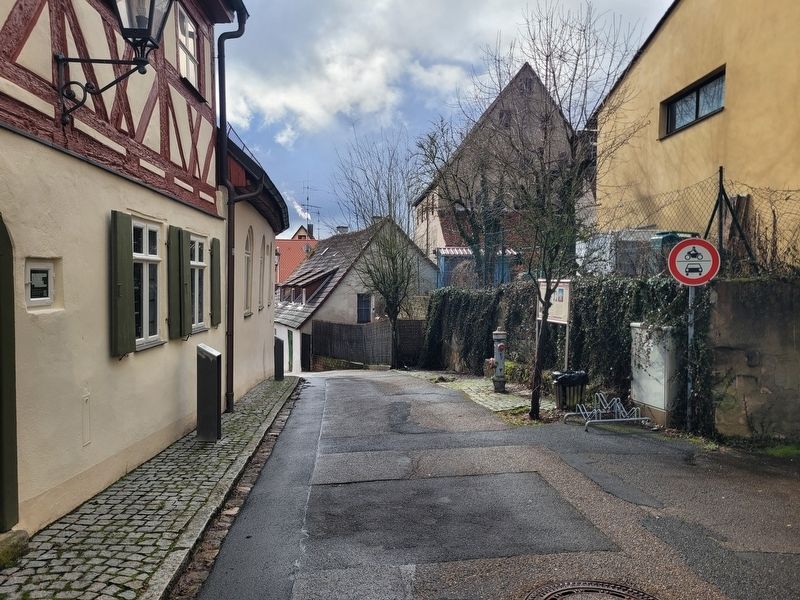
The marker is located across the street from the Museum.
Members of the Stammler family from Schnaittach have been documented as potters since the first half of the 17th century. “Hafner” is the common occupational term for both pottery and stove building (see also Station 22).
The museum was founded in 1923 at another location until, in 1939, it found a new home here in the previously desecrated Schnaittach synagogue.
On the upper floor is the local history museum. There, several stoves from the extensive Stammler collection are displayed, most of them dating from the period when industrial production gradually replaced the traditional potter’s trade.
In addition, products of the many other craft businesses that have long existed in Schnaittach can be seen there. Since the 16th century, blacksmiths,
Photographed by James Hulse
3. Local History Museum and the Jewish Museum of Franconia
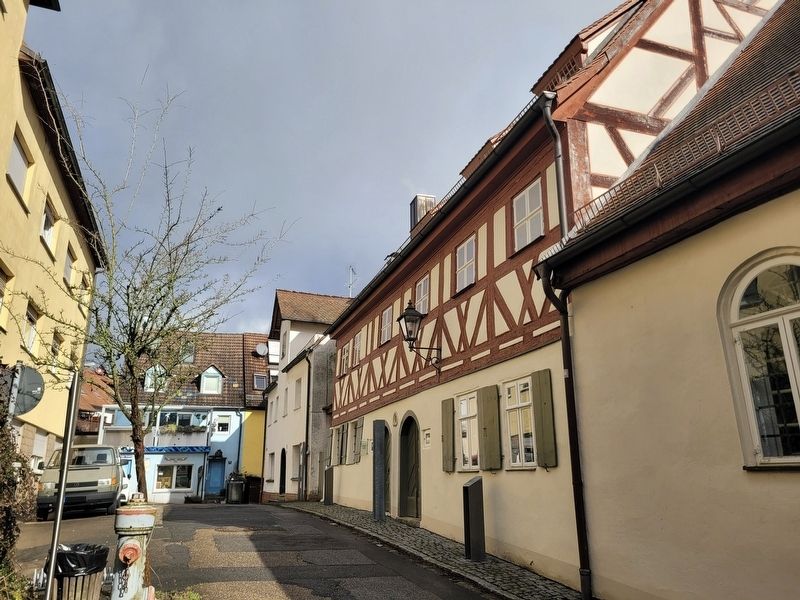
The main entrance to the Museum.
A separate section is devoted to Schnaittach’s eventful confessional history.
The ground floor of the museum deals with another chapter of Schnaittach’s history: it houses the branch of the Jewish Museum of Franconia (main site in Fürth).
From at least the late 15th century onward, homeless Jews were permitted to settle in Schnaittach. As elsewhere, they were not allowed to practice a craft. Therefore, they lived primarily from trade, for example in clothing or spices, but especially from trading livestock and hops.
However, the Jews here were not confined to a closed Jewish quarter, as was common in the Middle Ages and the early modern period. In Schnaittach they were able to live more freely for centuries than in many other places. The museum presents their rural way of life and everyday culture.
Gottfried Stammler surrounded by his treasures (Source: Schnaittach Local History Association)
Tiled stove from the extensive collection of Georg Stammler (Source: Schnaittach Local History Association)
Synagogue interior in Schnaittach from 1735 (Copyright: Jewish Museum of Franconia)
Erected by The
Photographed by James Hulse, February 24, 2026
4. Local History Museum and the Jewish Museum of Franconia
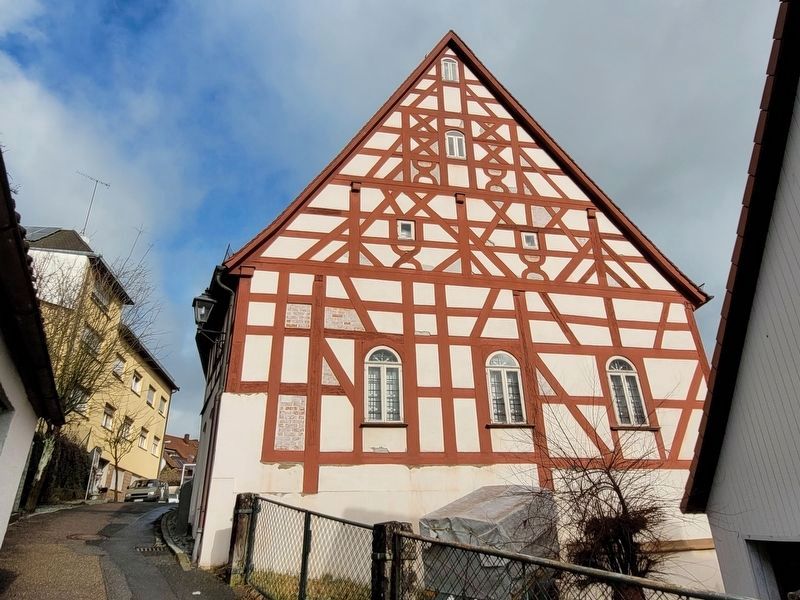
The view of the south end of the synagogue.
Topics. This memorial is listed in this topic list: Religion & Religious Structures. A significant historical year for this entry is 1885.
Location. 49° 33.471′ N, 11° 20.463′ E. Memorial is in Schnaittach, Bayern (Bavaria), in Nürnberger Land. It is on Museumsgasse just south of Birkensteingasse, on the right when traveling south. Touch for map. Memorial is at or near this postal address: Museumsgasse 12, Schnaittach BY 91220, Germany. Touch for directions.

Regionally, this memorial is in German Franconia. Globally, it is in Europe, the European Union, Atlantic Europe, Central Europe, the Schengen Area, Western Europe, and the Western World. Historically, it finds itself in what was once the Holy Roman Empire and also the former West Germany.
Other nearby markers. At least 8 other markers are within walking distance of this marker: Synagogue (here, next to this marker); Frauenschul / Women’s Prayer Room (here, next to this marker); Vorsängerhaus / Cantor’s House (a few steps from this marker); Moses Gutmann (a few steps from this marker); Rabbinerhaus/ Rabbi’s House (a few steps from this marker); Paula Gutmann (a few steps from this marker); Die Museen / The Museums (within shouting distance of this marker); Flora Altbater (within shouting distance of this marker). Touch for a list and map of all markers in Schnaittach.
Credits. This page was last revised on March 3, 2026. It was originally submitted on March 2, 2026, by James Hulse of Medina, Texas. This page has been viewed 40 times since then. Photos: 1, 2, 3, 4. submitted on March 3, 2026, by James Hulse of Medina, Texas.
