Medford in Middlesex County, Massachusetts — The American Northeast (New England)
“Grandfather’s House”
Photographed by Roger W. Sinnott, January 28, 2012
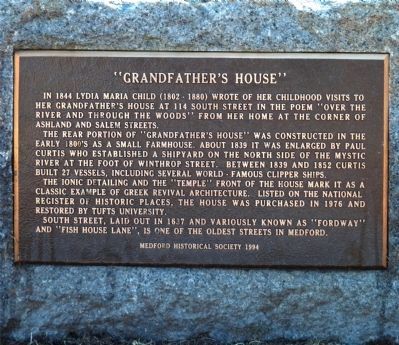
1. “Grandfather’s House” Marker
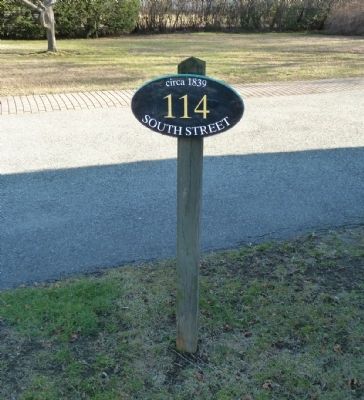
In 1844 Lydia Maria Child (1802 – 1880) wrote of her childhood visits to her grandfather’s house at 114 South Street in the poem “Over the River and Through the Woods” from her home at the corner of Ashland and Salem Streets.
The rear portion of “Grandfather’s House” was constructed in the early 1800’s as a small farmhouse. About 1839 it was enlarged by Paul Curtis who established a shipyard on the north side of the Mystic River at the foot of Winthrop Street. Between 1839 and 1852 Curtis built 27 vessels, including several world-famous clipper ships.
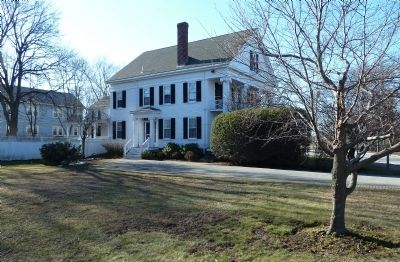
The ionic detailing and the “temple” front of the house mark it as a classic example of Greek revival architecture. Listed on the National Register of Historic Places, the house was purchased in 1976 and restored by Tufts University.
South Street, laid out in 1637 and variously known as “Fordway” and “Fish House Lane”, is one of the oldest streets in Medford.
Erected 1994 by the Medford Historical Society.
Topics. This historical marker is listed in these topic lists: Arts, Letters, Music • Entertainment. A significant historical year for this entry is 1844.
Location. 42° 25.046′ N,
this page online

Regionally, this marker is in Historic Boston and specifically in Greater Boston. It is also in the American Northeast, in New England, and on the Eastern Seaboard. Globally, it is in the North Atlantic Region, North America, the Western Hemisphere, the Western World, and the Anglosphere. Historically, it finds itself in what was once one of the original Thirteen Colonies.
Other nearby markers. At least 8 other markers are within walking distance of this marker: Medford Revolutionary War Memorial (approx. 0.2 miles away); Captain Isaac Hall Hitching Post (approx. 0.3 miles away); “Jingle Bells” Composed Here (approx. 0.3 miles away); The Isaac Royall House (approx. 0.4 miles away); Salem Street Burying Ground (approx. 0.4 miles away); Cemetery for the Enslaved (approx. 0.4 miles away);
Photographed by Roger W. Sinnott, January 28, 2012
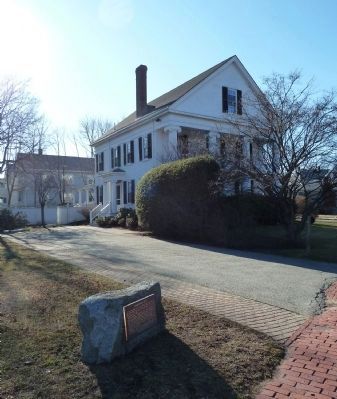
2. Today’s House with Marker in Yard
The farmhouse that belonged to Lydia Maria Child’s grandfather was considerably enlarged in 1839 when it became the home of shipbuilder Paul Curtis. Today the building is owned by Tufts University and used as a faculty residence.
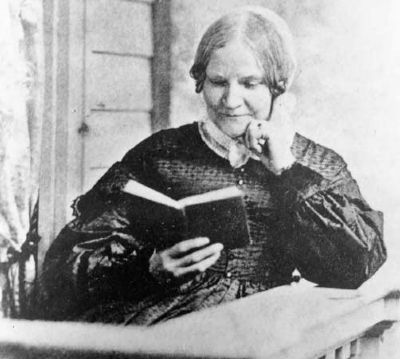
Regarding “Grandfather’s House”. During her lifetime, Lydia Maria Child became much better known as an abolitionist and activist for the rights of women and Native Americans. She wrote novels, advice books, poems, and worked as a journalist. Today, however, she perhaps best known the song lyrics that begin, "Over the river and through the woods..."
Her original poem, “A Boy’s Thanksgiving Day,” first appeared in Child’s Flowers for Children, Vol. 2, 1844. The following stanzas are the most familiar:
Over the river, and through the wood,
To Grandfather’s house we go;
The horse knows the way to carry the sleigh
Through the white and drifted snow.
Over the river, and through the wood,
To Grandfather’s house away!
We would not stop for doll or top,
For ’tis Thanksgiving Day.
Over the river, and through the wood —
Oh, how the wind does blow!
It stings the toes and bites the nose,
As over the ground we go.
Over the river, and through the wood
And straight through the barnyard gate.
We seem to go extremely slow —
It is so hard to wait!
Over the river, and through the wood —
When Grandmother sees us come,
She will say, “o, dear, the children are here,
Bring a pie for every one.”
Over the river, and through the wood —
Now Grandmother’s cap I spy!
Hurrah for the fun! Is the pudding done?
Hurrah for the pumpkin pie!
In
Photographed by Roger W. Sinnott, January 28, 2012
3. Side View of House
Also see . . .
1. Wikipedia entry for Lydia Maria Child. More about her life and work. (Submitted on February 5, 2012, by Roger W. Sinnott of Norwell, Massachusetts.)
2. Wikipedia entry on the original poem. (Submitted on February 5, 2012, by Roger W. Sinnott of Norwell, Massachusetts.)
3. Women’s History article. A biography of Lydia Maria Child by Jone Johnson Lewis. (Submitted on February 5, 2012, by Roger W. Sinnott of Norwell, Massachusetts.)
Photographed by Wikimedia Commons
4. Lydia Maria Child (1802–1880)
Photographed by Roger W. Sinnott, January 28, 2012
5. Street Number Sign
Photographed by Roger W. Sinnott, January 28, 2012
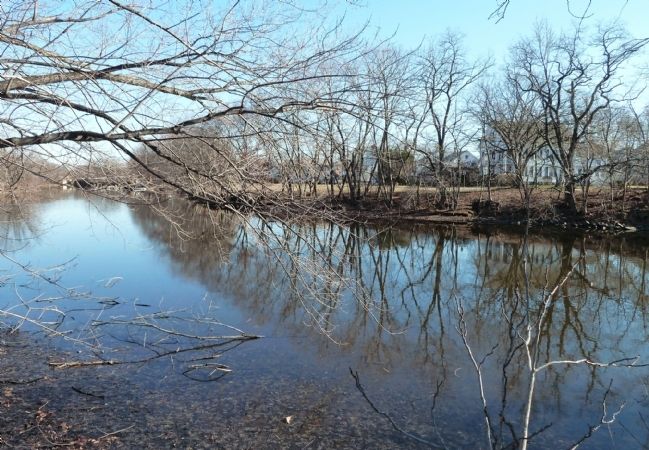
6. Mystic River Looking East
Credits. This page was last revised on March 3, 2026. It was originally submitted on February 5, 2012, by Roger W. Sinnott of Norwell, Massachusetts. This page has been viewed 1,627 times since then and 89 times this year. Last updated on March 2, 2026, by Mary Mangan of Somerville, Massachusetts. Photos: 1, 2, 3, 4, 5, 6. submitted on February 5, 2012, by Roger W. Sinnott of Norwell, Massachusetts. • Devry Becker Jones was the editor who published this page.
