
Camden in Greater London, England, United Kingdom — Northwestern Europe (the British Isles)
St Pancras Station

Photographed by Andrew Ruppenstein, February 28, 2026
1. St Pancras Station Marker
Built originally by the Derby based Midland Railway Company as its London terminus.
The station was opened in 1868 and is now Grade 1 listed.
Consulting engineer: W H Barlow
Principal contractor: The Butterley Company
Topics. This historical marker is listed in this topic list: Railroads & Streetcars. A significant historical date for this entry is October 1, 1868.
Location. 51° 31.867′ N, 0° 7.518′ W. Marker is in Camden, England, in Greater London. It is on Euston Road. Touch for map. Marker is at or near this postal address: Euston Road, Camden, England N1C 4AL, United Kingdom. Touch for directions.

Regionally, this marker is in the Greater South East. Globally, it is on the Atlantic Ocean, in the North Atlantic Region, in Europe, in Atlantic Europe, on one of the British Isles, in the Western World, and in the Anglosphere. Historically, it finds itself in what was once the Roman Empire.
Other nearby markers. At least 8 other markers are within walking distance of this marker: Channel Tunnel Anniversary (a few steps from this marker); King’s Cross Station (about 90 meters away, measured in a direct line);
this page online
Also see . . . St Pancras Railway Station (Wikipedia). Excerpt:
The station was constructed by the Midland Railway (MR), to connect its extensive rail network, across the Midlands and North of England, to a dedicated line into London. After rail traffic problems following the 1862 International Exhibition, the MR decided to build a connection from Bedford to London with its own terminus. The station was designed by William Henry Barlow, with wrought iron pillars supporting a single-span roof. At 689 feet (210 m) by 240 feet (73.2 m) wide, and 100 feet (30.5 m) high, it was then the largest enclosed space in the world. Following the station's opening 1 October 1868, the MR built the Midland Grand Hotel on the station's façade. George Gilbert Scott won the competition(Submitted on March 4, 2026.)to design it, with an ornate Gothic red-brick scheme. St Pancras has been widely praised for its architecture and is now a Grade I listed building.Photographed by Andrew Ruppenstein, February 28, 20262. St Pancras Station Marker - wide viewThe marker is visible here in the foyer at the eastern ground-level entrance to the station.
St Pancras came under threat during the 20th century; damaged in both World War I and World War II by bombs, and then in the late 1960s by plans to demolish it entirely and divert services to King's Cross and Euston stations. A passionate campaign to save the station, led by the Victorian Society, Jane Hughes Fawcett, and Poet Laureate John Betjeman, was successful, and St Pancras was awarded Grade I listed status just 10 days before demolition was due to commence.

Additional keywords. blue plaque
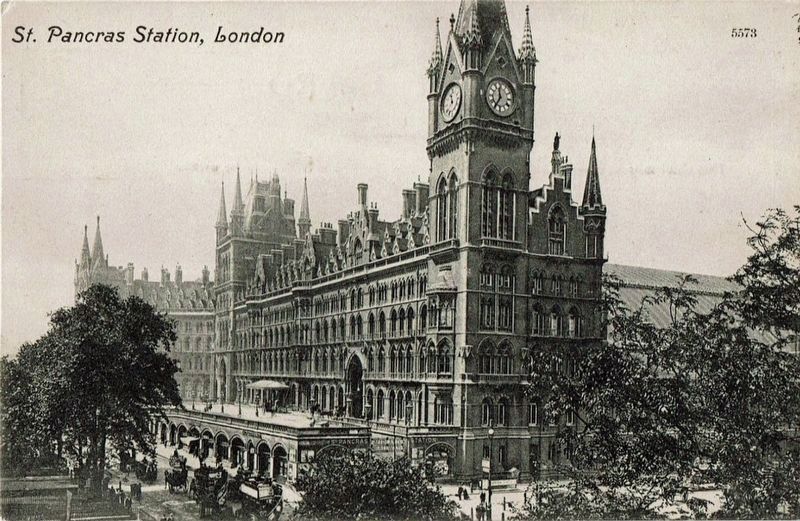
circa 1910
3. St Pancras Station
The marker is by the ground-level entrance on the east side of the station, which would be visible here but for the branches on the right-hand side of this picture.
Credits. This page was last revised on March 4, 2026. It was originally submitted on March 4, 2026, by Andrew Ruppenstein of Lamorinda, California. This page has been viewed 28 times since then. Photos: 1, 2, 3. submitted on March 4, 2026, by Andrew Ruppenstein of Lamorinda, California.
