Durango in La Plata County, Colorado — The American Mountains (Southwest)
Emma Sweeny — Movie Star

Photographed by Cosmos Mariner, July 16, 2025
1. Emma Sweeny — Movie Star Marker
A Ticket to Tomahawk
• In August and September 1949 20th Century Fox filmed A Ticket to Tomahawk, mainly in the Durango and Silverton area, with camp scenes at their studio in Los Angeles.
• The cast included four dance hall girls, one of whom was then-unknown Marilyn Monroe.
• The real steam locomotive RGS 20 was used in shots on tracks in Silverton, Animas Canyon, and on the old RGS trestle over Lightner Creek just west of Durango.
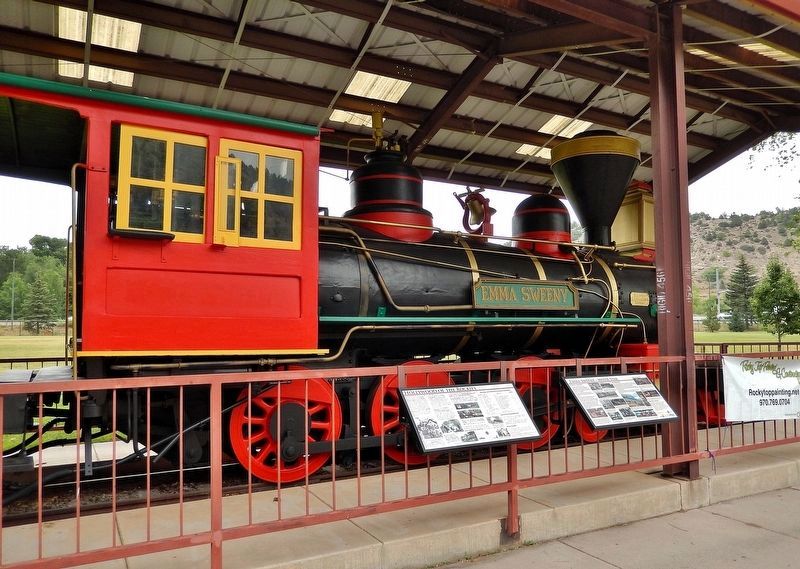
• Studio craftsmen built a full-size replica of RGS 20 as Emma Sweeny for use in scenes off the tracks in Silverton and Durango, on Molas Pass, and camp scenes at their studio.
The Movie Plot
Set in 1876, the movie is about getting a train and at least one paying passenger to Tomahawk by a deadline a few days away, to fulfill a contract and save the franchise.
However, 40 miles of track are missing between Epitaph and Tomahawk, so the locomotive is pulled over a mountain by a team of mules.
A competing stagecoach line will do anything to prevent Emma Sweeny from arriving at Tomahawk before the deadline.
Petticoat Junction
In 1960 the studio sold Emma Sweeny to a private party. The model was leased
this page online
Amador County, California
In March 1980 the model was donated to Amador County. It was renamed Amador Cannonball and displayed in Jackson, Amador County. Many original parts were missing.
Durango, Colorado
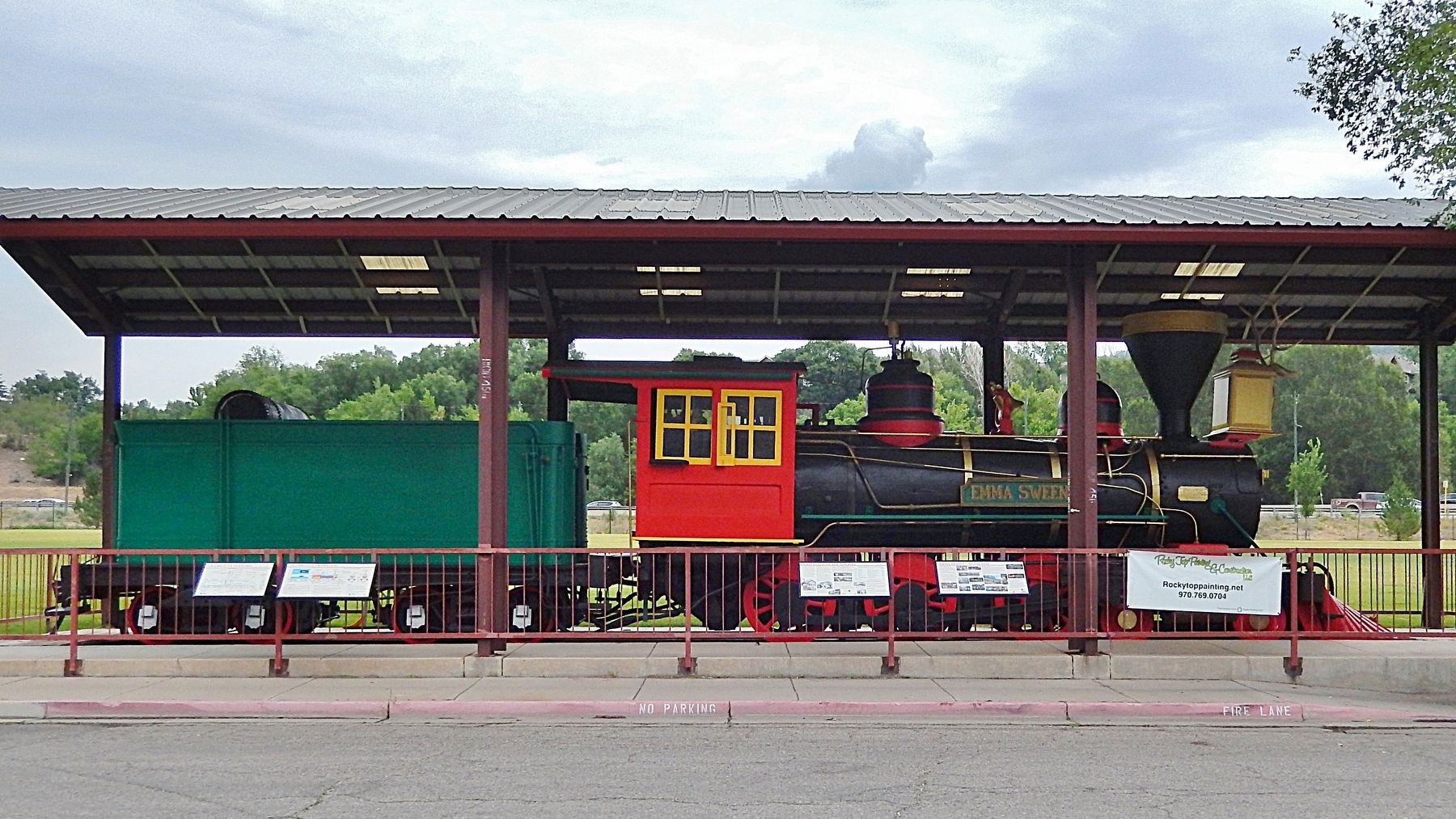
In April 2011 Amador County donated the model to the Durango Railroad Historical Society. DRHS restored it during 2011-17 to its original movie appearance. Fortunately, copies of studio drawings were found, allowing an accurate restoration.
[photo captions]
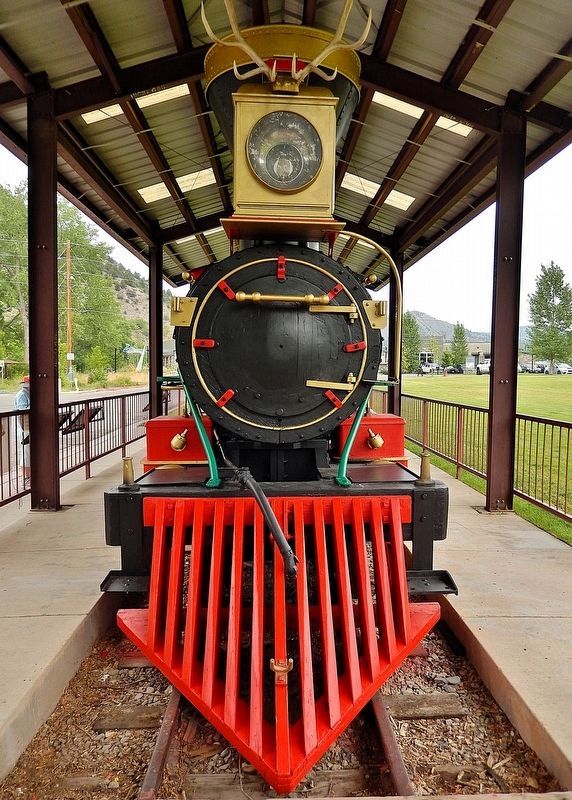
• August 1949. Rio Grande Southern Locomotive #20 (RGS 20) at the Silverton depot, dressed up for its movie role as Emma Sweeny. Movie props include the funnel stack, headlight with elk antlers, long pilot (cowcatcher), and link-and-pin coupler. The locomotive, originally black, was gaily painted and had much artwork added.
• July 1949. Building the model Emma Sweeny in the studio prop shop.
• August 1949. One of the trailer loads of the partially assembled Emma Sweeny model and its parts arrives in Silverton for final assembly.
Photographed by Cosmos Mariner, July 16, 2025
2. Emma Sweeny — Movie Star Marker
This marker is the rightmost of two interpretive panels beside the Emma Sweeny locomotive on exhibit in Santa Rita Park.
• The model Emma Sweeny is ready to be pulled down Blair Street in Silverton by a team of twenty mules.
• Filming with RGS 20 along the High Line in Animas Canyon. The flatcar holds the camera and its crew.
• On the old airfield where Fort Lewis College now stands, during an Indian raid scene.
• Emma Sweeny (RGS 20) train in Animas Valley with two flatcars for movie equipment and crew.
• October 1949. Rory Calhoun (outlaw), Anne Baxter (deputy sheriff), Dan Dailey (salesman), and Walter Brennan (engineer) in a camp scene at the studio.
• The engine and tender of the model Emma Sweeny are pulled separately by mules over Molas Pass. Parts of it are carried by people or hauled on wagons or travois. (The road was one lane of gravel at that time.)
• Restored front end at Santa Rita Park in summer 2017.
• Right side of restored model locomotive at Santa Rita Park in summer 2017.
For more information read: The Movie Railroads, 1985 and Hollywood’s Railroads, Vol. 3: Narrow Gauge Country, 2015, both by Larry Jensen.
Erected 2017 by Durango Railroad Historical Society.
Topics. This historical marker is listed in these topic lists:

Photographed by Cosmos Mariner, July 16, 2025
3. Emma Sweeny Locomotive
Location. 37° 15.69′ N, 107° 52.73′ W. Marker is in Durango, Colorado, in La Plata County. It is on Santa Rita Drive just west of South Camino Del Rio (U.S. 160/550), on the right when traveling west. The marker is in front of the Emma Sweeny locomotive exhibit in Santa Rita Park. Touch for map. Marker is at or near this postal address: 111 South Camino Del Rio, Durango CO 81301, United States of America. Touch for directions.

Regionally, this marker is in the American Mountain West and at the Four Corners. Globally, it is in North America, the Rocky Mountains, the Western Hemisphere, the Western World, and the Anglosphere. Historically, it finds itself in what was once the territory of the Ancestral Puebloans.
Other nearby markers. At least 8 other markers are within walking distance of this marker: Hollywood of the Rockies (here, next to this marker); Durango's Smelter (within shouting distance of this marker); Santa Rosa Community, circa 1948 (within shouting distance of this marker); Santa Rita (about 400 feet away, measured in a
Photographed by Cosmos Mariner, July 16, 2025
4. Emma Sweeny Front End
Related markers. Click here for a list of markers that are related to this marker. Emma Sweeny
Also see . . . Emma Sweeny History (Durango Railroad Historical Society).
Excerpt: The 1899 Schenectady locomotive RGS 20 (4-6-0, Ten-Wheeler), originally F&CC 20, acted as T&W 1, Emma Sweeny [in A Ticket to Tomahawk]. It was adorned with false funnel stack, long wooden pilot, link and pin coupler, oil or kerosene headlight box over the electric light with a set of six-point antlers on top, and a fancy and colorful paint scheme, including three-masted sailing ships on both sides of tender.(Submitted on March 9, 2026, by Cosmos Mariner of Cape Canaveral, Florida.)The Twentieth Century Fox Prop Shop built the accurate, full-size model locomotive in the summer of 1949. It has a steel frame, with wood, fiberglass, and metal parts, and weighs about 18,000 pounds. “The model was so good, it could fool experts” exclaimed Hank Philips, retired fireman
who worked as fireman on RGS 20 and was a stand-in for Arthur Hunnicutt.Photographed by Cosmos Mariner, July 16, 20255. Emma Sweeny CabBecause the model had to be pulled, it has a steel frame, steel pipe axles, and iron rims on wood wheels. Most of the model is wood, but some parts are metal or fiberglass. For example, handholds, fire door, ladder, journal box covers, and several brackets are metal. The steam dome, sand box, and much of the boiler are fiberglass. Piping, pipefittings, and valves are real.

Photographed by Cosmos Mariner, July 16, 2025
6. Emma Sweeny Exhibit
Credits. This page was last revised on March 9, 2026. It was originally submitted on March 6, 2026, by Cosmos Mariner of Cape Canaveral, Florida. This page has been viewed 27 times since then. Photos: 1, 2. submitted on March 8, 2026, by Cosmos Mariner of Cape Canaveral, Florida. 3, 4, 5, 6. submitted on March 9, 2026, by Cosmos Mariner of Cape Canaveral, Florida.
