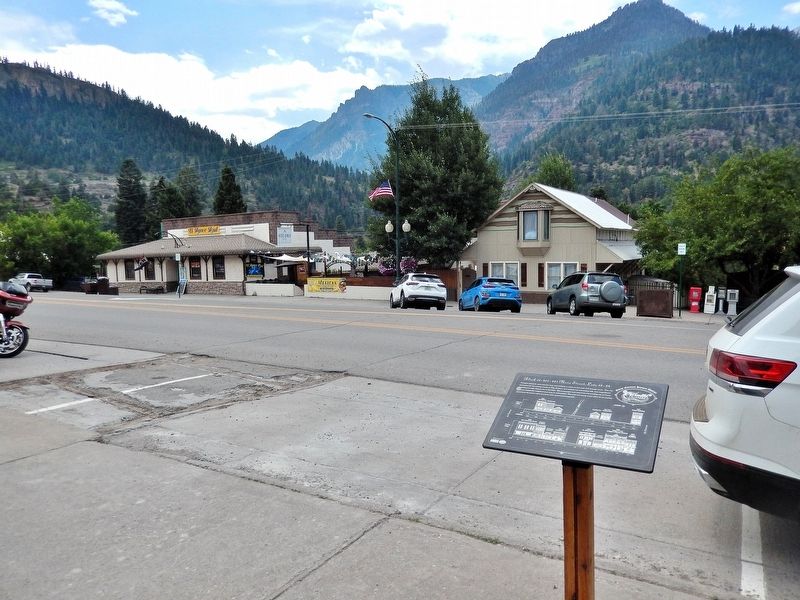
Block 12: 400-447 Main Street
Lots 13-24
| — | Ouray National Historic District | — |

Imagine being an early pioneer here and building a cabin on the main trail through town. You are fascinated by the passing bands of Ute Indians, and admire the cascading falls, and magnificent amphitheatre high above you to the east. Uncompahgre soon becomes the bustling city of Ouray and your residential neighborhood turns to commerce. The artist has made every effort to accurately reproduce this block's early structures from archival photographs.
Erected 2005 by Colorado Historical Society and Ouray County Historical Society.
Topics and series. This historical marker is listed in these topic lists: Architecture • Industry & Commerce • Settlements & Settlers. In addition, it is included in the National Register of Historic Places (NRHP) series list.
Location. 38° 1.265′ N, 107° 40.281′ W. Marker is in Ouray, Colorado, in Ouray County. It is on Main Street (U.S. 550) just north of 4th Avenue, on the right when traveling north. The marker is on the sidewalk in front of the Ouray Elks Lodge. Touch for map. Marker is at or near this postal address: 421 Main
this page online

Regionally, this marker is in the Western Slope. It is also in the American Mountain West. Globally, it is in North America, the Rocky Mountains, the Western Hemisphere, the Western World, and the Anglosphere.
Other nearby markers. At least 8 other markers are within walking distance of this marker: Box Canon Sign (here, next to this marker); Ouray Elks Lodge (a few steps from this marker); Beaumont Restoration (within shouting distance of this marker); Beaumont (about 300 feet away, measured in a direct line); Block 11: 500-548 Main Street (about 400 feet away); Block 19: 501-545 Main Street (about 400 feet away); True Grit Landmark #10 (about 700 feet away); The Walsh Bell (about 700 feet away). Touch for a list and map of all markers in Ouray.
Regarding Block 12: 400-447 Main Street. Contributing properties, Ouray Historic District, National Register of Historic Places № 83003537. Also, Colorado State Register of Historic Properties Site № 5OR.585.
From the National Register Nomination prepared by Martha Sullenberger and Roger Henn, 7/27/1981:
TheOuray Historic District encompasses almost the entire town which retains, to an amazing degree, its historic character spanning the period 1886 to 1915. These years encompass the height of Ouray’s importance as a supply center for nearby mining regions, and they also saw the architectural maturing of the town from a rude frame-dominated camp to a brick and stone, prosperous city. In this framework, Ouray is important as an example of the process of urbanization on the mining frontier in the last decade of the century. Along with Silverton and Telluride, Ouray was the principal town in the San Juan mining district, ranked as the third largest producing mining district in Colorado between 1893-1915 and first on the western slope. Ouray is a fine example of late 19th century architecture and a physical reminder of mining history in the San Juans.Photographed by Cosmos Mariner, July 15, 20252. Block 12: 400-447 Main Street MarkerLooking southwest across Main Street.Ouray had its beginnings as a town in 1875 when prospectors from Silverton worked their way into Ouray via Bear Creek and the Uncompahgre River searching for ore. The following spring the new community witnessed a rush and developed into a burgeoning mining camp. The town was surveyed and formally
incorporated in 1876. It had a population of 400 with 214 buildings (mostly log), a school with 43 children in attendance, four general stores, one sawmill, one ore sampling works, two hotels, and a post office. In 1877, Ouray County was established. With the removal of the Utes in 1881, the northern portion of the county was opened to ranching and homesteading. In 1882 Otto Mears constructed a toll road to the new region and Ouray was quickly taking on the trappings of a true urban center. Brick buildings began to replace the less permanent, more hazardous frame ones. By 1885, the town had a population of 1800. The silver crash of 1893 proved a temporary disaster to Ouray, as for the entire San Juan region which had primarily been a silver mining area. After a brief depression Ouray continued to grow and thrive because of rich gold mines which had been developed on Gold Hill, just north of Ouray. Ouray reached its peak around the turn-of-the-century. By 1900 it had a population of 2,196. Many large, predominantly Queen Anne style homes were built, concentrated in the southeast section of town. The commercial district contained manyPhotographed by Cosmos Mariner, July 15, 20253. St. Elmo Hotel (1899)From the National Register Nomination:
Two-story brick structure with central doorway flanked by two double hung 4-light windows. Round arch surrounds on windows and door. Double hung windows with segmental arched surrounds are found on the second floor. A plain brick and wood bracketed cornice top the structure.The St. Elmo Hotel was built in 1899 by Mrs. Kitty Heit who ran the Bon Ton restaurant in a frame building which stood adjoining the hotel on the north. The hotel originally catered to miners and as such is an important link to understanding the lifestyle of the miner in Ouray. The original brick wall facing the street was covered with stucco sometime in the 1950s. The present owners have (1982) removed the stucco, uncovering the original brick front.
brick structures ornately finished with cast iron facades or Italianate or Romanesque brickwork.Photographed by Cosmos Mariner, July 15, 20254. Wright’s Opera House (1888) and the Wright Building (1881)From the National Register Nomination:
This structure has one of the most elaborate and magnificent Mesker Brothers cast-iron facades in Colorado. The two-story brick Italianate structure has nearly every inch of its front facade covered with cast-iron detailing. The first floor has two doorways flanked by fixed flush windows and 3-light fixed transoms. Cast-iron pilasters vertically separate the windows. On the second story 4-light double hung windows are separated and surrounded by cast-iron arched detailing. An elaborate cast iron entablature and bracketed cornice top off the building.Wright’s Opera House was built in 1888 to provide a first-class theatre and entertainment hall. It was constructed adjoining the 1880 Wright Building and incorporated the older building. Its first show was on December 13, 1888. The hall, on the second floor of the building, seated 500 and was also used for dances and basketball games by the high school. The annual Fireman's Dance was traditionally held here. The original curtain (a hand painted reproduction of William Jackson’s photo of the Sneffels Range from the Dallas) still hangs on the stage. The hall is now used for a multimedia presentation to show summer visitors the area around Ouray. The hall was built by Ed (H.E.) Wright and after his death was bought by his brother George. The Wrights were among the earliest arrivals to the Ouray area and spent the winter of 1875 near Sneffels and discovered the first major mine of the area, the Wheel of Fortune. The Aarps Brothers Hardware occupied the lower floors for many years and were followed by the GOR Garage operated by W. Wheeler (1909 to 1960s).


Also see . . .
1. Ouray Historic District (Wikipedia).
Excerpt: The Ouray Historic District, in Ouray, Colorado, is a 114-acre historic district which was listed on the National Register of Historic Places in 1983. Many of the commercial buildings are Italianate in style; many residences are Victorian. Its 270 contributing buildings include government and commercial buildings. Many of the commercial buildings are along Ouray's Main Street, also known as Third Street, which is U.S. Highway 550. The historic district encompasses almost all the original townsite.(Submitted on March 10, 2026, by Cosmos Mariner of Cape Canaveral, Florida.)
2. Ouray Historic District (History Colorado).
Excerpt: Located in the San Juan mountains, the district reflects Ouray’s importance as a supply center for the nearby mining regions from 1886 to 1915. The buildings within the district represent a variety of styles, with brick Italianate structures predominating in the commercial area. Primarily frame residential structures are found on the hillsides overlooking the town.(Submitted on March 10, 2026, by Cosmos Mariner of Cape Canaveral, Florida.)
Credits. This page was last revised on March 10, 2026. It was originally submitted on March 6, 2026, by Cosmos Mariner of Cape Canaveral, Florida. This page has been viewed 14 times since then. Photos: 1, 2, 3, 4. submitted on March 10, 2026, by Cosmos Mariner of Cape Canaveral, Florida.
