Block 18: 601-647 Main Street
Lots 1-12
| — | Ouray National Historic District | — |
History Colorado website entry, links to National Register of Historic Places Nomination Form
Click for more information.
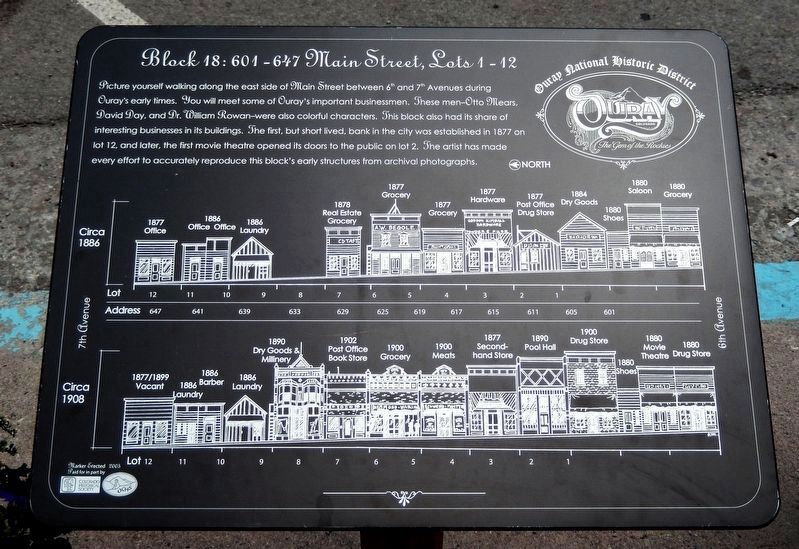
Picture yourself walking along the east side of Main Street between 6th and 7th Avenues during Ouray’s early times. You will meet some of Ouray's important businessmen. These men — Otto Mears, David Day, and Dr. William Rowan — were also colorful characters. This block also had its share of interesting businesses in its buildings. The first, but short lived, bank in the city was established in 1877 on lot 12, and later, the first movie theatre opened its doors to the public on lot 2. The artist has made every effort to accurately reproduce this block's early structures from archival photographs.
Erected 2005 by Colorado Historical Society and Ouray County Historical Society.
Topics and series. This historical marker is listed in these topic lists: Architecture • Industry & Commerce • Settlements & Settlers. In addition, it is included in the National Register of Historic Places (NRHP) series list. A significant historical year for this entry is 1877.
Location. 38° 1.401′ N, 107° 40.299′ W. Marker is in Ouray, Colorado, in Ouray County. It is on Main Street (U.S. 550) just south of 7th Avenue, on the right when
this page online

Regionally, this marker is in the Western Slope. It is also in the American Mountain West. Globally, it is in North America, the Rocky Mountains, the Western Hemisphere, the Western World, and the Anglosphere.
Other nearby markers. At least 8 other markers are within walking distance of this marker: True Grit Landmark #11 (within shouting distance of this marker); The Walsh Bell (about 300 feet away, measured in a direct line); Block 19: 501-545 Main Street (about 400 feet away); Block 11: 500-548 Main Street (about 400 feet away); Block 9: 700-746 Main Street (about 500 feet away); Beaumont (about 600 feet away); Beaumont Restoration (about 600 feet away); True Grit Landmark #10 (about 600 feet away). Touch for a list and map of all markers in Ouray.
Regarding Block 18: 601-647 Main Street. Contributing properties, Ouray Historic District, National Register of Historic Places № 83003537. Also, Colorado
From the National Register Nomination prepared by Martha Sullenberger and Roger Henn, 7/27/1981:
The Ouray Historic District encompasses almost the entire town which retains, to an amazing degree, its historic character spanning the period 1886 to 1915. These years encompass the height of Ouray’s importance as a supply center for nearby mining regions, and they also saw the architectural maturing of the town from a rude frame-dominated camp to a brick and stone, prosperous city. In this framework, Ouray is important as an example of the process of urbanization on the mining frontier in the last decade of the century. Along with Silverton and Telluride, Ouray was the principal town in the San Juan mining district, ranked as the third largest producing mining district in Colorado between 1893-1915 and first on the western slope. Ouray is a fine example of late 19th century architecture and a physical reminder of mining history in the San Juans.Ouray had its beginnings as a town in 1875 when prospectors from Silverton worked their way into Ouray via Bear Creek and the Uncompahgre
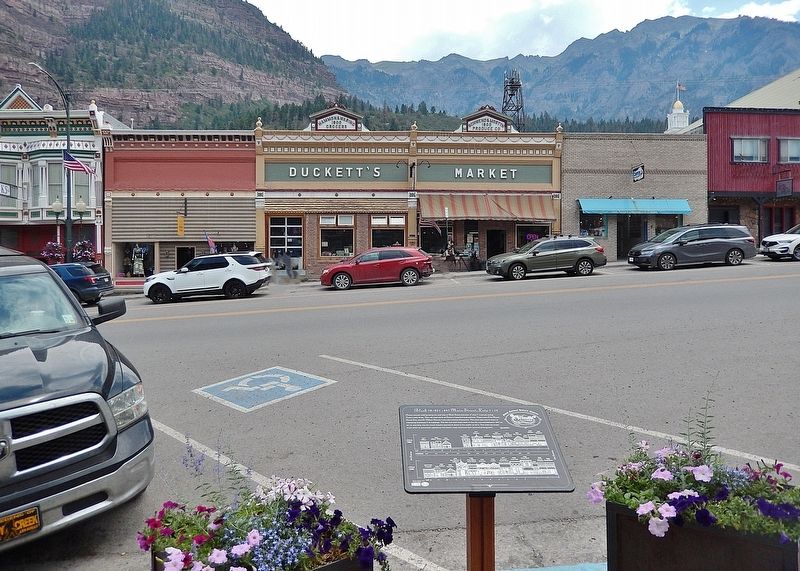
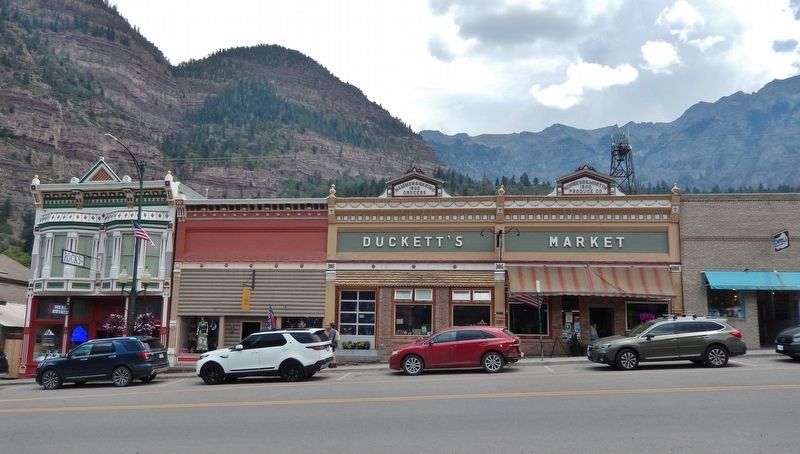
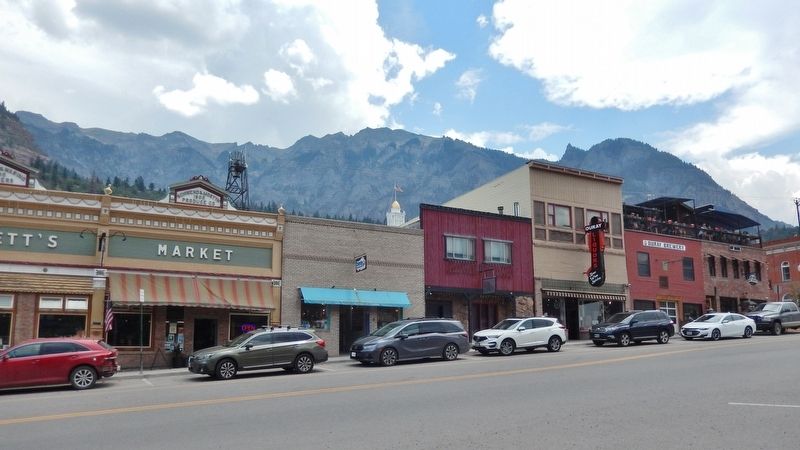
River searching for ore. The following spring the new community witnessed a rush and developed into a burgeoning mining camp. The town was surveyed and formally incorporated in 1876. It had a population of 400 with 214 buildings (mostly log), a school with 43 children in attendance, four general stores, one sawmill, one ore sampling works, two hotels, and a post office. In 1877, Ouray County was established. With the removal of the Utes in 1881, the northern portion of the county was opened to ranching and homesteading. In 1882 Otto Mears constructed a toll road to the new region and Ouray was quickly taking on the trappings of a true urban center. Brick buildings began to replace the less permanent, more hazardous frame ones. By 1885, the town had a population of 1800. The silver crash of 1893 proved a temporary disaster to Ouray, as for the entire San Juan region which had primarily been a silver mining area. After a brief depression Ouray continued to grow and thrive because of rich gold mines which had been developed on Gold Hill, just north of Ouray. Ouray reached its peak around the turn-of-the-century. By 1900 it had a populationPhotographed by Cosmos Mariner, July 15, 20253. Historic Main Street BuildingsLooking east across Main Street from the marker.of 2,196. Many large, predominantly Queen Anne style homes were built, concentrated in the southeast section of town. The commercial district contained many brick structures ornately finished with cast iron facades or Italianate or Romanesque brickwork.Photographed by Cosmos Mariner, July 15, 20254. Historic Main Street BuildingsLooking southeast across Main Street from the marker.
Also see . . .
1. Otto Mears (Wikipedia).
Excerpt: Otto Mears was a Colorado railroad builder and entrepreneur who played a major role in the early development of southwestern Colorado. Mears was known as the “Pathfinder of the San Juans” because of his road and railroad building projects through Colorado's San Juan Mountains in the late 19th century. He built hundreds of miles of toll roads in the rough terrain of the young state of Colorado, notably the “Million Dollar Highway” over Red Mountain Pass, connecting Silverton to Ouray.(Submitted on March 12, 2026, by Cosmos Mariner of Cape Canaveral, Florida.)
2. Ouray County (Society of Architectural Historians).
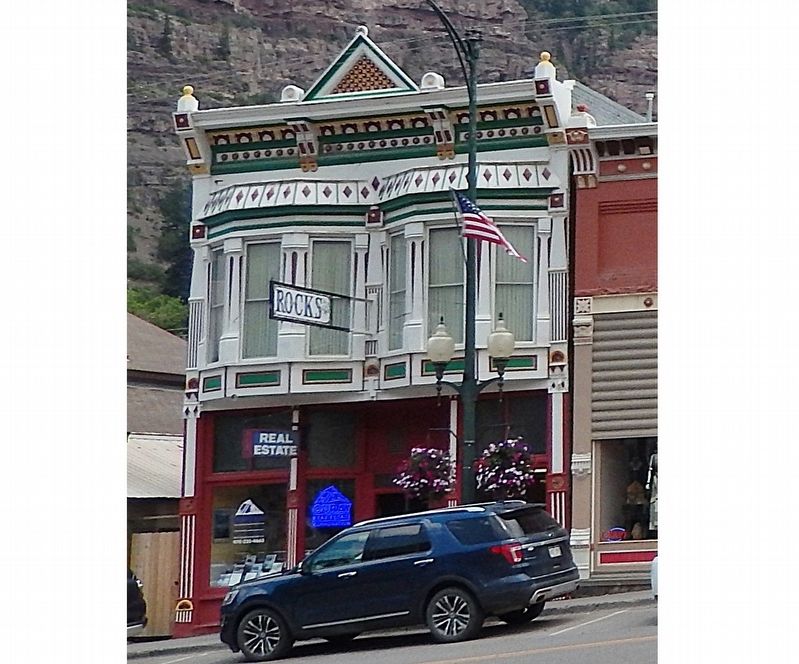
(by Thomas J. Noel) Excerpt: David Day, the founding editor of Ouray's wonderfully witty newspaper, the Solid Muldoon, maintained as early as the 1880s that tourism was a resource to(Submitted on March 12, 2026, by Cosmos Mariner of Cape Canaveral, Florida.)be mined. Despite Day's prodding, the county did not seriously begin to court tourists until the 1920s, when the town of Ouray built the municipal hot springs pool and bathhouse. By then the county had more ghost towns than live ones. Today, of twenty-four post office towns, only Ouray and Ridgway are still active.Photographed by Cosmos Mariner, July 15, 20255. Office Building, 633-635 Main StreetFrom the National Register Nomination:
Brick, two-story Italianate business structure with an elaborate cast-iron front. On the first floor a central doorway is flanked by four large windows with transoms, two angled and two flush with the facade. The windows are separated by cast-iron pilasters. The second story facade is dominated by two large oriel windows containing three double-hung windows separated by cast-iron pilasters. The window surrounds, cornice, frieze, and brackets are cast-iron and heavily decorated. A triangular cast-iron piece is located above the cornice.The building appears on the 1890 Sanborn Map as a two-story brick structure which housed a dry goods store. It was one of the first brick commercial structures on that lot and indicates a move away from frame to more substantial and fireproof buildings. Between 1890 and 1893 (possibly 1894) the facade was remodeled, the two oriel windows were added to the second floor and the front covered with a Mesker cast-iron facade (pat. 1887). By 1908, it was a books and stationary store and today houses a real estate office and gift shop. The building remains unchanged and makes a significant contribution to the historical integrity of the commercial district.
3. Dr. Rowan's Drug Store, Post Office in rear (Denver Public Library photo).
Customers and employees pose inside Dr. William W. Rowan's Ouray Drug Company, Ouray, Colorado. Counters, glass cases and shelves display: “Rat Cheese,” rum, cigars, medicine, book, hair brushes and combs; framed pictures and taxidermied cats, birds, deer, and a bear are on top of the shelves. The “General Delivery” post office is in the rear of the drug store.(Submitted on March 12, 2026, by Cosmos Mariner of Cape Canaveral, Florida.)
4. Ouray Historic District (Wikipedia).
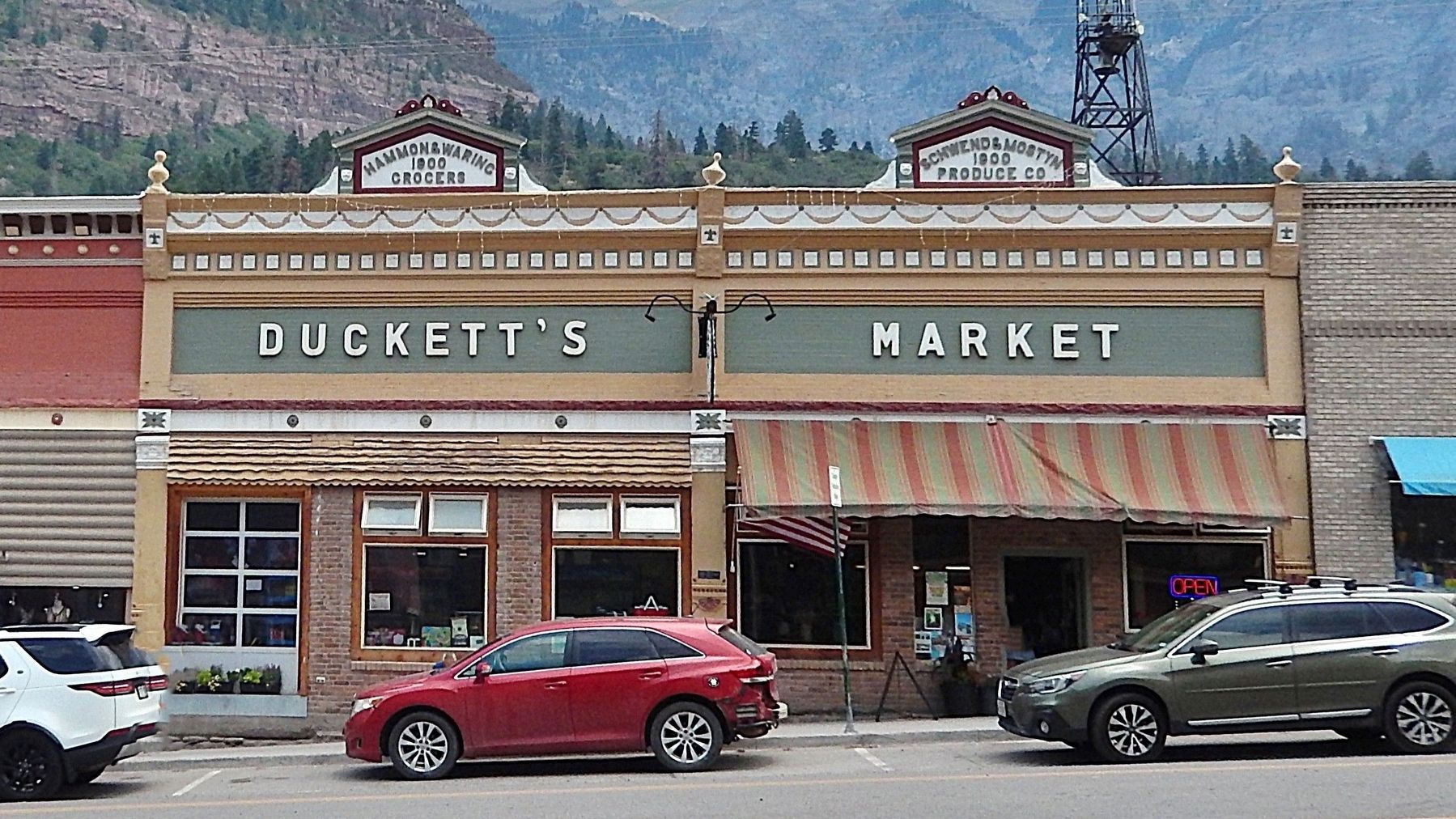
Excerpt: The Ouray Historic District, in Ouray, Colorado, is a 114-acre historic district which was listed on the National Register of Historic Places in 1983. Many of the(Submitted on March 12, 2026, by Cosmos Mariner of Cape Canaveral, Florida.)commercial buildings are Italianate in style; many residences are Victorian. Its 270 contributing buildings include government and commercial buildings. Many of the commercial buildings are along Ouray's Main Street, also known as Third Street, which is U.S. Highway 550. The historic district encompasses almost all the original townsite.Photographed by Cosmos Mariner, July 15, 20256. Duckett’s Market, 1900, 629 Main StreetFrom the National Register Nomination:
Composed of two business structures with matching Italianate facades. The structures were originally two separate enterprises. As early as 1886, lot 7 contained a two-story building with a one-story addition to the rear and underground warehouse. Lot 6 contained a one-story building. Both were grocery establishments. By 1890, lot 6 housed a meat market. By 1900 both buildings were expanded and a brick warehouse and sausage factory were added to the rear. Then between 1900 and 1908, Hammon and Waring (lot 7) and Schwend and Mostyn (lot 6) tore down the frame buildings, replacing them with matching one-story brick structures with Mesker iron facades.Today, the Duckett Market occupies both buildings. The one-story structure is well preserved and with its Mesker Brothers cast-iron facades, contributes to the historical integrity of the commercial district.
Credits. This page was last revised on September 15, 2026. It was originally submitted on March 10, 2026, by Cosmos Mariner of Cape Canaveral, Florida. This page has been viewed 24 times since then. Photos: 1. submitted on March 11, 2026, by Cosmos Mariner of Cape Canaveral, Florida. 2, 3, 4, 5, 6. submitted on March 12, 2026, by Cosmos Mariner of Cape Canaveral, Florida.
