Erlangen, Bavaria, Germany — Central Europe
Goethestraße Nō 2
Photographed by James Hulse, February 25, 2026
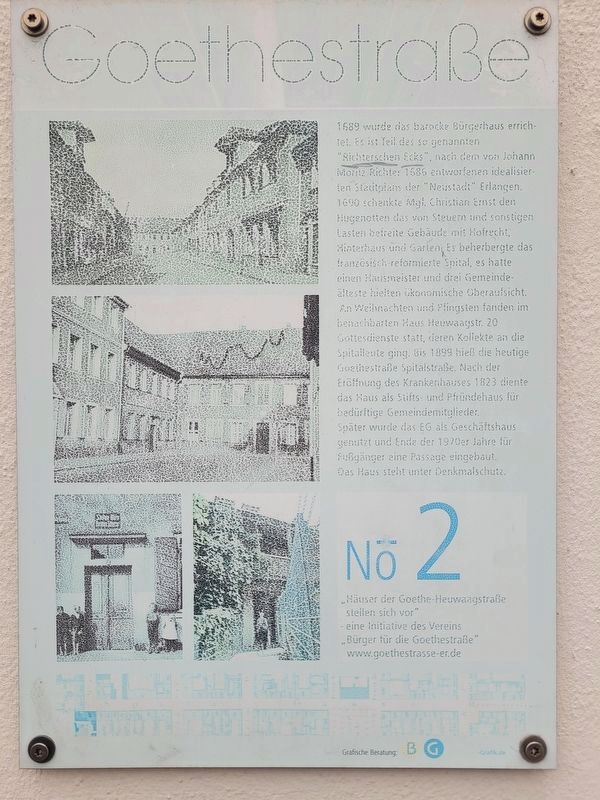
1. Goethestraße Nō 2 Marker

1589 wurde das barocke Bürgerhaus errichtet. Es ist Teil des so genannten „Richterschen Ecks“, nach dem von Johann Moritz Richter 1688 entworfenen idealisierten Stadtplans der „Neustadt“ Erlangens. 1690 schenkte Mgf. Christian Ernst den Hugenotten das von Steuern und sonstigen Lasten befreite Gebäude mit Hofrecht, Hinterhaus und Garten. Es beherbergte das französischreformierte Spital, es hatte einen Hausmeister und drei Gemeindeälteste hielten ökonomische Oberaufsicht. An Weihnachten und Pfingsten fanden im benachbarten Haus Heuwaagstr. 20 Gottesdienste statt, deren Kollekte an die Spitalleute ging. Bis 1899 hieß die heutige Goethestraße Spitalstraße. Nach der Eröffnung des Krankenhauses 1823 diente das Haus als Stifts- und Pfründnerhaus für bedürftige Gemeindemitglieder. Später wurde das EG als Geschäftshaus genutzt und Ende der 1970er Jahre für Fußgänger eine Passage eingebaut. Das Haus steht unter Denkmalschutz.
In 1589 this Baroque burgher house was built. It is part of the so-called “Richter Corner,” after the idealized city plan of Erlangen’s “New Town” designed
this page online
Erected by Grafische Beratung, “Citizens for Goethestraße” and “The Houses of Goethe–Heuwaagstraße Introduce Themselves”.
Topics. This historical marker is listed in this topic list: Notable Buildings. A significant historical year for this entry is 1589.
Location. 49° 35.922′ N, 11° 0.101′ E. Marker is in Erlangen, Bayern (Bavaria).
Photographed by James Hulse, February 25, 2026
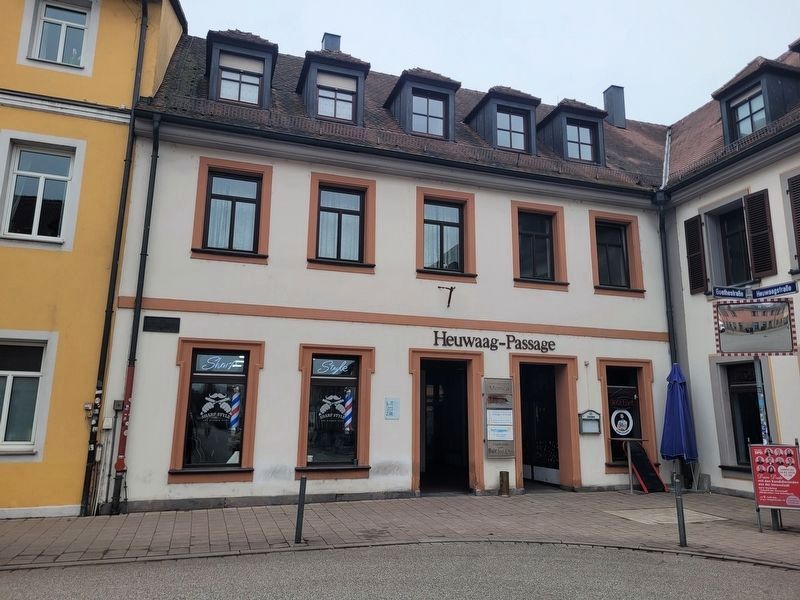
2. Goethestraße Nō 2 Marker
The marker is located on the left side of the entrance to the building.

Regionally, this marker is in German Franconia. Globally, it is in Europe, the European Union, Atlantic Europe, Central Europe, the Schengen Area, Western Europe, and the Western World. Historically, it finds itself in what was once the Holy Roman Empire and also the former West Germany.
Other nearby markers. At least 8 other markers are within walking distance of this marker: Spital der franz. ref. Gemeinde / Hospital of the French Reformed Congregation (here, next to this marker); Prof. Dr. Gg. Fr. Puchta (here, next to this marker); Heuwaagstraße Nō 20 (a few steps from this marker); Dr. Paul Gordan (a few steps from this marker); Goethestraße Nō 6 (a few steps from this marker); Heuwaagstraße Nō 7 (within shouting distance of this marker); Goethestraße No 5 (within shouting distance of this marker); Goethestraße Nō20 (about 120 meters away, measured in a direct line). Touch for a list and map of all markers in Erlangen.
Credits. This page was last revised on March 18, 2026. It was originally submitted on March 13, 2026, by James Hulse of Medina, Texas. This page has been viewed 20 times since then. Photos: 1, 2. submitted on March 15, 2026, by James Hulse of Medina, Texas.
