Rivière-Bleue in Témiscouata, Québec — Central Canada (French-Canadian)
La Chapelle évangélique baptiste de Rivière-Bleue
⎯⎯⎯
The Gospel Baptist Chapel of Rivière-Bleue

Photographed by Cosmos Mariner, August 2, 2019
1. La Chapelle évangélique baptiste de Rivière-Bleue / Gospel Baptist Chapel of Rivière-Bleue Marker

Comment expliquer ce phénomène ? Au début du 20e siècle, trois évènements historiques se déroulaient simultanément sur le territoire de la future municipalité de Rivière-Bleue, soit : la construction du chemin de fer traversant le Canada (NTR), l'exploitation de l'impressionnante richesse de la ressource forestière du territoire et l'ouverture de la colonisation donnant accès à des terres vierges aux colons désirant s'y installer.
Mais il faut revenir un peu en arrière pour se rappeler que dans la seconde partie du 19e siècle, des milliers de Canadiens français étaient partis en masse travailler dans les filatures américaines. Quelques décennies plus tard certains d'entre eux, par manque de travail, choisissent de revenir ou pays. Les nouveaux attraits économiques du Témiscouata en attirèrent plusieurs.
Fait important, au cours des années passées en Nouvelle-Angleterre, certains d'entre eux s'étaient convertis au protestantisme,
this page online
Dirigés par messieurs Luc Pelletier et Joseph Gaudreau de Waterville, Maine, ils formèrent un petit groupe qui s'installa au Pied-du-lac-long et dans ses environs. Ils eurent bientôt besoin d'un guide spirituel. On fit appel à la Mission de la Grande-ligne, organisme appartenant à l'une des branches des églises protestantes : les évangélistes baptistes. Dès 1909, on y fournit les services d'un pasteur en la personne de monsieur Napoléon Aubin remplacé, deux ans plus tard, par monsieur Henri Lanctin. En 1910, messieurs Pelletier et Gaudreau cèdent un grand terrain sur lequel on déménagera une vaste maison servant de &là résidence au pasteur, de lieu de culte aux membres et d'école ô leurs enfants.
Dix ans plus tard, la communauté évangélique baptiste du Pied-du-Lac-Long compte plus de 225 fidèles constituée d'arrivants de la Nouvelle-Angleterre, du Nouveau-Brunswick et de nouveaux convertis des environs. Les infrastructures existantes devenues insuffisantes, en 1921 on érige l'Église évangélique baptiste du Pied-du-Lac-long.

2. Marker detail: Presbytère / Presbytery
La maison qui servait de presbytère, de lieu de culte et d'école avant la construction de la chapelle.
• • •
The house that was used as a presbytery, place of worship and school until the chapel was built.
• • •
The house that was used as a presbytery, place of worship and school until the chapel was built.
À cette époque et dans ce lieu, être protestant et en porter les préceptes n'est pas facile. La présence de ce petit groupe de dissidents constitue un danger pour l'Église catholique qui o une forte tendance à diaboliser le phénomène, car la méconnaissance amène trop souvent à l'intolérance. Dans les années qui suivirent, les rapports entre les membres des deux communautés furent souvent marqués par des réactions de crainte et de fermeture à l'autre. Il faut cependant souligner que certaines situations provoquées par les nécessités de la vie ont permis des rapprochements, créant quelques belles histoires de collaboration et parfois même d'amitié qui, encore aujourd'hui, portent leurs fruits.
A partir des années 40, la situation devient de plus en plus difficile pour cette petite communauté qui voit ses membres partir les uns après les autres vers des lieux où ils pourront plus facilement assurer leur survie économique. Il n'y a plus de pasteur résident et l'école souffre d'une constante baisse de fréquentation.
Malgré tout, les membres restants se mobilisent à plusieurs reprises

3. Marker detail: Dimanche d'été 1947 / Summer Sunday 1947
À la sortie du culte, un dimanche de l'été 1947.
• • •
Leaving the service on a summer Sunday of 1947.
• • •
Leaving the service on a summer Sunday of 1947.
En 2016, à l'initiative de certains membres de la famille Lepage, une corporation à but non lucratif est constituée et fait l'acquisition de la propriété. Les objectifs de cette corporation sont la sauvegarde du site, la promotion de son histoire ainsi que la réalisation d'activités culturelles et sociales.
Nous nous retrouvons maintenant devant une histoire à suivre et à poursuivre...
What's the explanation for this?
In the early 20th century, three important events occurred at almost the same time in what would become the municipality of Rivière-Bleue: construction of the Trans-Canada railway, exploitation of the area's substantial forestry resources, and the opening up of land for settlement.
But we should go back a little further in time and recall
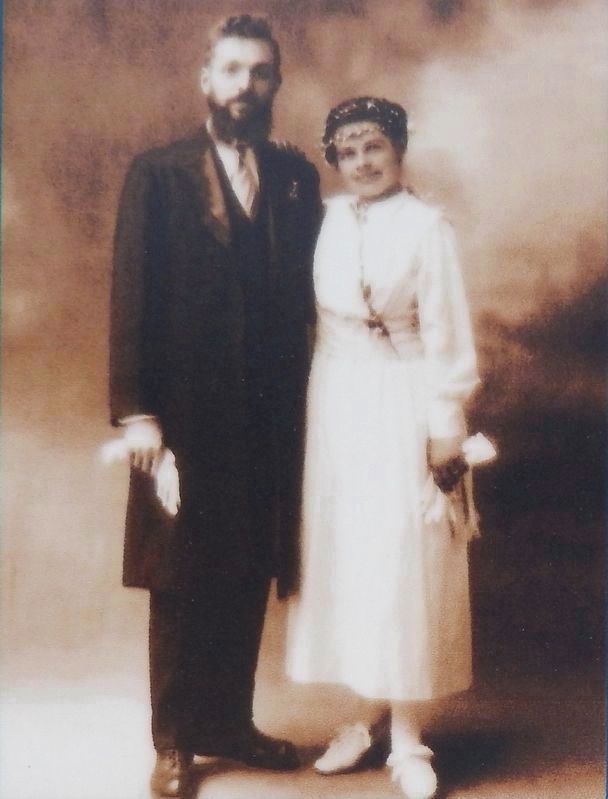
4. Marker detail: révérend Henri Lanctin / Reverend Henry Lanctin
Vers 1911, le révérend Henri Lanctin s'installa dans la région pour servir de pasteur à la communauté protestante du lac Long.
• • •
Around 1911, Reverend Henry Lanctin settled in the area to serve as pastor of the Protestant community of Long Lake.
• • •
Around 1911, Reverend Henry Lanctin settled in the area to serve as pastor of the Protestant community of Long Lake.
More significant is the fact that during their time in New England some of them had converted to Protestantism. They were attracted by how it put into practice the principles of the Scriptures, and by the possibility of a more personal connection with God.
Led by Luc Pelletier and Joseph Gaudreau of Waterville, Maine, they formed a small group and settled in Pied-du-Lac-Long and surrounding area. Before long they needed a spiritual leader and asked the Grande-Ligne Mission for their help. This organization belonged to one of the branches of the Protestant churches, the Evangelical-Baptists. From 1909, Napoleon Aubin served as pastor, and two years later, Henri Lanctin replaced him. In 1910, Messrs. Pelletier and Gaudreau donated a large piece of land. A big house was moved there to lodge the pastor and serve as a place of worship for members

5. Marker detail: École á l'arrière de la chapelle / School at the back of the chapel
À l'arrière de la chapelle, une école avait aussi été aménagée.
• • •
A school was also set up at the back of the chapel.
• • •
A school was also set up at the back of the chapel.
Ten years later, the Evangelical-Baptist community of Pied-du-Lac-Long numbered more than 225 believers, those coming from New England and New Brunswick, and new converts from the local area. In 1921, because the existing facilities were now inadequate, the Evangelical-Baptist Church of Pied-du-Lac-Long was built. The back part of the building would be used as a primary school until 1956.
At that time and in this place, it was not easy to be Protestant and live according to its precepts. The Catholic Church saw the presence of this small group of dissidents as a threat. There was a tendency to demonize the situation a great deal and all too frequently, ignorance led to intolerance and bigotry. In the years that followed, relations between the members of the two communities were often marked by fear and segregation. Even so, certain everyday life situations have brought us together, and provided a few really nice stories of cooperation and in some cases friendships, that are still having positive outcomes today.
Starting in the 1940s, this small community found itself in an increasingly difficult situation.

Photographed by Cosmos Mariner, August 2, 2019
6. La Chapelle évangélique baptiste de Rivière-Bleue / Gospel Baptist Chapel of Rivière-Bleue Marker
Looking east from Rue St Pierre. The chapel is in the background.
Despite everything, the remaining members came together on several occasions to restore and preserve their church and cemetery, and as a result, today we can enjoy a property in good condition. The Lafontaine and Lepage families were the driving force behind this community involvement.
In 2016, certain members of the Lepage family initiated the formation of a non-profit organization which acquired the property. The aims of this corporation are to protect the site itself and promote its history, as well as to produce cultural and social activities.
Today we find ourselves faced not just with a record of our history, but entrusted to carry it forward.
Erected by la Corporation touristique de la route des Frontières.
Topics. This historical marker is listed in these topic lists: Religion & Religious Structures • Settlements & Settlers. A significant historical year for this entry is 1921.
Location. 47° 28.039′ N, 68° 59.939′ W.

Photographed by Cosmos Mariner, August 2, 2019
7. La Chapelle évangélique baptiste de Rivière-Bleue / The Gospel Baptist Chapel of Rivière-Bleue

Regionally, this marker is in Eastern Québec & Gaspésie. It is also in Central Canada. Globally, it is in North America, the Western Hemisphere, and the Western World. Historically, it finds itself in what was once a British colony, the Viceroyalty of New France, the Haudenosaunee (Iroquois) Confederacy, and Rupert’s Land.
Other nearby markers. At least 6 other markers are within 13 kilometers of this marker, measured as the crow flies: La croix du parc Arthur-Lepage / The Cross of Arthur-Lepage Park (approx. 3.4 kilometers away); Le Moulin Blue River Lumber / Blue River Lumber Mill (approx. 3.4 kilometers away); La gare de Rivière-Bleue / The Rivière-Bleue Train Station (approx. 4.6 kilometers away); La Petit Gare Aubut (approx. 4.7 kilometers away); « Rivière-Bûche » / “River Drive” (approx. 5 kilometers away); Église St-Marc-Du-Lac-Long (approx. 11.8 kilometers away).
Credits. This page was last revised on March 15, 2026. It was originally submitted on March 14, 2026, by Cosmos Mariner of Cape Canaveral, Florida. This page has been viewed 20 times since then. Photos: 1, 2, 3. submitted on March 14, 2026, by Cosmos Mariner of Cape Canaveral, Florida. 4, 5. submitted on March 15, 2026, by Cosmos Mariner of Cape Canaveral, Florida. 6, 7. submitted on March 14, 2026, by Cosmos Mariner of Cape Canaveral, Florida.
