Camden in Greater London, England, United Kingdom — Northwestern Europe (the British Isles)
Seven Dials
Photographed by Andrew Ruppenstein, February 25, 2026
1. Seven Dials Marker
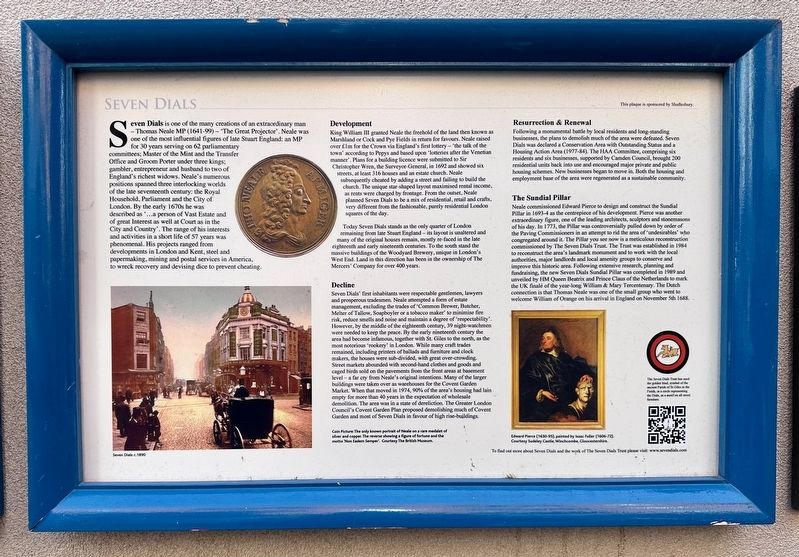
Seven Dials is one of the many creations of an extraordinary man - Thomas Neale MP (1641-99) - 'The Great Projector'. Neale was one of the most influential figures of late Stuart England: an MP for 30 years serving on 62 parliamentary committees; Master of the Mint and the Transfer Office and Groom Porter under three kings; gambler, entrepreneur and husband to two of England's richest widows. Neale's numerous positions spanned three interlocking worlds of the late seventeenth century: the Royal Household, Parliament and the City of London. By the early 1670s he was described as '...a person of Vast Estate and of great Interest as well at Court as in the City and Country'. The range of his interests and activities in a short life of 57 years was phenomenal. His projects ranged from developments in London and Kent, steel and papermaking, mining and postal services in America, to wreck recovery and devising dice to prevent cheating.
Development
King William III granted Neale the freehold of the land then known as Marshland or Cock and Pye Fields in return for favours. Neale raised over £1m for the Crown via England's first lottery - 'the talk of the town' according to Pepys and based upon
this page online
Today Seven Dials stands as the only quarter of London remaining from late Stuart England - its layout is unaltered and many of the original houses remain, mostly re-faced in the late eighteenth and early nineteenth centuries. To the south stand the massive buildings of the Woodyard Brewery, unique in London's West End. Land in this direction has been in the ownership of The Mercers' Company for over 400 years.
Decline
Seven Dials' first inhabitants were respectable gentlemen, lawyers and prosperous tradesmen. Neale attempted a form of estate management, excluding the trades of 'Common Brewer, Butcher, Melter of Tallow, Soapboyler or a tobacco maker' to
Photographed by Andrew Ruppenstein, February 25, 2026
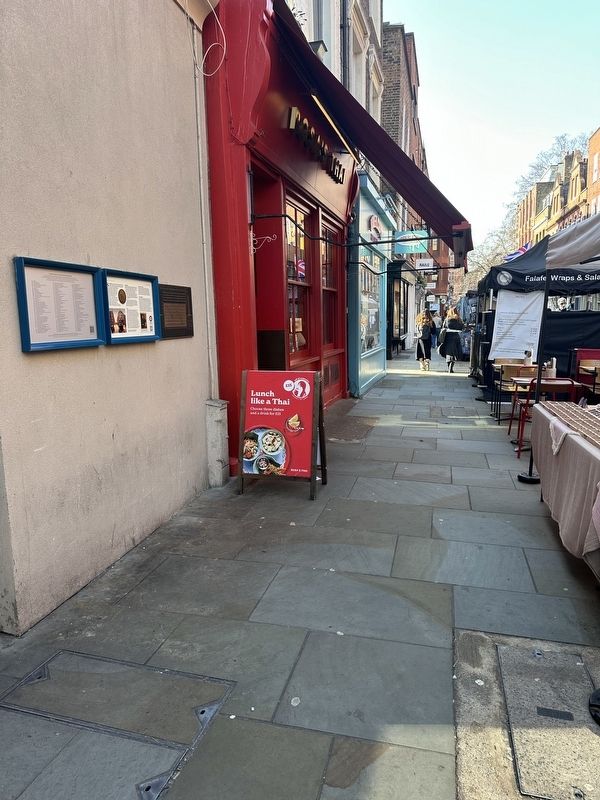
2. Seven Dials Marker - wide view, looking west along Earlham Street
Resurrection & Renewal
Following a monumental battle by local residents and long-standing businesses, the plans to demolish much of the
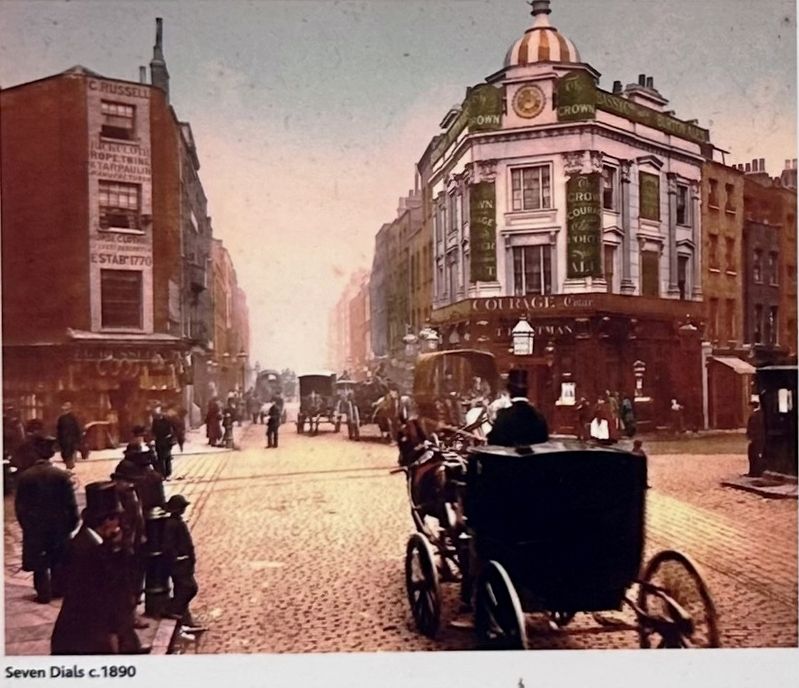
circa 1890s
3. Marker illustration: Seven Dials area
The Sundial Pillar
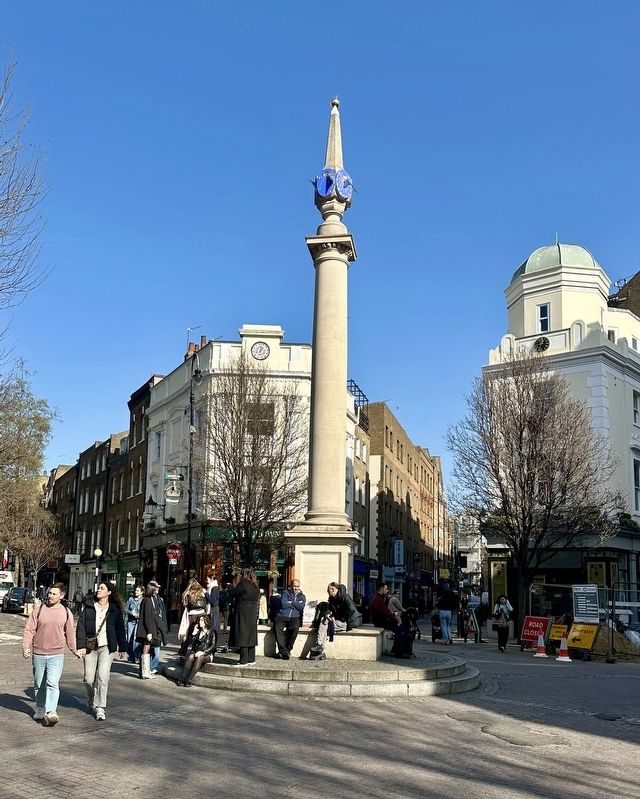
Neale commissioned Edward Pierce to design and construct the Sundial Pillar in 1693-4 as the centrepiece of his development. Pierce was another extraordinary figure, one of the leading architects, sculptors and stonemasons of his day. In 1773, the Pillar was controversially pulled down by order of the Paving Commissioners in an attempt to rid the area of 'undesirables' who congregated around it. The Pillar you see now is a meticulous reconstruction commissioned by The Seven Dials Trust. The Trust was established in 1984 to reconstruct the area's landmark monument and to work with the local authorities, major landlords and local amenity groups to conserve and improve this historic area. Following extensive research, planning and fundraising,
Photographed by Andrew Ruppenstein, February 25, 2026
4. Seven Dials area, with reconstructed pillar
Erected by Seven Dials Trust.
Topics and series. This historical marker is listed in these topic lists: Architecture • Industry & Commerce • Settlements & Settlers. In addition, it is included in the Seven Dials Trust series list. A significant historical date for this entry is November 5, 1688.
Location. 51° 30.82′ N, 0° 7.64′ W. Marker is in Camden, England, in Greater London. It is on Earlham Street west of Seven Dials, on the left when traveling west. Touch for map. Marker is at or near this postal address: 28 Earlham Street, Camden, England WC2H 9HA, United Kingdom. Touch for directions.

Regionally, this marker is in the Greater South East. Globally, it is on the Atlantic Ocean, in the North Atlantic Region, in Europe, in Atlantic Europe, on one of the British Isles, in the Western World, and in the Anglosphere. Historically, it finds itself in what was once the Roman Empire.
Other nearby markers. At least 8 other markers are within walking distance of this marker: Earlham Street (within shouting distance of this marker); Mercer Street (within shouting distance of this marker); Short’s Gardens (within shouting distance of this marker); The Kip (within shouting distance of this marker); Charles Boon (within shouting distance of this marker); John and Charles Wesley (about 90 meters away, measured in a direct line); Roger Keith ‘Syd’ Barrett (1946-2006) (about 90 meters away); Sir John Gielgud (1904-2000) (about 90 meters away). Touch for a list and map of all markers in Camden.
More about this marker. This is one of five Street History Plaques issued by the Seven Dials Trust.
Credits. This page was last revised on March 15, 2026. It was originally submitted on March 15, 2026, by Andrew Ruppenstein of Lamorinda, California. This page has been viewed 19 times since then. Photos: 1, 2, 3, 4. submitted on March 15, 2026, by Andrew Ruppenstein of Lamorinda, California.
