Bruck in Erlangen, Bavaria, Germany — Central Europe
Goethestraße Nō 32
Photographed by James Hulse, February 25, 2026
1. Goethestraße Nō 32 Marker

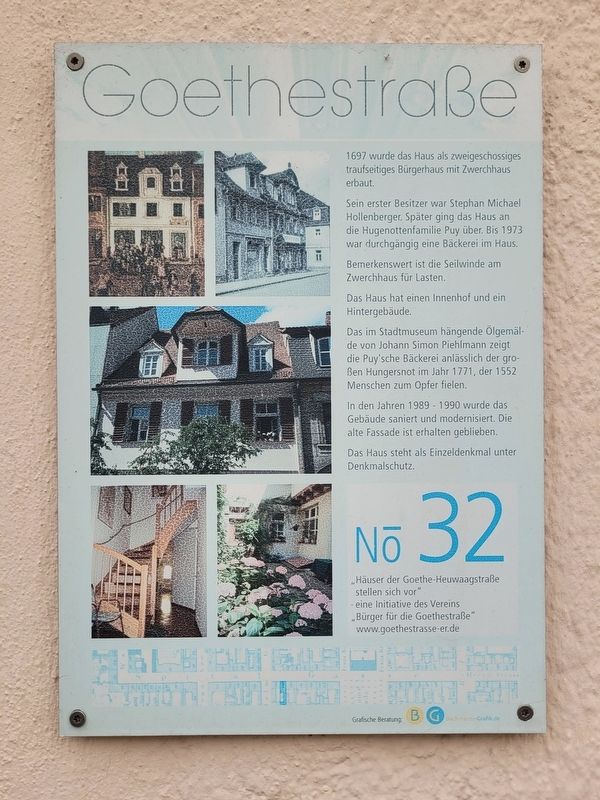
1697 wurde das Haus als zweigeschossiges traufseitiges Bürgerhaus mit Zwerchhaus erbaut. Sein erster Besitzer war Stephan Michael Hollenberger. Später ging das Haus an die Hugenottenfamilie Puy über. Bis 1973 war durchgängig eine Bäckerei im Haus. Bemerkenswert ist die Seilwinde am Zwerchhaus für Lasten. Das Haus hat einen Innenhof und ein Hintergebäude. Das im Stadtmuseum hängende Ölgemälde von Johann Simon Piehlmann zeigt die Puy’sche Bäckerei anlässlich der großen Hungersnot im Jahr 1771, der 1552 Menschen zum Opfer fielen. In den Jahren 1989–1990 wurde das Gebäude saniert und modernisiert. Die alte Fassade ist erhalten geblieben. Das Haus steht als Einzeldenkmal unter Denkmalschutz.
In 1697, the house was built as a two-story, eaves-side town house with a gabled dormer (Zwerchhaus). Its first owner was Stephan Michael Hollenberger. Later the house passed to the Huguenot family Puy. Until 1973, a bakery operated continuously in the house. Noteworthy is the hoisting winch on the gabled dormer, used for lifting loads. The house has an inner courtyard and a rear building. The oil painting by Johann Simon Piehlmann hanging in the city museum shows the Puy bakery during the great famine of 1771, which claimed the lives of 1,552 people. In 1989–1990, the building was renovated and modernized. The old façade has been preserved. The house is listed as an individual historic monument.
Erected by Grafische Beratung, “Citizens for Goethestraße” and “The
this page online
Topics. This historical marker is listed in this topic list: Notable Buildings. A significant historical year for this entry is 1697.
Location. 49° 35.821′ N, 11° 0.135′ E. Marker is in Erlangen, Bayern (Bavaria). It is in Bruck. It is at the intersection of Goethestraße and Helmstraße, on the left when traveling north on Goethestraße. Touch for map. Marker is at or near this postal address: Goethestraße 30, Erlangen BY 91054, Germany. Touch for directions.

Regionally, this marker is in German Franconia. Globally, it is in Europe, the European Union, Atlantic Europe, Central Europe, the Schengen Area, Western Europe, and the Western World. Historically, it finds itself in what was once the Holy Roman Empire and also the former West Germany.
Other nearby markers. At least 8 other markers are within walking distance of this marker: Goethestraße Nō 30 (here, next to this marker); Goethestraße Nō 36 (within shouting distance of this marker); Goethestraße Nō 38 (within shouting distance of this marker); Goethestraße Nō22 (within shouting distance of this marker); Dr. Karl Friedrich von Nagelsbach (within shouting distance of this marker); Goethestraße Nō20 (about 90 meters away, measured in a direct line); Thekla Wassermann (about 90 meters away); Bahnhofsplatz Nō 2 (about 120 meters away). Touch for a list and map of all markers in Erlangen.
Photographed by James Hulse, February 25, 2026
2. Goethestraße Nō 32 Marker
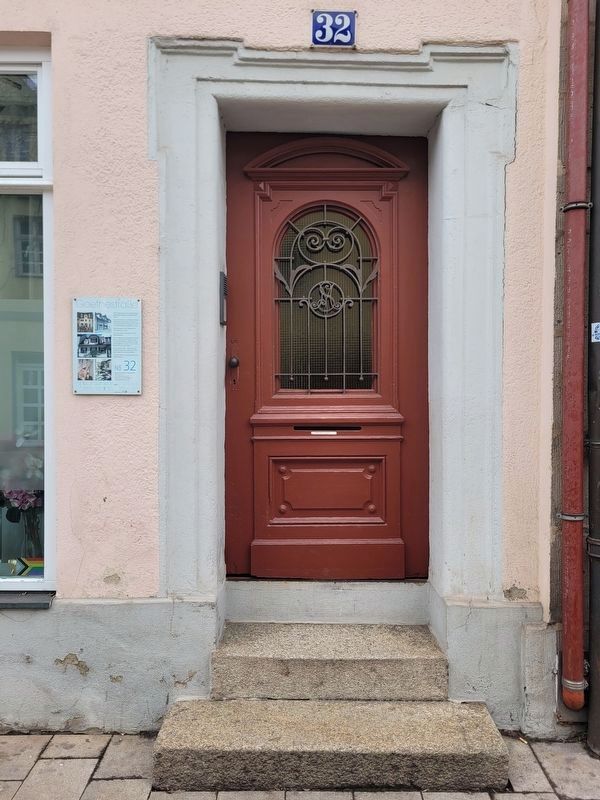
The entrance to the building with marker on the left side.
Photographed by James Hulse, February 25, 2026
3. Goethestraße Nō 32 Marker
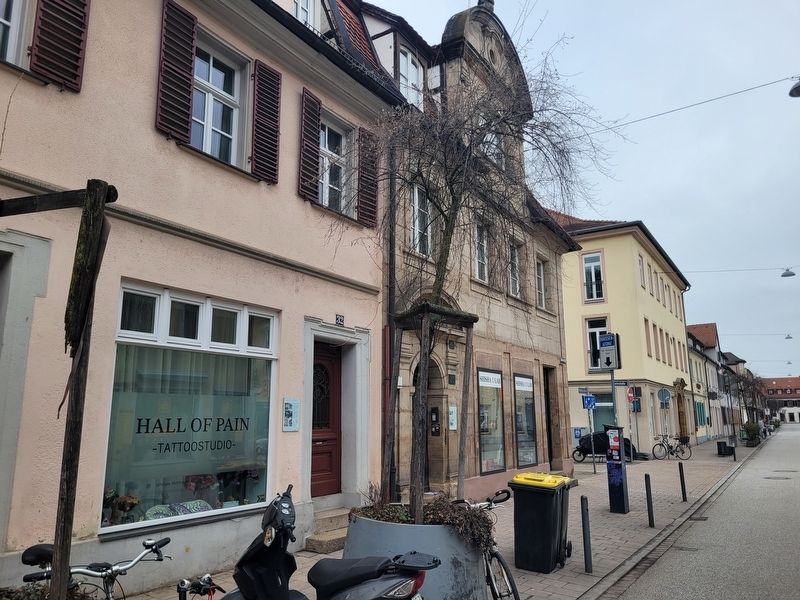
The view of the marker and building from across the street.
Credits. This page was last revised on March 19, 2026. It was originally submitted on March 18, 2026, by James Hulse of Medina, Texas. This page has been viewed 5 times since then. Photos: 1, 2, 3. submitted on March 19, 2026, by James Hulse of Medina, Texas.
