East Gwillimbury in York Region, Ontario — Central Canada (North America)
Sharon Temple

Photographed by Tim Boyd, March 9, 2026
1. Sharon Temple Marker
Erected by Ontario Archaeological and Historic Sites Board.
Topics and series. This historical marker is listed in these topic lists: Religion & Religious Structures • Settlements & Settlers. In addition, it is included in the Canada, Ontario Heritage Trust, and the Quakerism series lists. A significant historical year for this entry is 1825.
Location. 44° 6.096′ N, 79° 26.47′ W. Marker is in East Gwillimbury, Ontario, in York Region. It is at the intersection of Leslie Street and Mount Albert Road, on the right when traveling south on Leslie
this page online

Regionally, this marker is in Greater Toronto, specifically on the Golden Horseshoe, in the York, Durham and Headwaters Area, and in the Toronto Metropolitan Area. It is also in Central Canada. Globally, it is in North America, the Western Hemisphere, the Western World, and the Anglosphere. Historically, it finds itself in what was once a British colony, the Viceroyalty of New France, the Haudenosaunee (Iroquois) Confederacy, and Rupert’s Land.
Other nearby markers. At least 8 other markers are within 11 kilometers of this marker, measured as the crow flies: The Kelley Swing Bridge (approx. 2.7 kilometers away); Newmarket Radial Railway Arch (approx. 5 kilometers away); The Founding of Newmarket (approx. 5.7 kilometers away); Mazo de la Roche 1879-1961 (approx. 5.7 kilometers away); Pioneer Burying Ground (approx. 6.3 kilometers away); Meeting House of the Religious Society of Friends (Quakers) 1810 (approx. 7.2 kilometers away); The Dutch Settlement of Holland Marsh
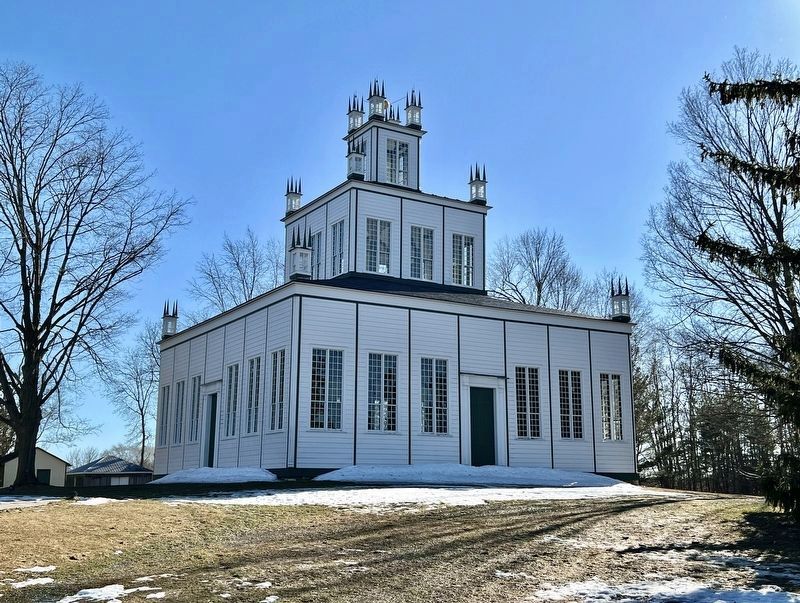
Photographed by Tim Boyd, March 9, 2026
2. The Sharon Temple in 2026
Also see . . . Children of Peace. The Canadian Encyclopedia website entry:
The Children of Peace. A religious sect active in the area of Sharon (known as Hope until the 1860s but from the 1840s mainly as Sharon), south of Lake Simcoe, Ont, from the second to the ninth decade of the 19th century. Maintaining a membership of a few hundred, the community rose and declined with its leader, David Willson (b Dutchess County, NY, 7 Jun 1778, d Sharon 19 Jan 1866), a self-made theologian and charismatic leader; indeed the members of the sect were known also as the Davidites. Of Irish descent and Presbyterian background, Willson had little formal education. He was a joiner and sailor before settling on Upper Canada crown land in 1801. A few years later he became a member of the Society of Friends (Quakers), but his independent interpretation of the Bible and his passion for music led to his secession, along with a few friends. In reaction to the austerity of the Quaker meetings, the Children of Peace expressed their Christianity in diverse and(Submitted on March 18, 2026, by Tim Boyd of Hamilton, Ontario.)imaginative ways: through the symbolism of their architecture, their emphasis on equality, and their cultivation of both vocal and instrumental music.Photographed by Tim Boyd, March 9, 20263. Sharon Temple MarkerFacing west across Leslie Street

Credits. This page was last revised on September 1, 2026. It was originally submitted on March 18, 2026, by Tim Boyd of Hamilton, Ontario. This page has been viewed 12 times since then. Photos: 1, 2, 3. submitted on March 18, 2026, by Tim Boyd of Hamilton, Ontario. • Andrew Ruppenstein was the editor who published this page.
