Harmony in Fillmore County, Minnesota — The American Midwest (Upper Plains)
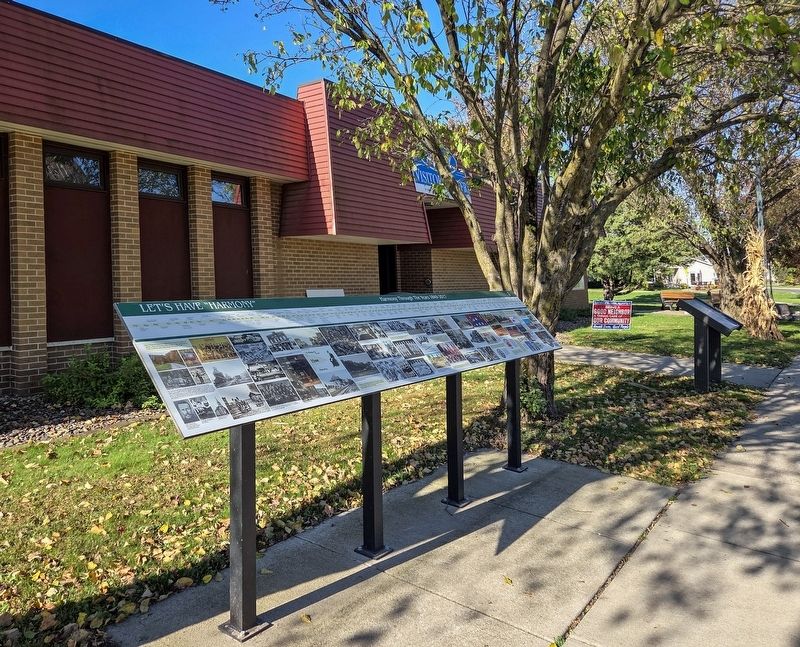
Let's Have "Harmony"
Harmony Through the Years 1849–2017
Photographed by McGhiever, October 5, 2025
1. Harmony Through the Years Marker
1840: Native Americans Winnebago
1844: Military Road Outpost Supply Route
1949: Settlement Greenfield Prairie
1852: Calvin Hoag First settler in Harmony Township
1854: Norwegian immigration, Ravine House
1856: Greenfield Prairie platted
1857: Stagecoach (Frink & Walker)
1859: Little Red Schoolhouse
1872: Harmony Post Office
1879: Railroad Narrow Gauge, First Businesses F. Trogstad, Two Grain Elevators, Day Bros. Lumber Co.
1880: First hotel Harmony House
1881: First Independence Day celebration
1882: Farmer's Mutual Insurance Col, first drug store, T. Johnson's Cafe
1883: Pool Hall Brass Band
1884: First school in Harmony, McCormick Elevator rebuilt
1885: Roller rink, Bergh Implements, first town well, circulating library
1889: Nine months of school
1890: Thundale Department Store
1893: Bank of Harmony T. Sanderson
1895: First Church Methodist, Wolsted Elevator, Harmony incorporated
1896: Kerosene street lights, Telephone Co., first annual election
1897: 60' wood windmill, wood frame school, Harmony News
1900: School enrollment to 205
1901: Roller mill, Lutheran chapel, RR tracks to standard gauge,
this page online
1902: Flax mill, water works system, wooden school enlarged
1903: Prey Building
1904: Harmony State Bank incorporated
1905: First high school graduation, high school baseball state champs, Wildwood Park, Brokken Building, Lutheran parsonage
1907: First Catholic church, First National Bank
1909: Opera House
1910: New brick high school
1912: Greenfield Lutheran Church, Boy Scouts
1914: Power & Light Plant, Electricity Five Globe Street Lights, Hoiness Creamery
1915: Vet clinic
1916: Peoples State Bank, Masonic Lodge
1917: American Red Cross
1918: Arnold Morem "Lost Battalion" survivor-WWI, WWI KIA (6)
1919: American Legion A. Berg Post
1920: Public library
1922: New post office building
1923: Chautauqua Circuit, Women's Club organized City Park
1924: Cave discovered, American Legion Auxiliary, radios arrived
1927: New Methodist Church dedicated
1928: Golf Club, Pederson Brothers Rock Quarry
1929: New sewer system
1930: First "talkie" movie Sweetie a musical
1931: Women's Club beautified Hwy 52 triangle
1933: Harmony's state baseball championship team
1934: Niagara Cave opened, water tower
1935:
Photographed by McGhiever, October 5, 2025
2. Harmony Through the Years Marker
1936: New brick high school dedicated
1937: First Jr/Sr Prom in high school
1939: Norwegian Crown Prince Olaf visit
1940: Garden Club, Jem Theatre
1931: Bowling alley built over sink hole
1945: WWII KIA (2), Girl Scouts, Local citizens buy telephone exchange
1947: Lions Club, Rochester Dairy
1948: Community Hospital Association organized, hospital in former Sanderson House
1949: Harmony House U of M venture
1950: Harmony Development Corporation
1951: Community Chest, A&W drive-in
1953: New medical clinic
1954: Dial Telephone
1956: Methodist parsonage, Catholic Church rectory, First National Bank and State Bank incorporated
1958: Roller rink & recreation center
1960: Community liquor store
1962: Harmony Development Corporation purchased 8 acres to build Harmony Enterprises
1964: $350,000 twenty bed hospital
1965: Grand opening Harmony Enterprises
1967: Natural gas, senior citizens group
1968: High school addition
1969: Vietnam KIA (1), $253,309 forty-one bed nursing home added to hospital
1970: Diamond jubilee celebration
1971: Community building and library
1972: Direct
Photographed by McGhiever, October 5, 2025
3. Harmony Through the Years Marker
1974: Harmony becomes city, Harmony Amish
1975: Catholic church dedicated, new water mains
1976: Harmony ambulance services, Harmony celebrates America's bicentennial
1977: Railroad discontinued, South Manor senior housing, Sunshine Place for developmentally disabled
1978: Zoning ordinances
1979: Improvements for library
1980: Farm financial crisis
1981: Norseland Kitchens
1983: Cable TV, touchtone dialing, elimination of party lines
1984: Football team clinches state class C title Class of 1985
1985: Recycling began, Amish tours
1986: $7.5 mil rate school referendum, cancer support group, North Manor senior housing, 911 emergency service, Meals on Wheels
1987: Roller rink & recreation center rebuilt, governor's design team visits
1988: Harmony EDA
1990: $930,000 grant for construction of new sewage treatment plant, Country Lodge Motel
1992: Bike & buggy lane on Hwy 52, City Park rennovation [sic] Renamed as Selvig Park
1993: Elementary school closed, consolidation of Harmony Preston & Fountain schools
1994: Ambulance & fire hall bldg., Harmony honored by Post Office with 3 Christmas stamps
1995: New school district
Photographed by McGhiever, October 5, 2025
4. Harmony Through the Years Marker
1996: Harmony's centennial celebration, Hwy 52 added signs "Amish Byway"
1997: Harmony-Preston Valley Trail
1998: Community center, visitor center
2000: Historical society
2002: New senior living facility, industrial park first occupant
2007: Chamber of commerce
2012: Community foundation
2016: Children's learning center
2017: Harmony logo
1900: Population 517
1910: Population 655
1920: Population 718
1930: Population 821
1940: Population 890
1950: Population 1022
1960: Population 1214
1970: Population 1130
1980: Population 1133
1990: Population 1081
2000: Population 1080
2010: Population 1020
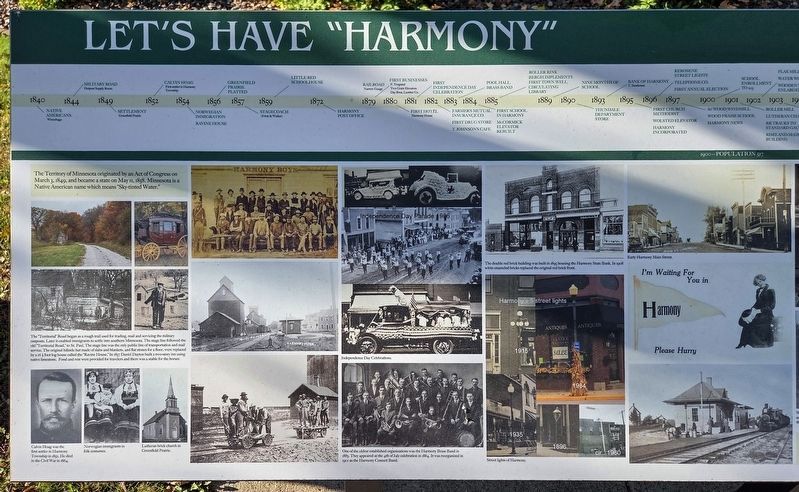
The Territory of Minnesota originated by an Act of Congress on March 3, 1849, and became a state on May 11, 1858. Minnesota is a Native American name which means "Sky-tinted Water."
The "Territorial" Road began as a rough trail used for trading, mail and servicing the military outposts. Later it enabled immigrants to settle into southern Minnesota. The stage line followed the old "Territorial Road," to St. Paul. The stage line was the only public line of transportation and mail service. The original hillside hut made of slabs and blankets, and flat stones for a floor, were replaced by a 16 1/2 foot log house called the "Ravine House." In 1857 Daniel Dayton built a two-story inn using native limestone. Food and rest were provided for travelers and there was a stable for the horses.
Calvin Hoag was the first settler in Harmony Township in 1852. He died in the Civil War in 1864.
Norwegian immigrants in folk costumes.
Lutheran brick church in Greenfield Prairie.
Independence Day Parade 1906
Independence Day Celebrations.
One of the oldest established organizations was the Harmony Brass Band in 1883. They appeared at the 4th of July celebration in 1884. It was reorganized in 1901 as the Harmony Concert Band.
The double red brick building was built in 1895 housing the Harmony State Bank. In 1908 white enameled bricks replaced the original red brick front.
Street lights of Harmony.
Early Harmony Main Street.
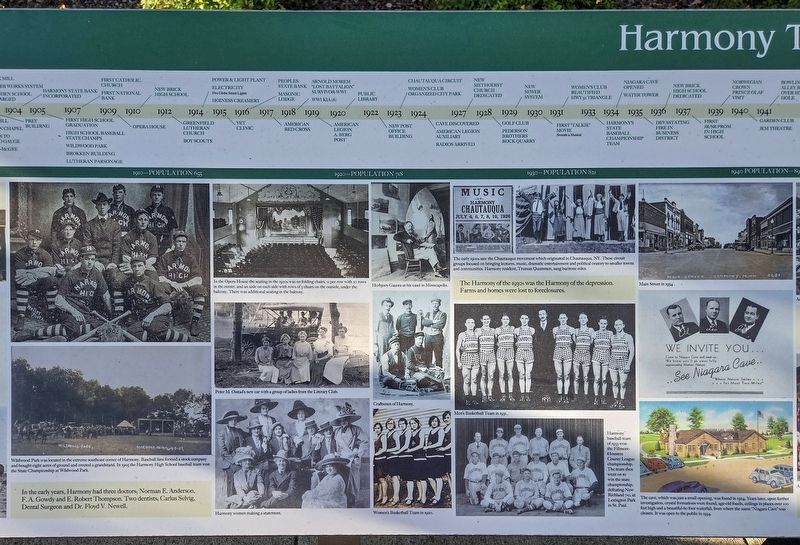
Wildwood Park was located in the extreme southeast corner of Harmony. Baseball fans formed a stock company and bought eight acres of ground and erected a grandstand. In 1905 the Harmony High School baseball team won the State Championship at Wildwood Park.
In
Photographed by McGhiever, October 5, 2025
5. Harmony Through the Years Marker in front of the Harmony Visitor and History Center
In the Opera House the seating in the 1920s was on folding chairs, 11 per row with 20 rows in the center, and an aisle on each side with rows of 3 chairs on the outside, under the balcony. There was additional seating in the balcony.
Peter M. Olstad's new car with a group of ladies from the Literary Club.
Harmony women making a statement.
Herbjorn Gausta at his easel in Minneapolis.
Craftsmen of Harmony.
Women's Basketball Team in 1920.
The early 1900s saw the Chautauqua movement which originated in Chautauqua, NY. These circuit groups focused on bringing lectures, dramatic entertainment and political oratory to smaller towns and communities. Harmon resident, Truman Quammen, sang baritone roles.
The Harmony of the 1930s was the Harmony of the depression. Farms and homes were lost to foreclosures.
Men's Basketball Team in 1931.
Harmony baseball team of 1933 won the Fillmore-Houston County League championship. The team then went on to win the state championship, defeating New Richland 7-0, at Lexington Park in St. Paul.
Main Street in 1934.
The cave, which was just a small opening, was found in 1924. Years later, upon further investigation, crystal formations were found, age-old fossils, ceilings in places over 100 feet high and a beautiful 60 foot waterfall, from where the name "Niagara Cave" was chosen. It was open to the public in 1934.
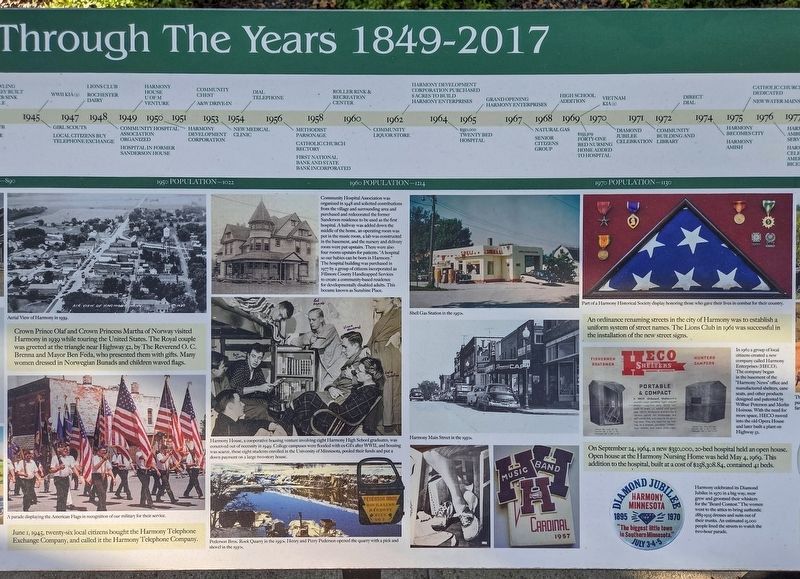
Aerial View of Harmony in 1939.
Crown Prince Olaf and Crown Princess Martha of Norway visited Harmony in 1939 while touring the United States. The Royal couple was greeted at the triangle near Highway 52 by The Reverend O.C. Brenna and Mayor Ben Feda, who presented them with gifts. Many women dressed in Norwegian Bunads and children waved flags.
A parade displaying the American Flags in recognition of our military for their service.
June 1, 1945, twenty-six local citizens bought the Harmony Telephone Exchange Company, and called it the Harmony Telephone Company.
Community Hospital Association was organized in 1948 and solicited contributions from the village and surrounding area and purchased and redecorated the former Sanderson residence to be used as the first hospital. A hallway was added down the middle of the home, an operating room was put in the music room, a lab was constructed in the basement, and the nursery and delivery room were put upstairs. There were also four rooms upstairs for patients. "A hospital so our babies can be born in Harmony." The hospital building was purchased in 1977 by a group of citizens incorporated as Fillmore County Handicapped Services to create a community-based residence for developmentally disabled adults. This became known as Sunshine Place.
Harmony House, a cooperative housing venture involving eight Harmony High School graduates, was conceived out of necessity in 1949. College campuses were flooded with ex-GI's after WWII, and housing was scarce, these eight students enrolled in the University of Minnesota, pooled their funds and put a down payment on a large two-story house.
Pederson Bros. Rock Quarry in the 1950s. Henry and Perry Pederson opened the quarry with a pick and shovel in the 1930s.
Shell Gas Station in the 1950s.
Harmony Main Street in the 1950s.
Part of a Harmony Historical Society display honoring those who gave their lives in combat for their country.
An ordinance renaming streets in the city of Harmony was to establish a uniform system of street names. The Lions Club in 1961 was successful in the installation of the new street signs.
In 1962 a group of local citizens created a new company called Harmony Enterprises (HECO). The company began in the basement of the "Harmony News" office and manufactured shelters, cane seats, and other products designed and patented by Wilbur Peterson and Merlin Hoiness. With the need for more space, HECO moved into the old Opera House and later built a plant on Highway 52.
On September 24, 1964, a new $350,000, 20-bed hospital held an open house. Open house at the Harmony Nursing Home was held May 4, 1969. This addition to the hospital, built at a cost of $258,308.84, contained 41 beds.
Harmony celebrated its Diamond Jubilee in 1970 in a big way: men grew and groomed their whiskers for the "Beard Contest." The women went to the attics to bring authentic 1885-1925 dresses and suits out of their trunks. An estimated 15,000 people lined the streets to watch the two-hour parade.
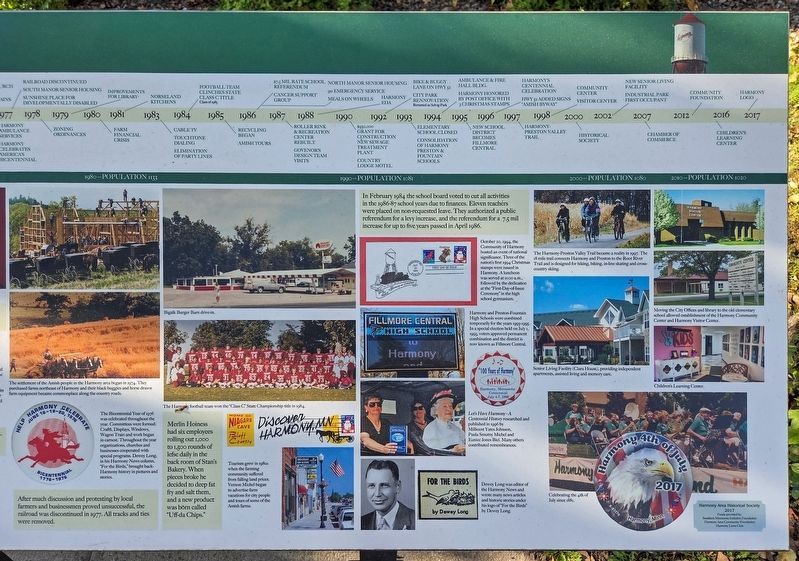
The settlement of the Amish people in the Harmony area began in 1974. They purchased farms northeast of Harmony and their black buggies and horse drawn farm equipment became commonplace along the country roads.
The Bicentennial Year of 1976 was celebrated throughout the year. Committees were formed: Crafts, Displays, Windows, Wagon Train and work began in earnest. Throughout the year organizations, churches and businesses cooperated with special programs. Dewey Long, in his Harmony News column, "For the Birds," brought back Harmony history in pictures and stories.
After much discussion and protesting by local farmers and businessmen proved unsuccessful, the railroad was discontinued in 1977. All tracks and ties were removed.
Bigalk Burger Barn drive-in.
The Harmony football team won the "Class C" State Championship title in 1984.
Merlin Hoiness had six employees rolling out 1,000 to 1,500 rounds of lefse daily in the back room of Stan's Bakery. When pieces broke he decided to deep fat fry and salt them, and a new product was born called "Uff-da Chips."
Tourism grew in 1980s when the farming community suffered from falling land prices. Vernon Michel began to advertise farm vacations for city people and tours of some of the Amish farms.
In February 1984 the school board voted to cut all activities in the 1986-87 school years due to finances. Eleven teachers were placed on non-requested leave. They authorized a public referendum for a levy increase, and the referendum for a 7.5 mil increase for up to five years passed in April 1986.
October 20, 1994, the Community of Harmony hosted an event of national significance. Three of the nation's first 1994 Christmas stamps were issued in Harmony. A luncheon was served at 11:00 a.m., followed by the dedication at the "First-Day-of-Issue Ceremony" in the high school gymnasium.
Harmony and Preston-Fountain High Schools were combined temporarily for the years 1993-1995. In a special election held on July 1, 1995, voters approved permanent combination and the district is now known as Fillmore Central.
Let's Have Harmony - A Centennial History researched and published in 1996 by Millicent Yates Johnson, Paula Smutny Michel and Eunice Jones Biel. Many others contributed remembrances.
Dewey Long was editor of the Harmony News and wrote many news articles and historic stories under his logo of "For the Birds" by Dewey Long.
The Harmony-Preston Valley Trail became a reality in 1997. The 18 mile trail connects Harmony and Preston to the Root River Trail and is designed for hiking, biking, in-line skating and cross-country skiing.
Senior Living Facility (Clara House), providing independent apartments, assisted living and memory care.
Celebrating the 4th of July since 1881.
Moving the City Offices and library to the old elementary school allowed the establishment of the Harmony Community Center and Harmony Visitor Center.
Children's Learning Center.
Topics. This historical marker is listed in these topic lists: Education • Entertainment • Settlements & Settlers • Sports.
Location. 43° 33.35′ N, 92° 0.617′ W. Marker is in Harmony, Minnesota, in Fillmore County. It is at the intersection of Main Avenue N. and 2nd Street NW, on the right when traveling south on Main Avenue N.. The marker is in front of the Harmony Visitor and History Center. Touch for map. Marker is at or near this postal address: 15 2nd Street NW, Harmony MN 55939, United States of America. Touch for directions.

Regionally, this marker is in Southeast Minnesota and in Greater Rochester. It is also in the American Midwest, in the Corn Belt, and in the Driftless Area — Bluff Country. Globally, it is in North America, the Western Hemisphere, the Western World, and the Anglosphere. Historically, it finds itself in what was once Rupert’s Land, the territory of the Mississippian Culture, and the Louisiana Purchase.
Other nearby markers. At least 8 other markers are within walking distance of this marker: A different marker also named Let's Have "Harmony" (within shouting distance of this marker); Historic McMichael Grain Elevator Preservation Project (within shouting distance of this marker); a different marker also named Let's Have "Harmony" (within shouting distance of this marker); a different marker also named Let's Have "Harmony" (within shouting distance of this marker); a different marker also named Let's Have "Harmony" (about 300 feet away, measured in a direct line); a different marker also named Let's Have "Harmony" (about 500 feet away); a different marker also named Let's Have "Harmony" (about 500 feet away); a different marker also named Let's Have "Harmony" (about 500 feet away). Touch for a list and map of all markers in Harmony.
Credits. This page was last revised on March 20, 2026. It was originally submitted on March 20, 2026, by McGhiever of Minneapolis, Minnesota. This page has been viewed 35 times since then. Photos: 1, 2, 3, 4, 5. submitted on March 20, 2026, by McGhiever of Minneapolis, Minnesota.
