Sacred Heart Catholic Church

Landmark
City of Alamosa
Historic Registry
Erected 2007 by City of Alamosa.
Topics and series. This historical marker is listed in these topic lists: Architecture • Notable Buildings • Religion & Religious Structures. In addition, it is included in the National Register of Historic Places (NRHP) series list. A significant historical year for this entry is 1922.
Location. 37° 28.174′ N, 105° 52.091′ W. Marker is in Alamosa, Colorado, in Alamosa County. It is on Fourth Street just east of Edison Avenue, on the left when traveling east. The marker is mounted directly on the subject building, on the right side of the south/front entrance. Touch for map. Marker is at or near this postal address: 715 Fourth Street, Alamosa CO 81101, United States of America. Touch for directions.

Regionally, this marker is in the San Juan Mountains and in the San Luis Valley. It is also in the American Mountain West. Globally, it is in North America, the Rocky Mountains, the Western Hemisphere, the Western World, and the Anglosphere. Historically, it finds itself in what was once New Spain and also the Republic
this page online
Other nearby markers. At least 8 other markers are within walking distance of this marker: Alamosa Post Office (1935) (within shouting distance of this marker); American Legion Building (about 600 feet away, measured in a direct line); First Baptist Church (approx. 0.2 miles away); Emperius Building (approx. 0.2 miles away); American National Bank Building (approx. 0.2 miles away); Alamosa Depot (approx. ¼ mile away); Adams State College (approx. 0.3 miles away); Alamosa (approx. 0.3 miles away). Touch for a list and map of all markers in Alamosa.
Regarding Sacred Heart Catholic Church. National Register of Historic Places № 98000855. Also Colorado State Register of Historic Properties Site № 5AL.262.
From the National Register Nomination prepared by Randy Apodaca and Holly Wilson, 11/24/1997:
The nomination includes the church that was completed in 1928, the rectory (1938), and the arcade that connects them (1945). Sacred Heart Church is a tan stuccoed-brick building in the Mission/Spanish Colonial Revival style. Construction began in 1922 on the two-story (with basement) building that is 78 feet wide and138 feet long. The modified cruciform plan has multiple roofs that consist of large intersecting gables forming the cross with a polygonal roof over the apse; smaller shed and hipped roofs cover various extensions. The building is distinguished by elaborate curvilinear parapet walls capped with decorative coping, round arched windows and entries on the main floor, and unusually shaped scalloped-edged ("rosa") clerestory windows. Most of the windows are filled with stained glass.Photographed by Cosmos Mariner, July 11, 20252. Sacred Heart Catholic Church MarkerThe marker is on the right side of the center doorway in the covered front entrance portico.The church faces south where concrete steps and wrought iron railings lead to the centrally located, projecting entrance bay. Three round arched openings provide access to the covered entry that is marked by a curvilinear parapet wall topped with a cross, above each arched opening is a sculptural design on the wall surface-two circles flank a more complex scallop-edged outline. The more ornate design is repeated in a large window on the wall behind the entrance bay. Flanking the central bay are two short towers that were originally designed to be four stories but have never been completed. A large, scallop-edged (rosa) window is positioned high on each tower
wall with a trio of round-arched windows below it. The towers' side elevations contain a rosa window above a single round arched window. Shallow corbeling near the top of the towers also adds to the surface decoration, while a subtle buttressing-effect occurs at the corners of the towers.Photographed by Cosmos Mariner, July 11, 20253. Sacred Heart Catholic ChurchThe towers were planned to rise to four stories but were never finished above two stories.Sacred Heart Church in Alamosa is significant in the areas of Architecture and Art. The church, constructed between 1922 and 1928, represents the work of prominent Colorado architect Robert Willison and is the only example of his work in Alamosa. While Willison designed many churches throughout Colorado, this is a particularly good example of his work in the Mission/Spanish Colonial Revival style. Willison's use of rosa windows as clerestories represents an unusual application of this Spanish Baroque detailing. Part of the master plan drawn by Willison included a rectory connected to the church by an arcade. The rectory was completed in 1938 from revised drawings by architect John Monroe. The arcade that gracefully connects the two buildings was constructed in 1945. Both complement the church and convey the design originally conceived by Willison.
Photographed by Cosmos Mariner, July 11, 20254. Sacred Heart Catholic Church Arcade and RectoryFrom the National Register Nomination:
From the southwest corner of the church is an arcade of brick covered in stucco that leads to the rectory. Identified on the architectural drawings as a "cloister," it has a concrete floor and a flat roof behind a parapet with cast concrete coping. The series of arches rest on square pillars with simple capitals. Like the church, the rectory faces south. The arcade connecting the church with the rectory was constructed in 1945.An outstanding interior feature of Sacred Heart is the artwork by Josef Steinhage. Murals painted in 1942 and between 1946 and 1948 adorn the walls and ceilings of the church. These paintings are unlike any others found in the Diocese of Southern Colorado and were recognized nationally in Catholic circles.
In 1887 when Machebeuf became the Bishop of Denver, one of his first actions was the purchase of land in the 400 block of Eighth Street in Alamosa. Sacred Heart became official when a frame building that seated about 200 was built at this location and blessed by Machebeuf. In 1919, Alamosa County was designated as Sacred Heart Parish, ending decades of status as a mission. Discussions of building a new church began in 1920. Fund raising and special collections were successful and the well-known architect who designed the Denver Auditorium, Robert Willison, was hired. A contract was awarded for the installation of the foundations for both the church and rectory, and this work was completed in the fall of 1922. The foundations stood for several years as money ran short and work was halted. In 1926, work resumed with the help of a $50,000
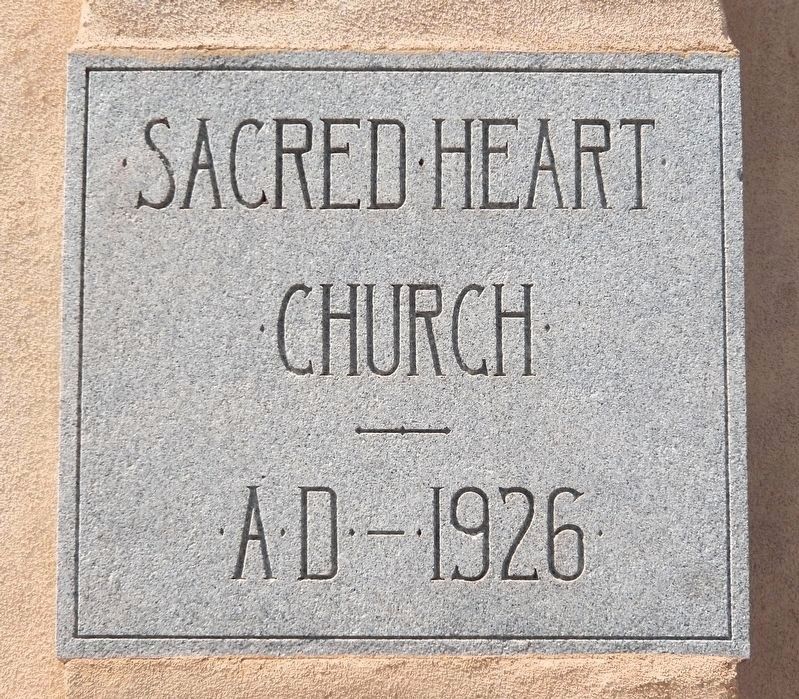
bond issue and the cornerstone of the church was laid in October. The following year the walls and roof were completed. But then work slowed again. Dedication ceremonies for the church would not be until May 13, 1928.Photographed by Cosmos Mariner, July 11, 20255. Sacred Heart Catholic Church CornerstoneThe foundation was laid in 1922. Construction resumed in 1926 and was completed in 1928.Foundations for the rectory stood empty for sixteen years while the priest lived in the small room off the sacristy of the church. Estimates for the construction of the building in 1935 were $6,500 and it was decided to leave the second floor unfinished. Two years later, an anonymous gift of $3,000 would spur the congregation in a drive to match the amount. In 1938, another Denver architect, John K. Monroe, revised the original 1922 plans which were displayed in church. Monroe, like Willison, would become a principal architect for the Archdiocese of Denver. A local contractor was selected for the house with the garage and "cloister" (arcade) eliminated. (They would be constructed later.) The house "was under roof" before Christmas and opened for public viewing by March 1939.


Also see . . .
1. Sacred Heart Catholic Church (Wikipedia).
Excerpt: Sacred Heart Catholic Church was built beginning in 1922 in(Submitted on March 21, 2026, by Cosmos Mariner of Cape Canaveral, Florida.)a Mission Revival/Spanish Revival style and was added to the National Register in 1998. It was planned for its two towers to rise to four-stories tall, but these were never finished. The listing included two contributing buildings and a contributing structure: besides the church, an arcade and a rectory were built.Photographed by Cosmos Mariner, July 11, 20256. Sacred Heart Catholic Church (south/front elevation)

2. Sacred Heart Catholic Church (History Colorado).
Excerpt: Constructed between 1922 and 1928, the church is an interesting interpretation of the Mission style designed by prominent architect Robert Willison. The interior includes outstanding murals painted by local artist Josef Steinhage that were recognized nationally in Catholic circles.(Submitted on March 21, 2026, by Cosmos Mariner of Cape Canaveral, Florida.)
3. City of Alamosa Historic Registry.
Sacred Heart Catholic Church (1922; 1926-28)(Submitted on March 21, 2026, by Cosmos Mariner of Cape Canaveral, Florida.)
Ordinance approved and signed July 18th, 2007
Credits. This page was last revised on August 8, 2026. It was originally submitted on March 21, 2026, by Cosmos Mariner of Cape Canaveral, Florida. This page has been viewed 18 times since then. Photos: 1, 2, 3, 4, 5, 6. submitted on March 21, 2026, by Cosmos Mariner of Cape Canaveral, Florida.
