Mitte in Nürnberg, Bavaria, Germany — Central Europe
Homosexuelle Opfer des Nationalsozialismus
⎯⎯⎯
Homosexual Victims of National Socialism
Photographed by James Hulse, February 26, 2026
1. Homosexuelle Opfer des Nationalsozialismus / Homosexual Victims of National Socialism Marker

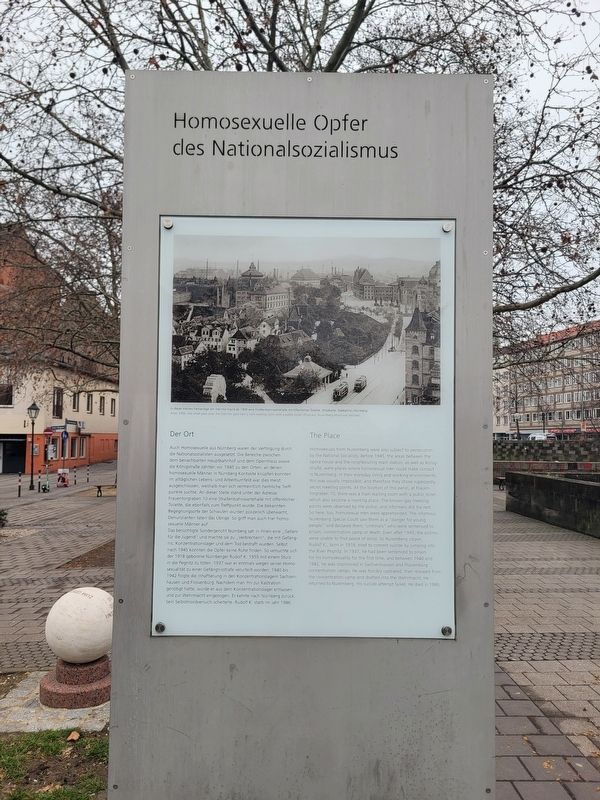
Der Ort
Auch Homosexuelle aus Nürnberg waren der Verfolgung durch die Nationalsozialisten ausgesetzt. Die Bereiche zwischen dem benachbarten Hauptbahnhof und dem Opernhaus sowie die Königstraße zählten vor 1945 zu den Orten, an denen homosexuelle Männer in Nürnberg Kontakte knüpfen konnten. Im alltäglichen Lebens- und Arbeitsumfeld war dies meist ausgeschlossen, weshalb man sich vermeintlich heimliche Treffpunkte suchte. An dieser Stelle stand unter der Adresse Frauentorgraben 10 eine Straßenbahnwartehalle mit öffentlicher Toilette, die ebenfalls zum Treffpunkt wurde. Die bekannten Begegnungsorte der Schwulen wurden polizeilich überwacht, Denunzianten taten das Übrige. So griff man auch hier homosexuelle Männer auf.
Das berüchtigte Sondergericht Nürnberg sah in ihnen eine „Gefahr für die Jugend“ und machte sie zu „Verbrechern“, die mit Gefängnis, Konzentrationslager und dem Tod bestraft wurden. Selbst nach 1945 konnten die Opfer keine Ruhe finden. So versuchte sich der 1918 geborene Nürnberger Rudolf K. 1955 mit einem Sturz in die Pegnitz zu töten. 1937 war er erstmals wegen seiner Homosexualität zu einer Gefängnisstrafe verurteilt worden, 1940 bis 1942 folgte die Inhaftierung in den Konzentrationslagern Sachsenhausen und Flossenbürg. Nachdem man ihn zur Kastration genötigt hatte, wurde er aus dem Konzentrationslager entlassen und zur Wehrmacht eingezogen. Er kehrte nach Nürnberg zurück. Sein Selbstmordversuch scheiterte. Rudolf K. starb im Jahr 1986.
In dieser kleinen Parkanlage am Sterntor stand ab 1909 eine Straßenbahnwartehalle mit öffentlicher Toilette. (Postkarte: Stadtarchiv Nürnberg)
Die Geschichte
Während
this page online
Viele Jahrzehnte blieb den Homosexuellen die gesellschaftliche Anerkennung als Opfer des Nationalsozialismus verwehrt. Die Stadt Nürnberg, als Stadt des Friedens und der Menschenrechte, will an diese Opfer erinnern, sie dürfen nicht vergessen werden. Das Erinnern weist auch in unsere Gegenwart und Zukunft, es ist ein Aufruf zur Toleranz. Homosexualität muss nicht hinterfragt werden. Lesben und Schwule sind ein selbstverständlicher Teil der Bürgerschaft.
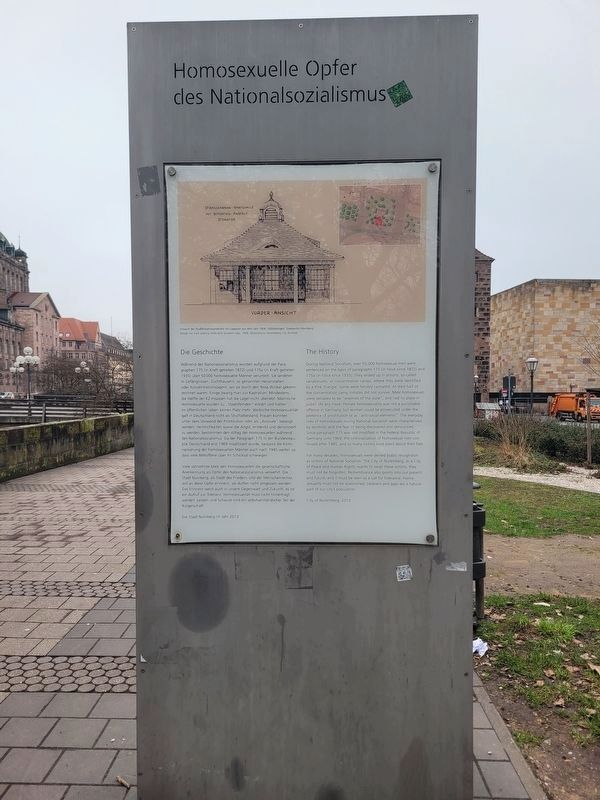
Entwurf der Straßenbahnwartehalle mit Lageplan aus dem Jahr 1908. (Abbildungen: Stadtarchiv Nürnberg)
The Place
Homosexuals from Nuremberg
Photographed by James Hulse, February 26, 2026
2. Homosexuelle Opfer des Nationalsozialismus / Homosexual Victims of National Socialism Marker
Reverse Side of the marker
After 1909, this small park near the Sterntor gate had a tram waiting room with a public toilet. (Postcard: Nuremberg Municipal Archive)
The History
During National Socialism, over 50,000 homosexual men were sentenced on the basis of paragraphs 175 (in force since 1872) and 175a (in force since 1935). They
Photographed by James Hulse, February 26, 2026
3. Homosexuelle Opfer des Nationalsozialismus / Homosexual Victims of National Socialism Marker
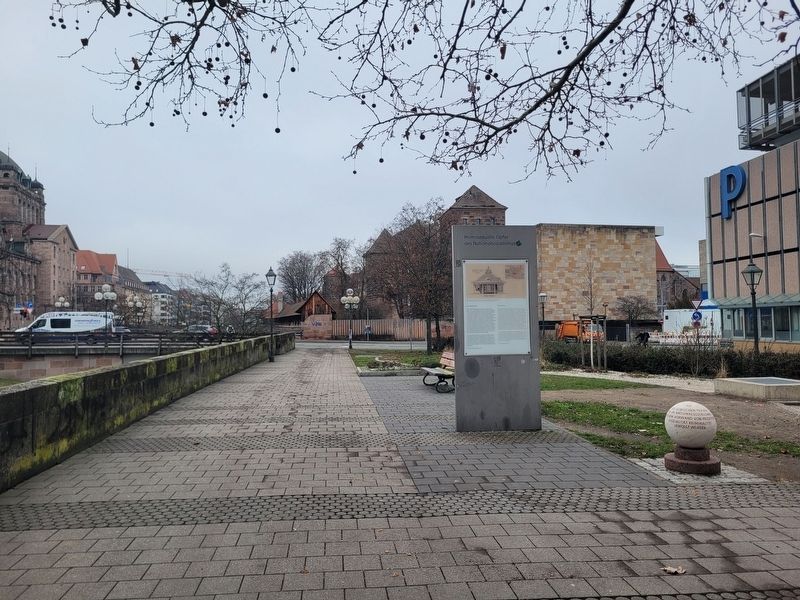
The view of the marker along the walkway.
For many decades, homosexuals were denied public recognition as victims of National Socialism. The City of Nuremberg, as a City of Peace and Human Rights, wants to recall these victims, they must not be forgotten. Remembrance also points into our present and future, and it must be seen as a call for tolerance. Homosexuality must not be questioned. Lesbians and gays are a natural part of our city's population.
Design for tram waiting room with location map, 1908. (Illustrations. Nuremberg City Archive)
Erected 2013 by City of Nuremberg.
Topics. This historical marker is listed in this topic list: War, World II. A significant historical year for this entry is 1969.
Location. 49° 26.82′ N, 11° 4.657′ E. Marker is in Nürnberg, Bayern (Bavaria). It is in Mitte. It is at the intersection of Vordere Sterngasse and Frauentormauer on

Photographed by James Hulse, February 26, 2026
4. Lesbian Women marker next to marker
Translation - To the lesbian women who were persecuted under National Socialism under the pretext of prostitution, asociality, and criminality.

Regionally, this marker is in German Franconia. Globally, it is in Europe, the European Union, Atlantic Europe, Central Europe, the Schengen Area, Western Europe, and the Western World. Historically, it finds itself in what was once the Holy Roman Empire and also the former West Germany.
Other nearby markers. At least 8 other markers are within walking distance of this marker: Rudolf Brinkmann (within shouting distance of this marker); In Gedenken an die Opfer rechten Terrors / In memory of the victims of right-wing terror (approx. 0.2 kilometers away); Waffenhof / Weapons Court (approx. 0.2 kilometers away); St. Klara Kirche / St. Klara Church (approx. 0.3 kilometers away); Handwerkerhof / Craftsmen's Courtyard (approx. 0.3 kilometers away); Alt-Nürnberg / Old Nuremberg (approx. 0.3 kilometers away); Georg Winter (approx. 0.4 kilometers away); Georg Simon Ohm (approx. 0.4 kilometers away). Touch for a list and map of all markers in Nürnberg.
Additional keywords. Homosexuality, LGBT, LGBTQ
Credits. This page was last revised on March 23, 2026. It was originally submitted on March 21, 2026, by James Hulse of Medina, Texas. This page has been viewed 19 times since then. Photos: 1, 2, 3, 4. submitted on March 22, 2026, by James Hulse of Medina, Texas.
