Mitte in Nürnberg, Bavaria, Germany — Central Europe
Rudolf Brinkmann
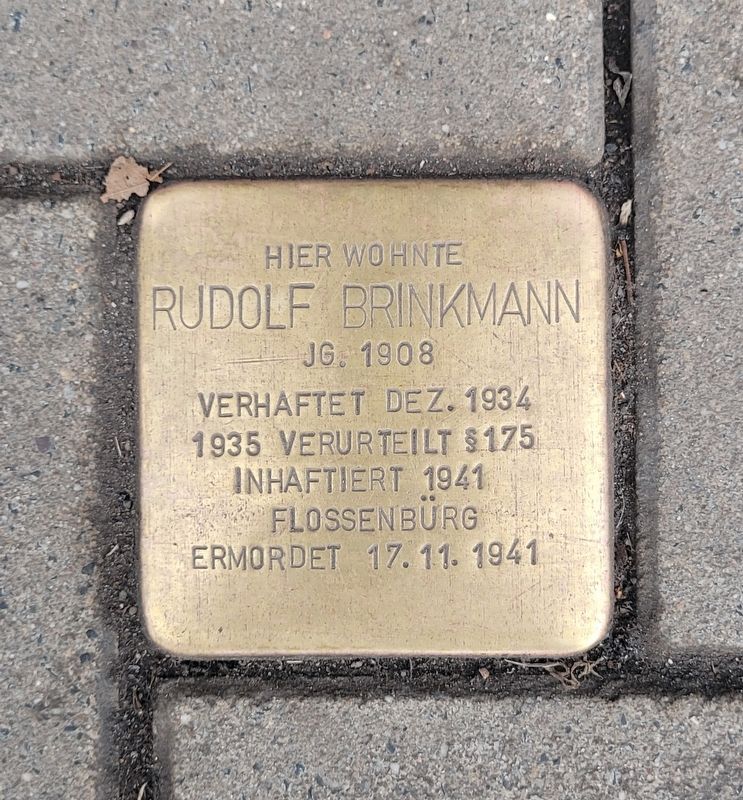
Photographed by James Hulse, February 26, 2026
1. Rudolf Brinkmann Marker

Hier wohnte
Rudolf Brinkmann
Jg. 1908
Verhaftet Dez. 1934
1935 verurteilt §175
Inhaftiert 1941
Flossenbürg
Ermordet 17.11.1941
Rudolf Brinkmann, born in 1908, lived here. He was arrested in Dec. 1934, convicted in 1935 under §175, imprisoned in 1941 in Flossenbürg, and murdered there on 17 Nov. 1941.
Topics and series. This historical marker is listed in this topic list: War, World II. In addition, it is included in the Stolpersteine series list. A significant historical date for this entry is October 17, 1941.
Location. 49° 26.792′ N, 11° 4.645′ E. Marker is in Nürnberg, Bayern (Bavaria). It is in Mitte. It is at the intersection of Frauentorgraben and Tafelhofstraße, on the right when traveling east on Frauentorgraben. Touch for map. Marker is at or near this postal address: Frauentorgraben 17, Nürnberg BY 90402, Germany. Touch for directions.

Regionally, this marker is in German Franconia. Globally, it is in Europe, the European Union, Atlantic Europe, Central Europe, the Schengen Area, Western Europe, and the Western World. Historically, it finds itself in what was once the Holy Roman Empire and also the former West Germany.
Other nearby markers. At least 8 other markers are within walking distance of this marker: Homosexuelle Opfer des Nationalsozialismus / Homosexual Victims of National Socialism (within shouting distance of this marker); Waffenhof / Weapons Court (approx. 0.3 kilometers away); In Gedenken an die Opfer rechten Terrors / In memory of the victims of right-wing terror (approx. 0.3 kilometers away); Handwerkerhof / Craftsmen's Courtyard (approx.
this page online
More about this marker. §175 refers to the section of the German criminal code used by the Nazi regime to persecute men accused of homosexual acts.
Also see . . .
1. Stolperstein. Wikipedia
A Stolperstein (in English "stumbling block") is a ten-centimetre (four-inch) concrete cube bearing a brass plate inscribed with the name and life dates of victims of Nazi extermination or persecution. The Stolpersteine project, initiated by the German artist Gunter Demnig in 1992, aims to commemorate persons at the last place that they chose freely to reside, work or study (with exceptions possible on a case-by-case basis) before they fell victim to Nazi terror, forced euthanasia, eugenics, deportation to a concentration or extermination camp, or escaped persecution by emigration or suicide. As of June 2023, 100,000 Stolpersteine have been laid, making the Stolpersteine project the world's largest decentralized memorial.(Submitted on March 22, 2026, by James Hulse of Medina, Texas.)
2. Rudolf Brinkmann (Stolpersteine Nürnberg, in German). Excerpt (in translation):
Rudolf Hans Brinkmann was born on February 21, 1908, in Stettin. His parents were the telegraph office director Rudolf Brinkmann (senior) and Sophia, née Dannermann. The family was Catholic.(Submitted on March 23, 2026, by James Hulse of Medina, Texas.)
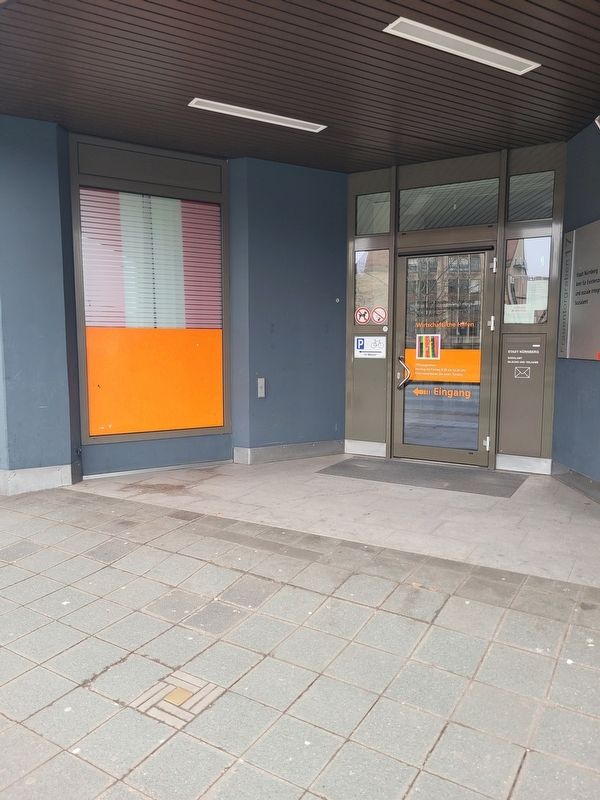
Brinkmann grew up in Hildesheim, where he attended middle schooland then a humanistic grammar school. After graduating, he began studying Slavic studies and philosophy. For this purpose he first moved to Freiburg im Breisgau and later to Münster. In 1933 Brinkmann settled in Berlin, where he lived openly as a homosexual and visited well-known meeting places of the gay scene. That community was increasingly subjected to repression by the National Socialists, who came to power in the same year.Photographed by James Hulse, February 26, 20262. Rudolf Brinkmann MarkerThe view of the marker at the entrance to the building.
In December 1934 the Gestapo arrested Brinkmann during a raid targeting homosexual men. He was deported to the Lichtenburg concentration camp near Torgau and held there for eight months. After his release, the Berlin District Court sentenced him to eight months in prison for violating Paragraph 175; the time he had already spent in the concentration camp was counted as having served the sentence.
Nevertheless, the consequences of the conviction were dramatic for Brinkmann. He was registered by the police as a previously convicted homosexual and had to accept severe disadvantages in his professional career. He was no longer allowed to complete his studies. Brinkmann returned to his parents’ household in Hildesheim and decided to train as a bookseller. However, this plan failed due to official resistance. In July 1937 the Reich Chamber of Literature refused him the necessary license, stating that as a homosexual he lacked the suitability for the profession of bookseller.
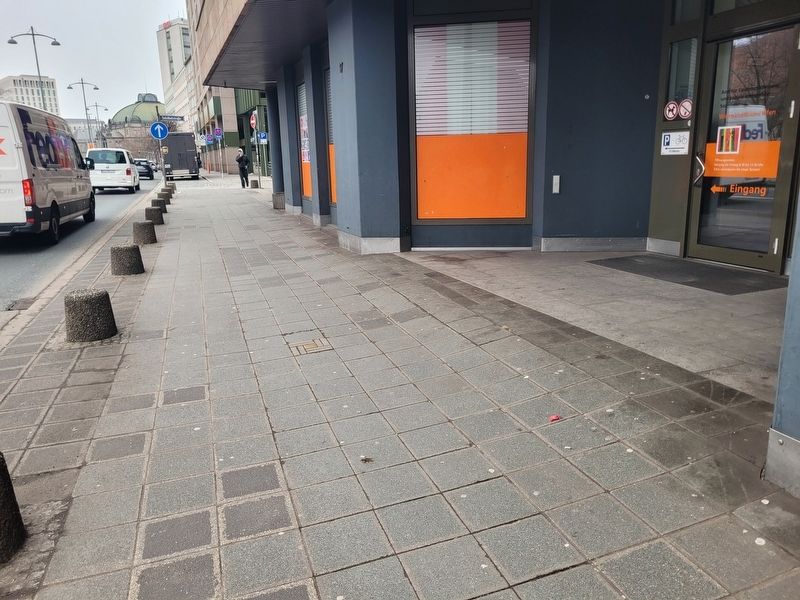
Brinkmann must have felt great relief when he found work almost a year later. At the beginning of July 1938 he took a position at the Official Bavarian Travel Agency in Nuremberg. There he quickly gained the respect of hiscolleagues. His direct superior described him as a “very quiet, diligent, and decent person.” Brinkmann rented a room as a subtenant in the apartment of Betti Götz at Frauentorgraben 17.Photographed by James Hulse, February 26, 20263. Rudolf Brinkmann MarkerThe view of the marker along the street.
In Nuremberg Brinkmann lived a rather secluded life, occasionally seeking contact with other homosexual men. His acquaintance with a 23-year-old man whom he approached in the main railway station in February 1939 proved to be his downfall. After several meetings, Brinkmann indicated that he was homosexual and interested in the young man. The latter then denounced him to the police.
After extensive investigations, the Nuremberg-Fürth Regional Court sentenced Brinkmann on August 3, 1939, to two years in prison. At first he served the sentence in the Ebrach penitentiary and later in the Bayreuth prison. When his release approached in February 1941, the Nuremberg criminal police decided to place Brinkmann in “preventive police custody.” As a result, he was not released after completing his sentence but was instead sent to the Flossenbürg concentration camp. Rudolf Brinkmann was murdered there on November 17, 1941.
Additional keywords. Holocaust
Credits. This page was last revised on March 23, 2026. It was originally submitted on March 21, 2026, by James Hulse of Medina, Texas. This page has been viewed 17 times since then. Photos: 1, 2, 3. submitted on March 22, 2026, by James Hulse of Medina, Texas.
