Fairfax in Cleveland in Cuyahoga County, Ohio — The American Midwest (Great Lakes)
Olivet Institutional Baptist Church
Photographed by Craig Doda, March 7, 2026
1. Olivet Institutional Baptist Church Marker
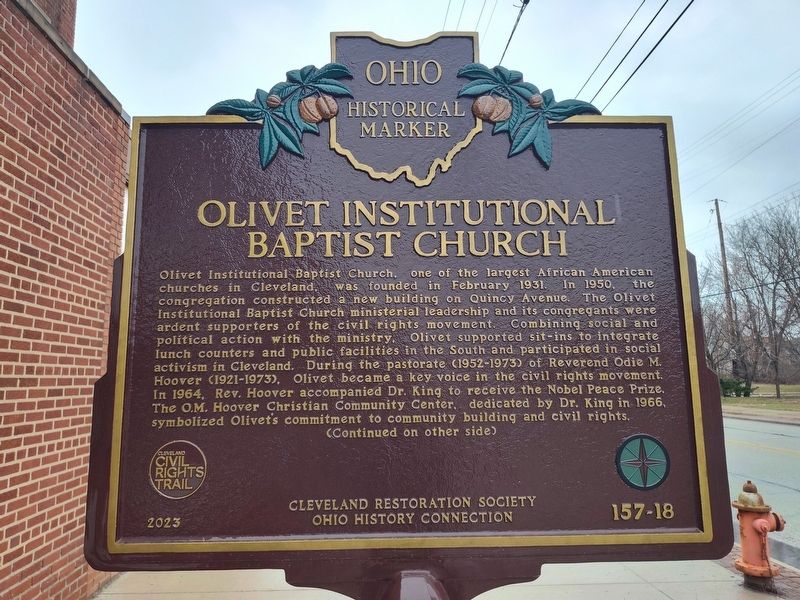
Olivet Institutional Baptist Church, one of the largest African American churches in Cleveland, was founded in February 1931. In 1950, the congregation constructed a new building on Quincy Avenue. The Olivet Institutional Baptist Church ministerial leadership and its congregants were ardent supporters of the civil rights movement. Combining social and political action with the ministry, Olivet supported sit-ins to integrate lunch counters and public facilities in the South and participated in social activism in Cleveland. During the pastorate (1952-1973) of Reverend Odie M. Hoover (1921-1973), Olivet became a key voice in the civil rights movement. In 1964, Rev. Hoover accompanied Dr. King to receive the Nobel Peace Prize. The O.M. Hoover Christian Community Center, dedicated by Dr. King in 1966, symbolized Olivet's commitment to community building and civil rights.
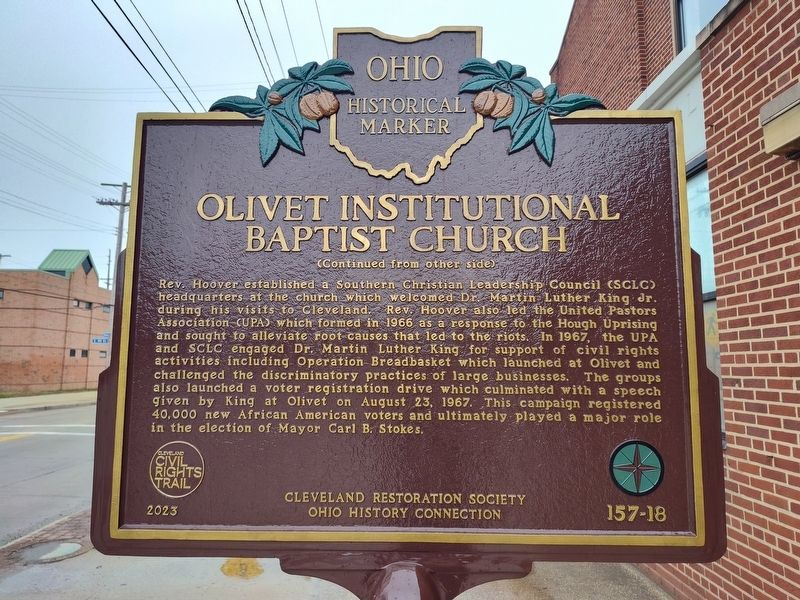
Rev. Hoover established a Southern Christian Leadership Council (SCLC) headquarters at the church which welcomed Dr. Martin Luther King Jr. during his visits to Cleveland. Rev. Hoover also led the United Pastors Association (UPA) which formed in 1966 as
this page online
Erected 2023 by Cleveland Restoration Society / Ohio History Connection. (Marker Number 157-18.)
Topics and series. This historical marker is listed in these topic lists: African Americans • Religion & Religious Structures. In addition, it is included in the Ohio Historical Society / The Ohio History Connection series list. A significant historical month for this entry is February 1931.
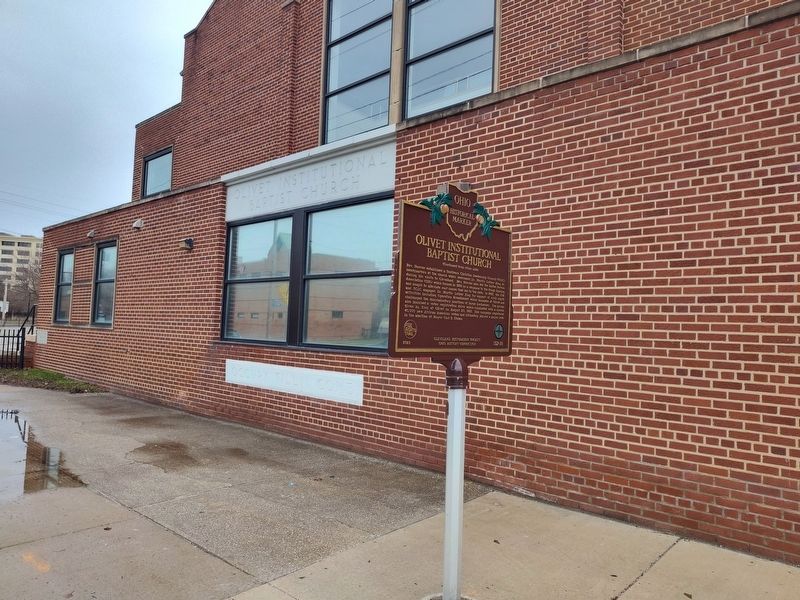
Location. 41° 29.599′ N, 81° 37.531′ W. Marker is in Cleveland, Ohio, in Cuyahoga County. It is in Fairfax. It is at the intersection of Quincy Avenue and East 88th Street, on the right when
Photographed by Craig Doda, March 7, 2026
2. Olivet Institutional Baptist Church Marker

Regionally, this marker is on the Lake Erie Shore and in the Western Reserve. It is also in the American Midwest. Globally, it is in North America, on the Great Lakes, in the Western Hemisphere, in the Western World, and in the Anglosphere. Historically, it finds itself in what was once the Haudenosaunee (Iroquois) Confederacy, the territory of the Mississippian Culture, and the Northwest Territory.
Other nearby markers. At least 8 other markers are within walking distance of this marker: Karamu House (about 400 feet away, measured in a direct line); John Patterson Green (approx. 0.9 miles away); US Civil War (approx. 0.9 miles away); Veterans Memorial (approx. 0.9 miles away); War of 1812 (approx. 0.9 miles away); 23rd Ohio Volunteer Infantry Monument (approx. 0.9 miles away); a different marker also named 23rd Ohio Volunteer Infantry Monument (approx. 0.9 miles away); Woodland Cemetery Civil War Memorial (approx. 0.9 miles away). Touch for a list and map
Photographed by Craig Doda, March 7, 2026
3. Olivet Institutional Baptist Church Marker
Photographed by Craig Doda, March 7, 2026
4. Olivet Institutional Baptist Church Marker
Credits. This page was last revised on March 22, 2026. It was originally submitted on March 22, 2026, by Craig Doda of Napoleon, Ohio. This page has been viewed 19 times since then. Photos: 1, 2, 3, 4. submitted on March 22, 2026, by Craig Doda of Napoleon, Ohio. • Devry Becker Jones was the editor who published this page.
