Mitte in Nürnberg, Bavaria, Germany — Central Europe
Sara Berger
Photographed by James Hulse, February 26, 2026
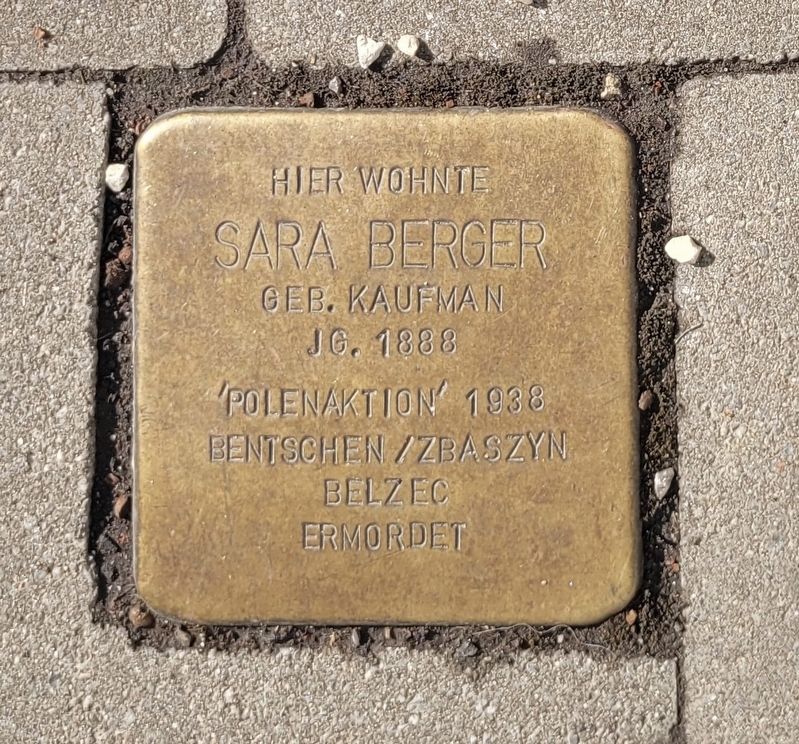
1. Sara Berger Marker

Hier wohnte
Sara Berger
Geb. Kaufmann
Jg. 1888
Polenaktion 1938
Bentschen/Zbąszyń
Bełżec
Ermordet
Sara Berger, née Kaufmann, born in 1888, lived here. She was deported during the Polenaktion in 1938 to Bentschen/Zbąszyń and later murdered in Bełżec.
Topics and series. This historical marker is listed in this topic list: War, World II. In addition, it is included in the Stolpersteine series list. A significant historical year for this entry is 1888.
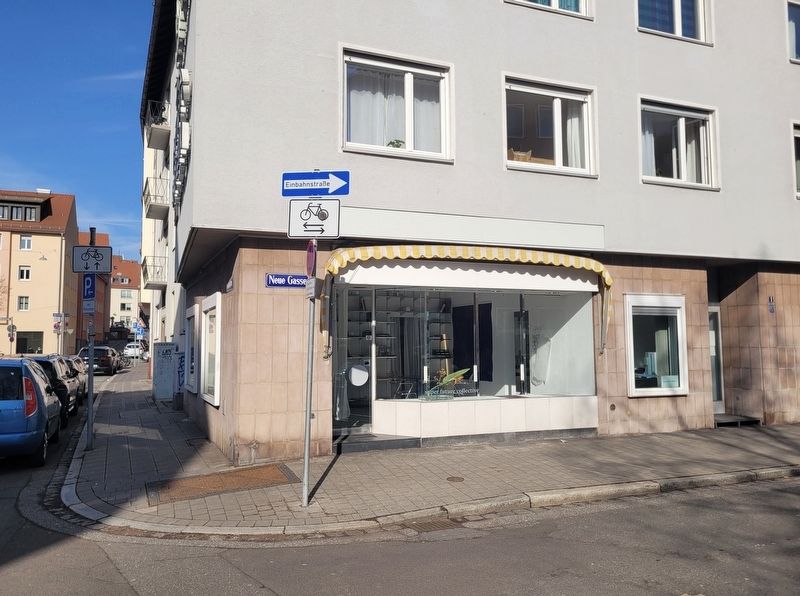
Location. 49° 27.238′ N, 11° 4.823′ E. Marker is in Nürnberg, Bayern (Bavaria). It is in Mitte. It is at the intersection of Neue Gasse and Heugäßchen, on the left when traveling east on Neue Gasse. Touch for map. Marker is at or near this postal address: Neue G 1, Nürnberg BY 90402, Germany. Touch for directions.

Regionally, it is in Europe, the European Union, Atlantic Europe, Central Europe, the Schengen Area, Western Europe, and the Western World. Historically, it finds itself in what was once the Holy Roman Empire.
Other nearby markers. At least 8 other markers are within walking
this page online
Also see . . .
1. Stolperstein. Wikipedia
A Stolperstein (in English "stumbling block") is a ten-centimetre (four-inch) concrete cube bearing a brass plate inscribed with the name and life dates of victims of Nazi extermination or persecution. The Stolpersteine project, initiated by the German artist Gunter Demnig in 1992, aims to commemorate persons at the last place that they chose freely to reside, work or study (with exceptions possible on a case-by-case basis) before they fell victim to Nazi terror, forced euthanasia, eugenics,(Submitted on March 22, 2026, by James Hulse of Medina, Texas.)deportation to a concentration or extermination camp, or escaped persecution by emigration or suicide. As of June 2023, 100,000 Stolpersteine have been laid, making the Stolpersteine project the world's largest decentralized memorial.Photographed by James Hulse, February 26, 20262. Sara Berger Marker (left marker)
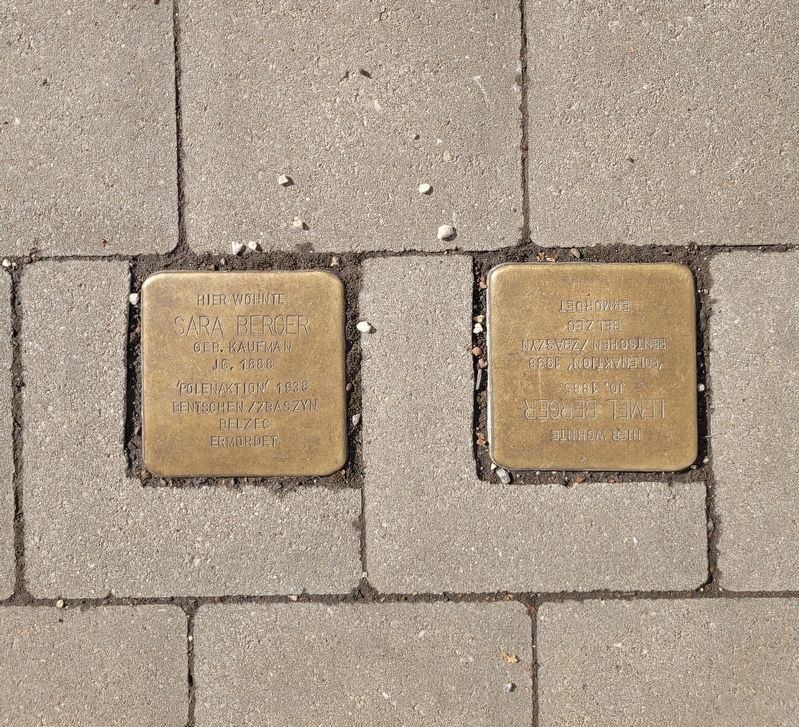
2. Lemel and Sara Berger (Stolpersteine Nürnberg, in German). Excerpt (in translation):
Leopold (called Lemel) Berger was born on December 12, 1885, in Sokolow, and Sara Kaufmann on April 18, 1888, in nearby Nienadowka. The two small villages lie about 200 kilometers east of Kraków, close to what is today the border with Ukraine. At that time the region was known as Western Galicia.(Submitted on March 23, 2026, by James Hulse of Medina, Texas.)
In search of better living conditions, many Jews from Eastern Europe fled westward at the end of the nineteenth century. Pogroms in Russia and neighboring countries were the main cause. Over several decades about one thousand “Eastern Jews” came to Nuremberg, including the Berger couple. The term “Eastern Jews” at first merely indicated the regional and cultural origin of this group, but it soon acquired a discriminatory meaning, implying backwardness.
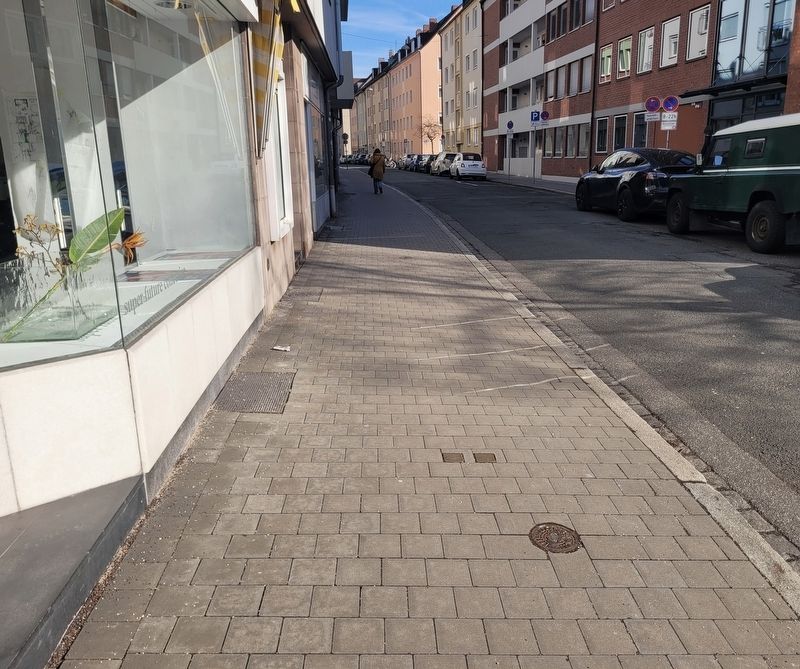
InNuremberg, Lemel and Sara Berger established a leather goods shop and lived in the house at Heugäßchen 2, on the corner of Neue Gasse. The building no longer exists today: after air raids during the Second World War the district was largely destroyed, and reconstruction did not follow the exact pattern of the earlier buildings.Photographed by James Hulse, February 26, 20263. Sara Berger MarkerThe view of the markers along the sidewalk.
The Berger couple had four children: Giza (born 1911), Elsa (born 1913), Zalo (born 1915), and Sami (born 1917). Between 1933 and 1936 they were able to emigrate to Palestine. The parents likely did not want to emigrate once again to a foreign country and leave behind everything they had built for themselves in Nuremberg.
On October 28, 1938, the Reich government ordered the so-called “Polenaktion.” Throughout the German Reich about 17,000 Jews of Polish origin were arrested and deported in collective transports across the border into Poland. The mass deportation was carried out violently and came as a complete surprise to those affected. The pretext was a decree by the Polish government declaring that the passports of Polish citizens of Jewish faith would become invalid if they had spent more than fiveyears abroad.Photographed by James Hulse, February 26, 20264. Sara Berger MarkerThe view of the markers in front of the building.
Lemel and Sara Berger were among those deported. In Poland they were confined with about 5,000 others in a barracks in the border town of Zbąszyń, where people had to live under catastrophic conditions. After ten months the Berger couple reached Lemel’s birthplace, Sokolow. From there they were deported in 1942 to Bełżec and murdered.
Additional keywords. Holocaust
Credits. This page was last revised on March 23, 2026. It was originally submitted on March 22, 2026, by James Hulse of Medina, Texas. This page has been viewed 12 times since then. Photos: 1, 2, 3, 4. submitted on March 23, 2026, by James Hulse of Medina, Texas.
