Mitte in Nürnberg, Bavaria, Germany — Central Europe
Rudolf Koch
Photographed by James Hulse, February 26, 2026
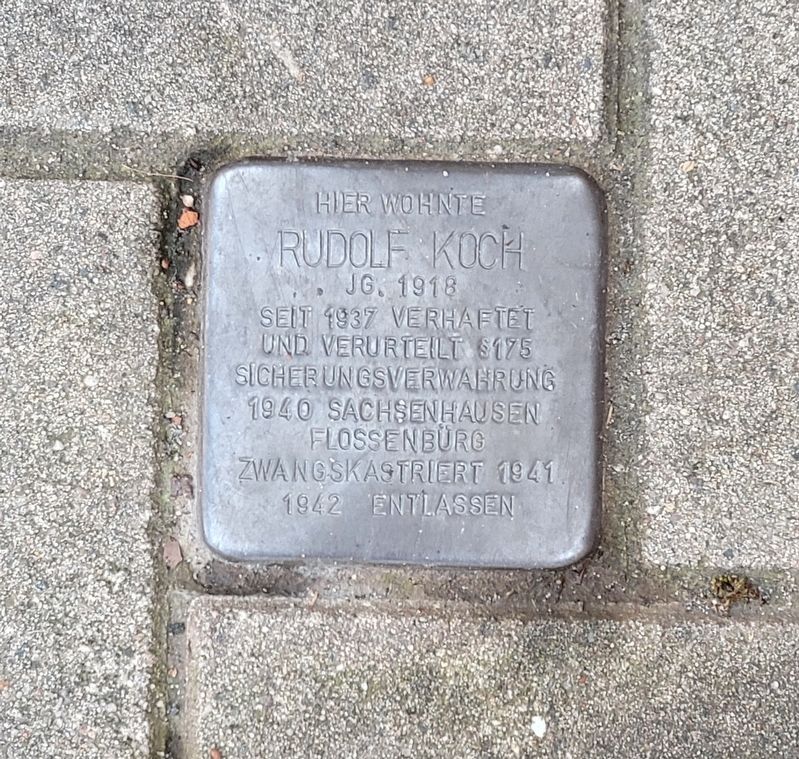
1. Rudolf Koch Marker

Hier wohnte
Rudolf Koch
Jg. 1918
Seit 1937 verhaftet
und verurteilt §175
Sicherungsverwahrung
1940 Sachsenhausen
Flossenbürg
Zwangskastriert 1941
1942 entlassen
Rudolf Koch, born in 1918, lived here. Since 1937 he was arrested and convicted under §175, placed in preventive detention, sent in 1940 to Sachsenhausen and later to Flossenbürg, forcibly castrated in 1941, and released in 1942.
Topics and series. This historical marker is listed in this topic list: War, World II. In addition, it is included in the Stolpersteine series list. A significant historical year for this entry is 1918.
Location. 49° 27.264′ N, 11° 5.018′ E. Marker is in Nürnberg, Bayern (Bavaria). It is in Mitte. It is on Untere Talgasse just east of Rotschmiedsgasse, on the left when traveling north. Touch for map. Marker is at or near this postal address: u Talgasse 6, Nürnberg BY 90403, Germany. Touch for directions.

Regionally, this marker is in German Franconia. Globally, it is in Europe, the European Union, Atlantic Europe, Central Europe, the Schengen Area, Western Europe, and the Western
this page online
Other nearby markers. At least 8 other markers are within walking distance of this marker: Laufer Schlagturm / Laufer Battle Tower (about 180 meters away, measured in a direct line); Wehrturm Tratzenzwinger / Defensive Tower with Sentry Enclosure (about 210 meters away); Landauer Kapelle / Landauer Chapel (about 210 meters away); Wehrturm / Defense Tower (about 240 meters away); Georg J. Mayer (about 240 meters away); Sara Berger (about 240 meters away); Lemel Berger (about 240 meters away); Leo Katzenberger (approx. 0.2 kilometers away). Touch for a list and map of all markers in Nürnberg.
More about this marker. §175 refers to the section of the German criminal code used by the Nazi regime to persecute men accused of homosexual acts.
Also see . . .
1. Stolperstein. Wikipedia
A Stolperstein (in English "stumbling block") is a ten-centimetre (four-inch) concrete cube bearing a brass plate inscribed with the name and life dates of victims of Nazi extermination or persecution. The Stolpersteine project, initiated(Submitted on March 22, 2026, by James Hulse of Medina, Texas.)by the German artist Gunter Demnig in 1992, aims to commemorate persons at the last place that they chose freely to reside, work or study (with exceptions possible on a case-by-case basis) before they fell victim to Nazi terror, forced euthanasia, eugenics, deportation to a concentration or extermination camp, or escaped persecution by emigration or suicide. As of June 2023, 100,000 Stolpersteine have been laid, making the Stolpersteine project the world's largest decentralized memorial.Photographed by James Hulse, February 26, 20262. Rudolf Koch Marker
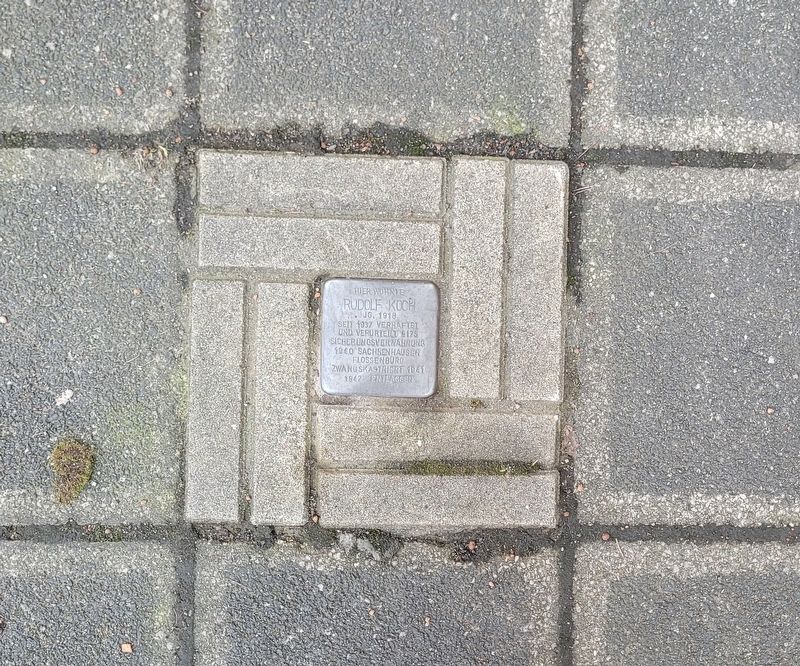
2. Rudolf Koch (Stolpersteine Nürnberg, in German). Excerpt (in translation):
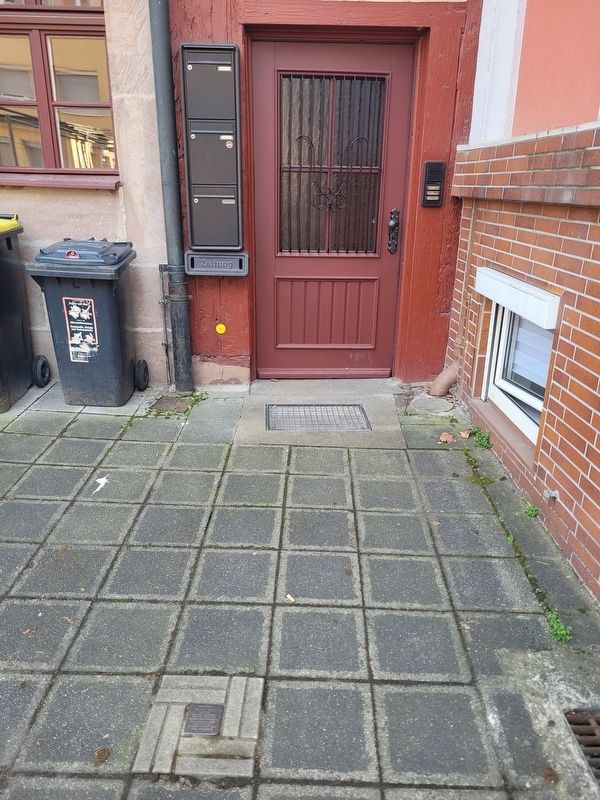
Rudolf Koch was born on September 27, 1918, in Nuremberg as the child of a single mother. After attending elementary school, he began an apprenticeship as an electrical installer. In January 1935, the police first apprehended him in the restroom area of the “Weißer Turm” department store, which was known as a meeting place for homosexual men. The following year, an investigation was opened against him for violating Paragraph 175. The now 18-year-old Koch had maintained a sexual relationship with someone(Submitted on March 23, 2026, by James Hulse of Medina, Texas.)his own age. For this reason, he was sentenced in March 1937 to seven months in prison.Photographed by James Hulse, February 26, 20263. Rudolf Koch MarkerThe view of the marker at the entrance to the house.
Koch served the sentence until the end of October 1937 in Niederschönenfeld prison, after which he returned to Nuremberg. He again lived with his mother at Schmausengasse 21. Because he had been unable to complete his apprenticeship, he worked as a delivery driver for a butcher shop. Later he was employed as an assistant machine operator at the local detonator works.
In 1939 police officers saw Koch in the Waffenhof (today the Handwerkerhof), a well-known meeting place for homosexual men. He was accused of intending to engage in prostitution there and was placed under “systematic police surveillance.” He was now forbidden to leave his apartment at night and to be present at the main railway station or at several other locations in the city center. In addition, he was not allowed to associate with other men suspected of homosexuality.
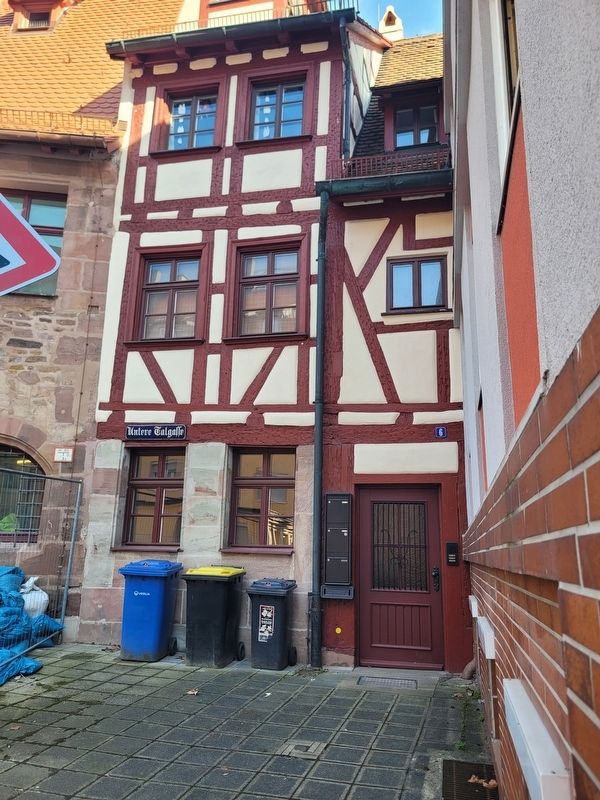
Soon afterward the police were able to establish a violation of these restrictions: on December 20, 1939, officers again encountered Koch in the restroom facility of the “Weißer Turm” department store. Forthis reason he was placed in “preventive police custody.” This meant that he was committed to a concentration camp for an indefinite period. In mid-January 1940 Koch was sent to the Sachsenhausen concentration camp. Three months later he was transferred to the Flossenbürg concentration camp.Photographed by James Hulse, February 26, 20264. Rudolf Koch MarkerThe view of the house.
After months of imprisonment in the camp, he apparently chose the only path to freedom available to him. In November 1941 the then 23-year-old Rudolf Koch “voluntarily” underwent castration in Flossenbürg. On the grounds that his sexual drive had now subsided and that he no longer posed a danger to society, the camp administration released him a few months later.
Information about Koch’s later life is sparse. It is documented that after his release in 1942 he was drafted into the Wehrmacht, survived the war, and then returned to Nuremberg. According to a report in the newspaper Nürnberger Nachrichten in the spring of 1955, Koch—by then 37 years old—attempted to drown himself in the Pegnitz River. However, he was rescued from the water by passers-by. He stated that the reason for the suicide attempt was depression brought on by the anniversary of his mother’s death.
Koch last lived at Untere Talgasse 6, very close to the house on Schmausengasse where he had lived with his mother and which had been destroyed during the Second World War. During research into his biography, a neighbor who had known Koch in his final years was located. She described him as a shy and reserved person who ultimately lived in complete isolation. Rudolf Koch died in 1986 at the age of 68.
Additional keywords. Holocaust
Credits. This page was last revised on March 23, 2026. It was originally submitted on March 22, 2026, by James Hulse of Medina, Texas. This page has been viewed 20 times since then. Photos: 1, 2, 3, 4. submitted on March 23, 2026, by James Hulse of Medina, Texas.
