Galloping Goose No. 4
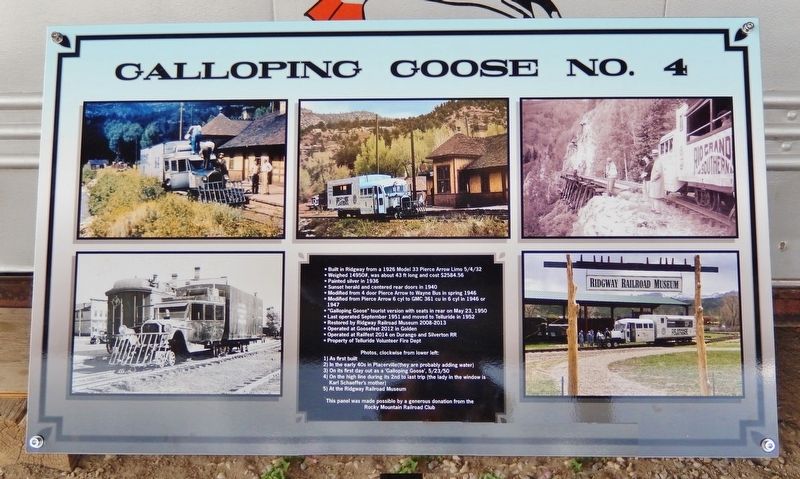
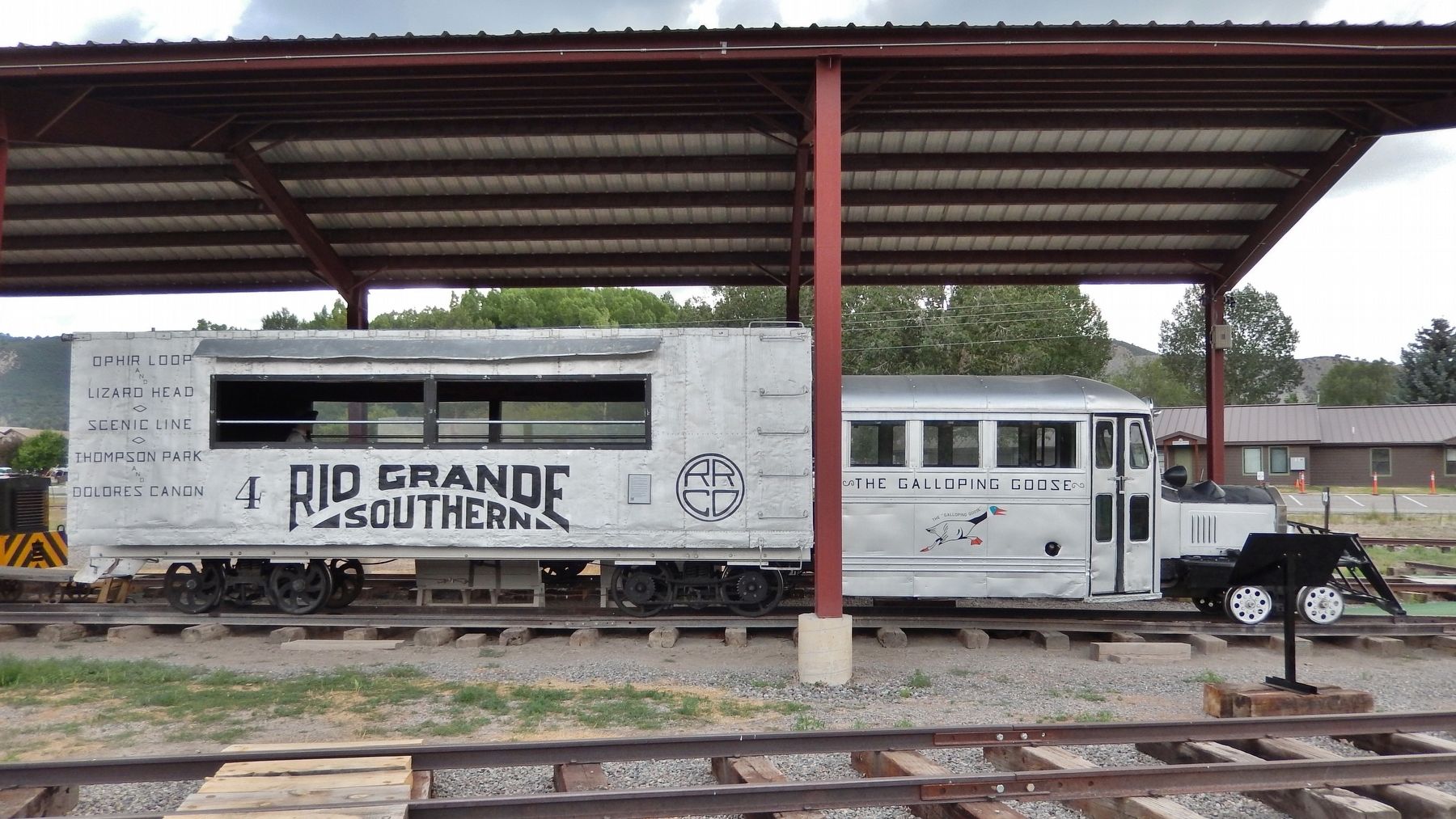
• Built in Ridgway from a 1926 Model 33 Pierce Arrow Limo 5/4/32
• Weighed 14,950 lbs, was about 43 ft long and cost $2584.56
• Painted silver in 1936
• Sunset herald and centered rear doors in 1940
• Modified from 4 door Pierce Arrow to Wayne Bus in spring 1946
• Modified from Pierce Arrow 6 cyl to GMC 361 cu in 6 cyl in 1946 or 1947
• “Galloping Goose” tourist version with seats in rear on May 23, 1950
• Last operated September 1951 and moved to Telluride in 1952
• Restored by Ridgway Railroad Museum 2008-2013
• Operated at Goosefest 2012 in Golden
• Operated at Railfest 2014 on Durango and Silverton RR
• Property of Telluride Volunteer Fire Dept
Photos, clockwise from lower left:
1) As first built
2) In the early 40s in Placerville (they are probably adding water)
3) On its first day out as a “Galloping Goose”, 5/23/50
4) On the high line during its 2nd to last trip (the lady in the window is Karl Schaeffer's mother)
5) At the Ridgway Railroad Museum
This panel was made possible by a generous donation from the Rocky Mountain Railroad Club
Erected by Ridgway Railroad Museum and Rocky Mountain Railroad Club.
Topics.
this page online
Location. 38° 9.17′ N, 107° 45.265′ W. Marker is in Ridgway, Colorado, in Ouray County. It can be reached from North Railroad Street just north of Sherman Street (State Highway 62), on the right when traveling north. The marker and restored Galloping Goose No. 4 are on the Ridgway Railroad Museum grounds. Touch for map. Marker is at or near this postal address: 200 North Railroad Street, Ridgway CO 81432, United States of America. Touch for directions.

Regionally, this marker is in the Western Slope. It is also in the American Mountain West. Globally, it is in North America, the Rocky Mountains, the Western Hemisphere, the Western World, and the Anglosphere.
Other nearby markers. At least 8 other markers are within walking distance of this marker: RGS Motor 1 (here, next to this marker); Ridgway Railroad Museum (a few steps from this marker); D&RG(W) Caboose 91 (0575) (within shouting distance of this marker); RGS Coach 252 Restoration (within shouting distance of this marker);
Related markers. Click here for a list of markers that are related to this marker. Galloping Geese of the Rio Grande Southern Railroad
Also see . . .
1. Galloping Goose (Wikipedia).
Excerpt: “Galloping Goose” is the popular name given to a series of seven railcars built in the 1930s by the Rio Grande Southern Railroad (RGS) and operated until the end of service on the line in the early 1950s.(Submitted on March 24, 2026, by Cosmos Mariner of Cape Canaveral, Florida.)
Originally running steam locomotives on narrow gauge railways, the perpetually struggling RGS developed the first of the “geese” as a way to keep its contract to run mail into towns in the Rocky Mountains in Colorado. There was not enough passenger or cargo income to justify continuing the expensive steam train service at then-current levels.All of the “geese” were built in the railroad's shops at Ridgway, Colorado. The first was built
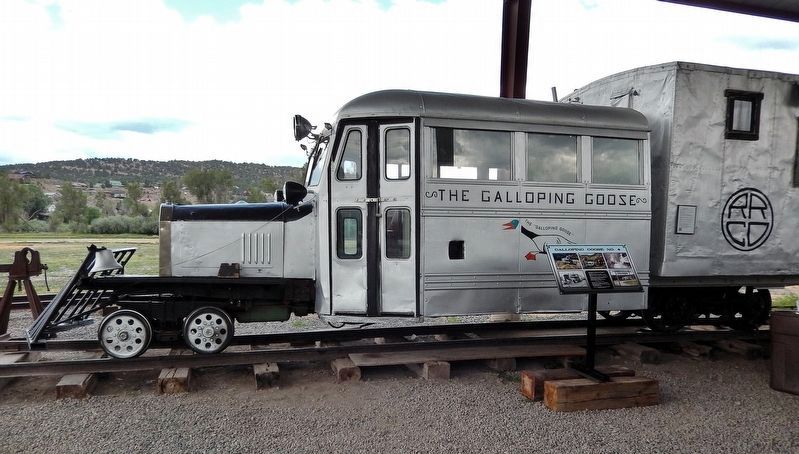
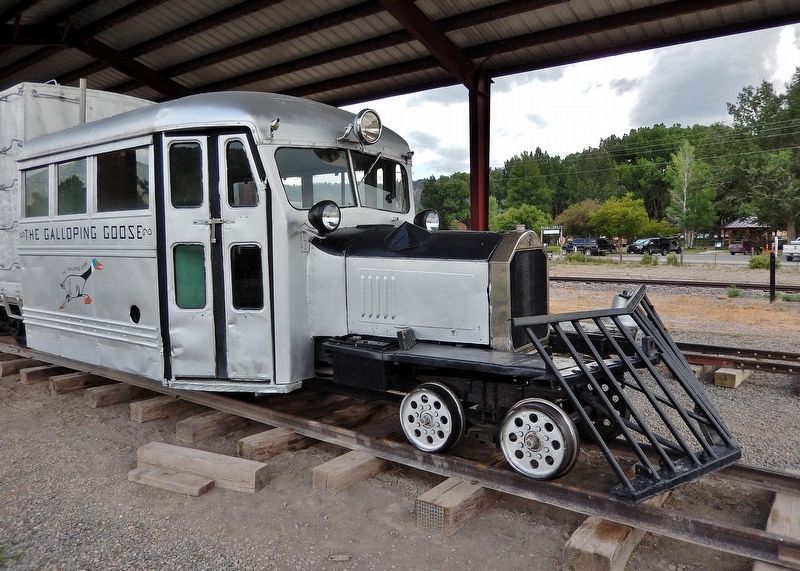
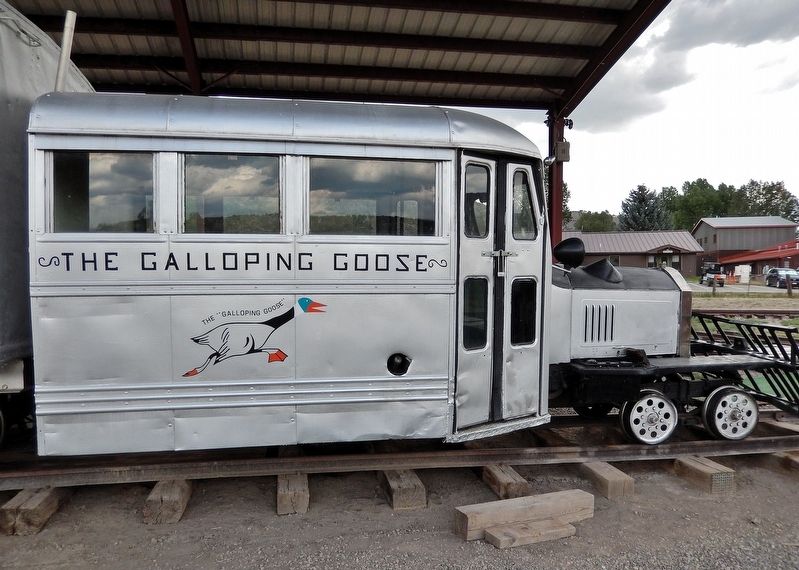
in 1931 from the body of a Buick “Master Six” four-door sedan. It had a two-axle truck in place of the front axle. Part of the rear of the car was replaced by a truck stake-bed for carrying freight and mail; this was later enclosed and partially fitted with seating.Photographed by Cosmos Mariner, July 18, 20253. Galloping Goose No. 4 ("locomotive" & "cab")Initially, the “geese” were painted in black and dark green. In 1935 they were all painted in a silver scheme which they retain to this day, though the style of lettering and heralds changed over the years. In 1945, #3, #4, and #5 were rebuilt with Wayne bus bodies (at least the front half). This provided more passenger seating and comfort. A year later they also received new war surplus GMC engines.
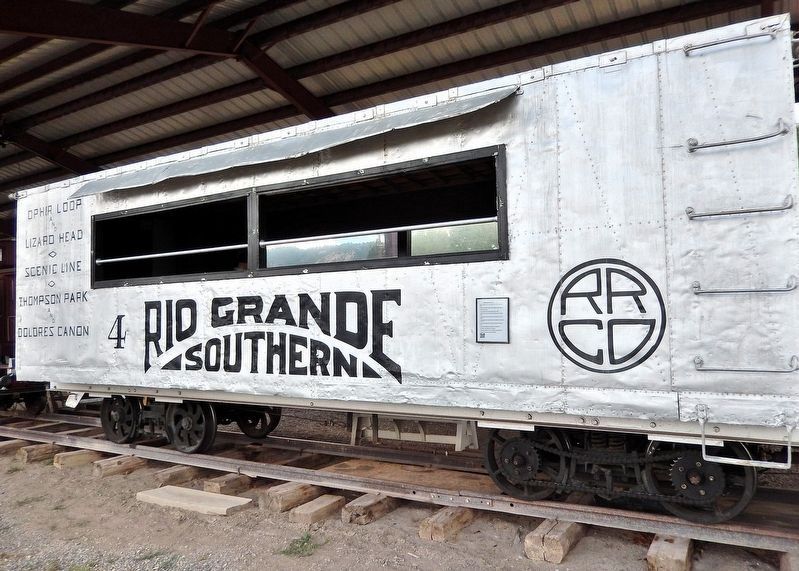
In 1950, when the railroad finally lost its mail contract (in favor of highway mail carriers), #3, #4, #5, and #7 were converted for tourist operations. Large windows were cut into the sides of the freight compartments, and seating was added. A figure of a running goose and the words “Galloping Goose” were added to the carbody doors. This service lasted only two years, and the last work of the “geese” on their home line was to take up the rails.
It is unclear exactly where
the name “Galloping Goose” comes from. It is mostly commonly suggested that it referred to the way the carbody and the freight compartment tended to rock back and forth on the line's sometimes precarious track.Photographed by Cosmos Mariner, July 18, 20254. Galloping Goose No. 4 (passenger & freight “box”)
2. RGS Goose 4 Comes to Ridgway for Restoration (Ridgway Railroad Museum).
Excerpt: The Ridgway Railroad Museum signed a formal agreement with the Telluride Volunteer Fire Dept (TVFD) to restore Galloping Goose No. 4 to operating condition. The TVFD deserves a big thank you for keeping No. 4 in condition such that it is still possible to do this restoration after 55 years.(Submitted on March 24, 2026, by Cosmos Mariner of Cape Canaveral, Florida.)The move to Ridgway occurred in May of 2008. The first phase was to research photos from the summer of 1950 for the prototype, document existing condition with photos and drawings, determine parts that would have to be acquired and materials that would be replaced (all the wood), and carefully begin disassembly of the rear box. The Galloping Goose Historical Society of Dolores shared all their expertise obtained during restoration of Goose No. 5.
We completely rebuilt
the freight/passenger box using the same construction techniques as used in the original. The engine and transmission were rebuilt in Telluride. The power truck and the trailing truck were completely refurbished and reinstalled. The original Denver Tramway seats were re-caned and restored. The restoration was completed in Spring 2012.Photographed by Cosmos Mariner, July 18, 20255. Galloping Goose No. 4
Credits. This page was last revised on March 24, 2026. It was originally submitted on March 22, 2026, by Cosmos Mariner of Cape Canaveral, Florida. This page has been viewed 19 times since then. Photos: 1, 2, 3, 4, 5, 6. submitted on March 24, 2026, by Cosmos Mariner of Cape Canaveral, Florida.
